
Startups3 min read
Moncton's AgroGene Solutions Takes Startupfest's Top $100K Prize


The Université de Moncton spinout beat 275 pitches in Montréal with hive-monitoring tech that catches bee pathogens before symptoms show.
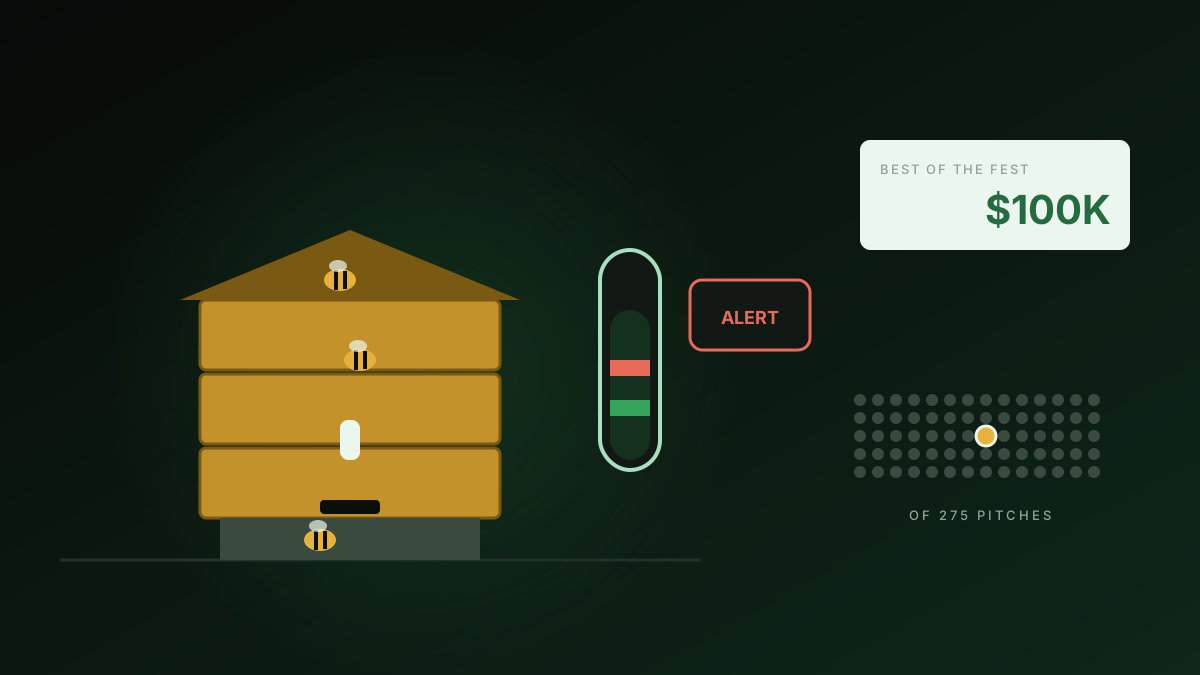
Out of 275 pitches at Startupfest 2026 in Montréal, the $100,000 Best of the Fest cheque went to a Moncton company that watches beehives for trouble. AgroGene Solutions closed the conference on Friday as the clear New Brunswick story of the weekend — molecular diagnostics plus a data platform, aimed at keeping honeybee colonies alive.
What they built
AgroGene pairs a molecular diagnostic with software that helps beekeepers read hive health before visible collapse. Co-founder and CEO Pascale Michaud told BetaKit: “We have discovered how to detect infections earlier, before symptoms appear. We pair a molecular diagnostic with a data platform to help beekeepers keep their hives alive.”
That is not a hobbyist gadget pitch. Bees pollinate a large share of food crops; colony losses are an agricultural-risk problem as much as an entomology one. ResearchNB's profile of the team notes New Brunswick hive losses on the order of 30–50% annually, with climate-linked parasite pressure lengthening the danger window.
The Moncton bench
The company grew out of Université de Moncton research. Alongside Michaud, co-founders Dr. Luc Boudreau, Dr. Nicolas Pichaud, and Dr. Gilles Robichaud bring immunology, molecular biology, and genetics — the uncommon founding mix of a lab team that decided testing had to get cheaper and less disruptive than ripping hives apart for slow lab work.
The test itself
What AgroGene actually sells is a mail-in lab service, and the specifics matter more than the pitch language.
The diagnostic is a PCR assay run on genetic material collected from the hive — a swab plus a sample of roughly five to ten bees, rather than pulling frames apart and shipping brood for slow culture work. It screens and quantifies a panel of ten pathogens: Nosema, European foulbrood, American foulbrood, Varroa, and six viruses. Beekeepers mail samples to the Moncton lab and get a report back within about 72 hours.
Quantification is the part that distinguishes it from a yes/no test. A beekeeper who knows a colony is carrying Varroa learns little; one who knows the load and how it has moved since the last pass can decide whether to treat now, and can tell afterward whether the treatment worked.
The company sells three things on that base: the pathogen panel, a separate honeybee health analysis measuring immune activation and energy reserves, and a seasonal monitoring package bundling three full passes across spring, summer, and fall. That last one is the business model — a recurring diagnostic subscription rather than a one-off kit — and it is the one that has to work for the company to be more than a prize winner. The tests are also reaching beekeepers through equipment retailers rather than direct sales alone.
What $100,000 does and does not solve
Startupfest's “sweet sixteen” edition handed out more than $800,000 across pitch prizes, per BetaKit, with Best of the Fest the headline cheque. For a lab-services company, that money buys throughput: PCR capacity, sample handling, and the staff to turn samples around in 72 hours when volume arrives in seasonal spikes rather than evenly.
What it does not buy is the thing the pitch rests on. “We have discovered how to detect infections earlier, before symptoms appear” is a clinical claim, and the proof that matters is longitudinal: apiaries that tested, acted on the report, and lost fewer colonies than comparable operations that did not. AgroGene has not published that comparison, and the prize did not require one.
The adoption problem is also specific rather than general. Commercial beekeepers run on thin margins and long habit, and a per-hive diagnostic has to cost less than the colonies it saves — a calculation that depends on the beekeeper's own loss rate, which is exactly what they do not currently measure well. The seasonal package is priced for operations big enough to treat testing as an input cost. Whether hobbyists and mid-size outfits follow is the open commercial question, and it is a harder one than winning in Montréal.
Sources
- AgroGene Solutions takes top prize at Startupfest 2026 — BetaKit (Best of the Fest $100K; 275 pitches; Michaud quote; July 10 close)
- AgroGene Solutions — company site (hive diagnostics and monitoring services)
- Elegant Solutions to an Agricultural Crisis — ResearchNB (co-founders; UdeM roots; hive-loss context)
- AgroGene Solutions test kit listing — Dancing Bee Equipment — PCR method; swab plus 5–10 bee sample; 10-pathogen panel; ~72-hour report turnaround; retail distribution
Related coverage
Startups · October 12, 2026
Venn Innovation Founder AMA Puts AgroGene's Four-Win Streak on Stage
Startups · October 12, 2026
TLT East Ventures Joins Picketa's Backers as LENS Reaches More Growers
Startups · July 22, 2026
SomaDetect’s Dairy Sensors Keep Shipping — and Join THRIVE Canada V