
News3 min read
AVSS Makes the First Cut of Canada's Defence Drone Marketplace


The Rothesay-founded parachute-and-drone firm is one of six suppliers on Ottawa's initial Defence Drone Initiative contracts — a pot worth up to $50 million, not a cheque written to one company.
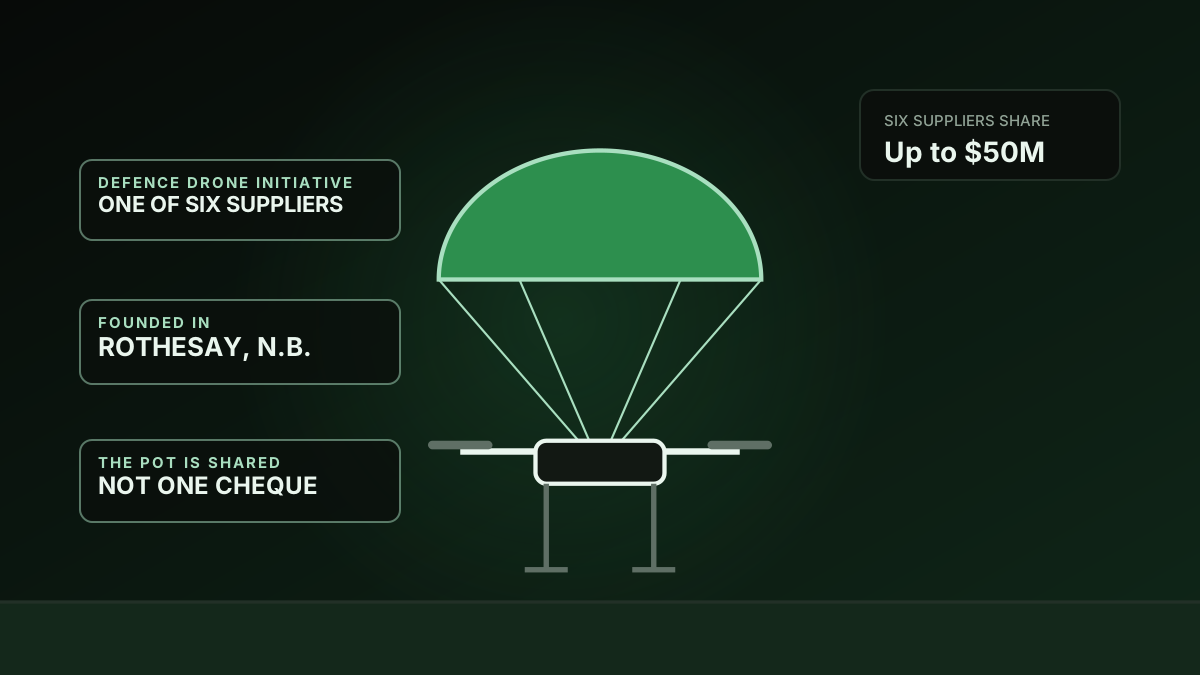
AVSS — Aerial Vehicle Safety Solutions, the New Brunswick company that built its name on drone parachute recovery systems — is on the first supplier list for Ottawa's new Defence Drone Initiative Marketplace. Prime Minister Mark Carney announced the contracts on September 10 in Calgary, as part of a broader Canada-Ukraine package on uncrewed systems. BetaKit put the New Brunswick name in the national write-up today.
The pot is up to $50 million, split across six companies. It is not a $50-million raise, and Ottawa did not publish AVSS's share.
What Ottawa actually bought
The marketplace — DDIM — is a digital procurement rail modelled on Ukraine's Brave1. Nearly 400 vendors qualified. The first contracts cover low-cost uncrewed aircraft and uncrewed ground vehicles for complex terrain, and are meant to grow the Canadian Armed Forces drone inventory tenfold.
AVSS is on the aircraft side. The PMO backgrounder lists the AVSS Drone D1, with locations in Fredericton and Carp, Ontario. It calls the system predominantly Canadian-made. Manufacturing and assembly, it says, take place in Ontario; most major components, software, electronics, sensors, and support systems are sourced in Canada, with limited content from the United States, France, and the Netherlands.
The other first-wave names are Beonyx and Volatus (Quebec), Twenty20 Insight and Objexis AI (Ontario), and Draganfly (Saskatchewan). AVSS is the only New Brunswick company on that list.
The Globe and Mail reported that each bidder was chasing one of two up to $25-million contracts. For the low-cost surveillance drone track, the first delivery is 100 drones at $5,000 or less per unit by March 1. After troops test those airframes, Ottawa can buy more — up to 4,900 additional drones — with that $25-million envelope split among the winners. The Globe did not publish AVSS's unit price.
Ogden's read
CEO Josh Ogden told the Globe the speed mattered as much as the paperwork. The marketplace launched July 23; first contracts landed in 50 days, per the PMO. "From a drone tech perspective, the government is making us do a lot of paperwork," he said. "But then, for them to execute on one of them this quickly, they set a tone of 'No, yeah, do the paperwork, there are carrots at the end of it.'"
He also welcomed Ottawa naming which systems are built here and which ride on allied licences. AVSS is one of three first-wave firms the Globe flagged as offering a predominantly Canadian-made system. "The transparency on who won, who is building and who is using allied partners in selling, that transparency is great," Ogden said.
The company behind the D1
AVSS is not a new logo invented for this procurement. The public site still leads with ASTM F3322 parachute recovery and flight-termination systems — the kit that lets operators fly over people — plus guided delivery and avalanche-control hardware. The mailing address on avss.co is Rothesay. The PMO's New Brunswick pin for this contract is Fredericton.
The company has been in the federal testing stream before. CanadaBuys lists a 2025–26 Innovative Solutions Canada contract for a Universal Precision Payload System against a Rothesay address; Entrevestor wrote up an earlier $1.1-million payload-delivery test with Transport Canada and Indigenous Services Canada.
This is a different beat from Kognitiv Spark's navy mixed reality or Lastwall's identity stack. It is a hardware company from the south of the province showing up on a CAF uncrewed-systems buy. The next DDIM intake is in October. More requests for proposals are already moving, including maritime mine-countermeasure vehicles.
Sources
- Canada and Ukraine to scale up drone production — PMO news release — Sept. 10, 2026: DDIM launch, up to $50 million across six suppliers, AVSS listed as New Brunswick and Ontario, Carney quote
- PMO backgrounder — AVSS Drone D1; Fredericton and Carp locations; Ontario manufacturing and assembly; Canadian content note
- Canada, Ukraine tap Canadian drone companies in binational deal — BetaKit — Jesse Cole, Sept. 14, 2026: national write-up naming AVSS
- Ottawa awards first drone contracts worth up to $50-million through new marketplace — The Globe and Mail — Pippa Norman, Sept. 11, 2026: 100-drone / $5,000 first-order terms, Ogden quotes, Canadian-made distinction
- AVSS — company site: parachute recovery, flight termination, guided delivery, Rothesay mailing address
- CW2427799-AS174-AVSS-Universal Precision Payload System — CanadaBuys — prior Innovative Solutions Canada testing contract, Rothesay business address
- AVSS Bags $1.1M Testing Deal — Entrevestor — earlier payload-delivery test with Transport Canada and Indigenous Services Canada
Related coverage
News · August 24, 2026
Lastwall Clears CMMC Level 2 — While Washington Has the Program on Pause
Startups · October 8, 2026
NBIF, BDC and ACOA Fund Vimy Forge's Second Defence Cohort
Startups · September 22, 2026
Fredericton's Vimy Forge Taps MaRS to Match Defence Startups With Investors