
Companies3 min read
How Fredericton Became a Cybersecurity Town


From NBTel's first-in-North-America digital network and McKenna's information highway to IBM's Q1 Labs acquisition and UNB's Canadian Institute for Cybersecurity — how a university city became one of Canada's security clusters.
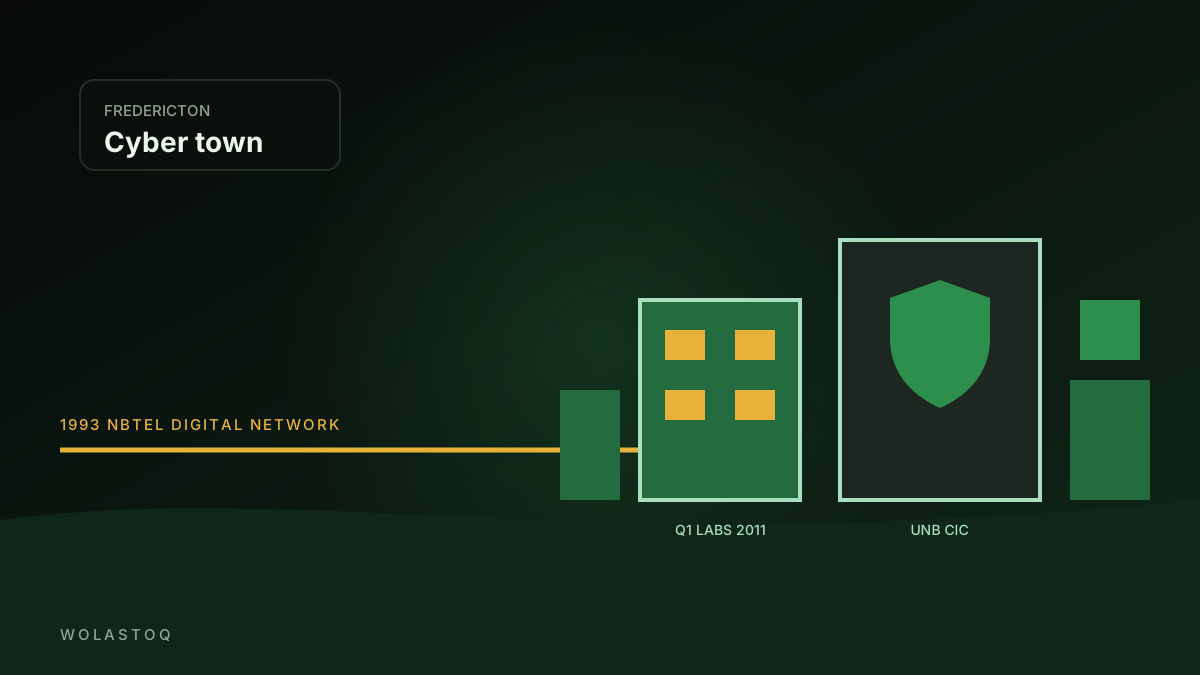
If you want to understand Fredericton's tech scene, start with a single acquisition: in 2011, IBM bought Q1 Labs, the Fredericton-born company behind the QRadar security intelligence platform — a product whose cloud business changed hands again in 2024. Rather than dissolving into the acquirer, the team became a pillar of IBM Security — and stayed.
But 2011 is the middle of this story, not the beginning.
The groundwork: a wired province before it was cool
Two decades earlier, New Brunswick made a bet that looks obvious now and looked eccentric then. NBTel completed North America's first fully digital switching network in 1993, and by mid-decade roughly three-quarters of the province's homes and businesses sat within about three kilometres of its fibre. Premier Frank McKenna turned that network into an economic pitch during the "information superhighway" years — "Information technology is the great equalizer," he told the Christian Science Monitor in 1994 — and the call-centre strategy it powered created some 5,000 jobs in three years, at a time when nobody expected phone-company infrastructure to be an economic development plan.
NBTel used the same network to run the province as a "living lab," piloting services larger telcos wouldn't touch — including Canada's first commercial IPTV service in 1999, branded VibeVision and built on middleware from its spin-off iMagicTV (the long version of that story belongs to Saint John).
The security cluster inherited two things from that era. The first is cultural: a small province had already shipped world-first network technology, so building world-class software from Fredericton didn't require anyone's permission. The second is people. Marcel LeBrun went from iMagicTV to co-founding Radian6, the social-analytics company Salesforce bought for US$326 million in 2011 — the same year IBM bought Q1 Labs. The twin exits that put Fredericton on the map weren't spontaneous; they were the McKenna-era bet compounding fifteen years later.
The flywheel
That decision mattered. IBM kept a security development lab in the city, which kept senior security engineers in the province, which made it plausible to start the next security company without leaving.
The alumni effect is visible in today's roster:
- Sonrai Security, co-founded by Q1 Labs alumni including co-founder Sandy Bird, builds cloud identity and data security tooling.
- Beauceron Security, founded by David Shipley, tackles the human side of cyber risk with awareness training and risk scoring.
The university anchor
The Canadian Institute for Cybersecurity at UNB gives the cluster a research engine and a talent pipeline, publishing widely used security datasets and graduating students directly into local employers. The province has leaned in, with cybersecurity repeatedly featured in economic development strategy through agencies like Opportunities NB.
Why it holds together
Security clusters need three things: anchor employers, specialized talent, and founders who have seen scale. Fredericton — improbably, for a city of ~65,000 — has all three. The open question for the next five years is whether the cluster can produce its next Q1-sized outcome, or whether its role is to keep seeding mid-size firms that sell early.
Either way, it is the province's clearest tech identity, and the one the rest of the country already knows about.
Sources
- Salesforce Buys Social Media Monitoring Company Radian6 For $326 Million — Radian6 acquisition coverage
- IBM and Palo Alto Networks to Jointly Provide AI-Powered Security Offerings — later QRadar SaaS chapter referenced in the lede
- Canadian Institute for Cybersecurity — UNB research anchor for the cluster
ChronologyUNB· 35 stories since Nov 20, 2024
- Gray Wolf Analytics Brings Scam-Detection Playbook to UNB's RBC Lunch & Learn
- McKenna Institute Pulls District Tech Leads to Chelmsford to Scale Teacher Upskilling
Chronology · show all 35 storiesShow fewer
- Sussex Elementary Opens a Saber STEAM Studio for Robotics and 3D Printing
- UNB Joins $5M National Push to Keep AI Weather Forecasts Grounded in Physics
- UNB's Fifth-Scale ATV Predicts the Ground Under Each Wheel — and Left AI Out of It
- Mastercard's Canada Security VP Keynoted CIC's Fredericton Summit — Then Toured the IoT Lab It Funds
- UNB Names Its First Digital Agriculture Chair — and He Starts With Small Farms
- UNB Sent Middle Schoolers Back to Class With Games, Websites and AI
- Review: UNB's Scott Bateman on the Three AI Myths That Won't Die
- UNB's Machine Learning Health Vault Wins CFI Infrastructure Funding
- UNB Co-Authors Confirm the First Native Sulfur Ever Found on Mars
- UNB Researchers Threat-Model the Protocols That Let AI Agents Act
- UNB Researchers Build a Practical Roadmap for the Post-Quantum Migration
- UNB Poster Weighs the Privacy Cost of Federated-Learning Aggregation
- UNB Researchers Deploy Collaborative AI Agents to Guard Power-Substation Networks
- UNB Researchers Build a Mixture-of-Experts Defence Against Adversarial AI Attacks
- UNB Researchers Make AI Malware Detection Explainable with a 'Dual Prototype' Framework
- UNB Researcher Takes a Geometric Axe to Optimization's Symmetry Problem
- UNB Researcher's 'Trust Passport' Would Stamp Every AI Reply with Its Risk Profile
- National Cyber Agencies and Big Banks Head to Fredericton for UNB's Cybersecurity Summit
- When the First Canadian Flew to the Moon, Fredericton Was Listening
- UNB Partners with Talent Innovation Canada to Put Grad Talent Inside Industry R&D
- McKenna Connect Puts UNB Mentors Beside 250 Rural Neighbours
- Cybersecurity Pioneer Ali Ghorbani Named to the Order of New Brunswick
- McKenna Institute's TeXplore Turns 17 Days Off School Into Soldering, Robots and AI
- SeaGreen Puts Seaweed Biochar in Ten Queen Street Flower Planters
- UNB Stitches Its Startup Machinery Into One Network
- Creduman Takes Top Spot at UNB’s MTME: NEXT 2026
- Four UNB MTME Startups Launch Next Week at MTME: NEXT
- The UNB Startup Pipeline: How a Fredericton Campus Keeps Minting Companies
- How Fredericton Became a Cybersecurity Town (this story)
- A Century of Circuits: UNB's Electrical Engineering Program Turns 100
- First Cheques: UNB's Fraser Fund Backs SpatialOne, Profitual, and AinaTest
- Gray Wolf Analytics: Crypto Forensics from a Fredericton Classroom
- Three Years In, the McKenna Institute Is Quietly Rewiring New Brunswick
Related coverage
Startups · October 12, 2026
Gray Wolf Analytics Brings Scam-Detection Playbook to UNB's RBC Lunch & Learn
News · September 6, 2026
Mastercard's Canada Security VP Keynoted CIC's Fredericton Summit — Then Toured the IoT Lab It Funds
News · August 19, 2026
UNB Researchers Threat-Model the Protocols That Let AI Agents Act