
Companies3 min read
Kognitiv Spark Finds Its Post-HoloLens Headset in Japan


The Fredericton mixed-reality firm has paired RemoteSpark with HMS Inc.'s SiNGRAY G2, a standalone 3D AR headset from Fukuoka, after Microsoft stopped making the HoloLens 2.
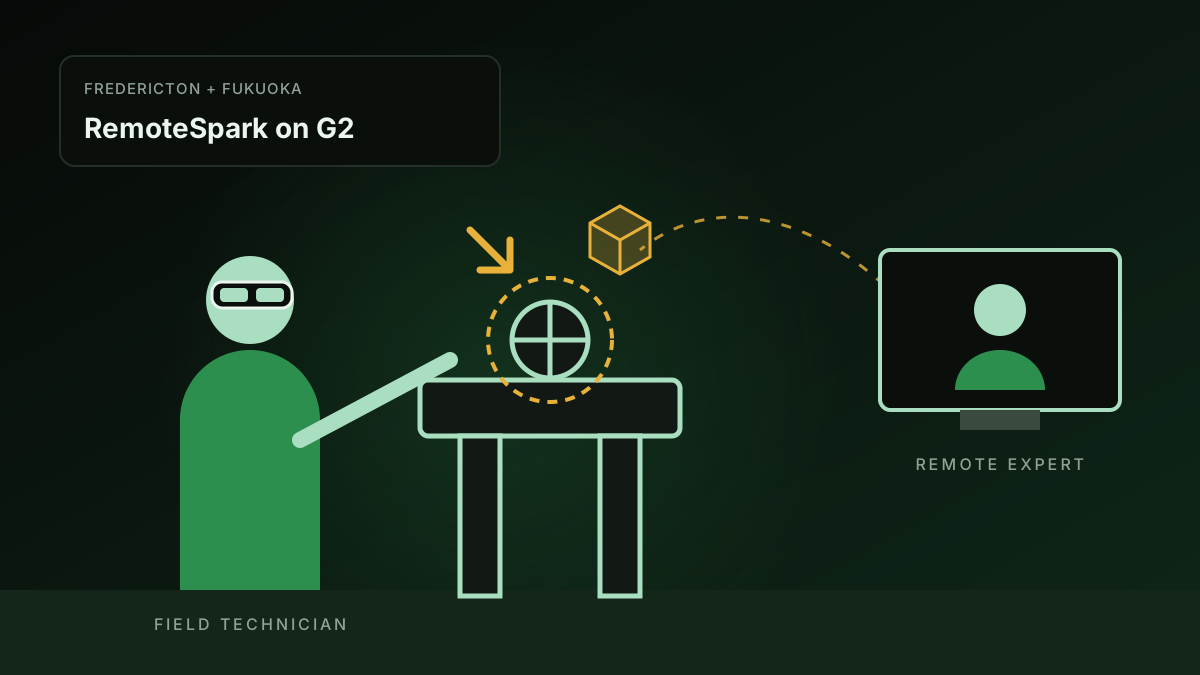
Kognitiv Spark has a new headset to run its software on. On Oct. 1, the Fredericton company and HMS Inc. of Fukuoka, Japan, announced a strategic partnership. It connects HMS's SiNGRAY G2 industrial augmented-reality glasses to RemoteSpark, Kognitiv Spark's mixed-reality remote-support platform.
The mechanics haven't changed. A technician in the defence, energy or manufacturing sector calls an expert through RemoteSpark, and the expert sees what the technician sees. The expert can talk them through the job, mark up the equipment, and send over 3D models, manuals and schematics while the technician keeps both hands on the work. Entrevestor reported the deal on Oct. 13.
The hole HoloLens left
The release is blunt about why the hardware matters. RemoteSpark already runs on Android smart glasses, laptops and phones. The G2 gives customers "something they have been asking for since HoloLens 2 left the market: a fully standalone, stereoscopic 3D AR headset for true holographic work."
That gap is real. Microsoft says the HoloLens 2 "is no longer being manufactured and is currently out of stock in all geographies." Its release notes say security updates continue only through December 2027, and November 2024 brought the last feature release. Kognitiv Spark's best-known deployment ran on that headset. When the Royal Canadian Navy adopted RemoteSpark in 2019, its technicians wore HoloLens headsets to see repair steps over shipboard machinery.
What the G2 brings
According to the release, the headset adds:
- 3D holograms anchored to equipment, using what the companies call kilohertz-level tracking
- high-resolution capture and depth sensing for the remote expert
- a separate vision processor for tracking, which leaves headroom for detailed 3D models and live video
- hot-swappable power, so long jobs don't stop for charging
- IP65 sealing and Micro-OLED displays for decks, rigs and plant floors
- testing to IEC 62368-1, 62471 and 60825-1, plus drop-ball and impact tests
HMS specializes in AI image processing, visual SLAM (simultaneous localization and mapping) and edge computing. The company says it has shipped more than 32,000 3D sensing devices to industrial customers in Japan.
"We've never been about the headset for its own sake. We're about the person wearing it," Kognitiv Spark CEO Yan Simard said in the release. "The G2 is built for the places our users actually work." HMS president and CEO Dr. Zhencheng Hu said Kognitiv Spark "has spent years earning the trust of Defence departments, utilities and manufacturers."
What it doesn't say
Neither company disclosed pricing, deal terms, a named customer, or when G2 units will reach RemoteSpark users in Canada. In a LinkedIn post, Simard said he was excited about "what is coming next." For now, the announcement is a hardware partnership, not a contract.
Sources
- Kognitiv Spark — HMS SiNGRAY G2 joins Kognitiv Spark's mixed reality platform (Oct. 1, 2026): partnership, G2 features, quotes, HMS background
- Entrevestor — Kognitiv Spark partners with Japanese hardware firm (Oct. 13, 2026): independent report of the deal
- Canadian Defence Review — Kognitiv Spark and HMS partner to deploy SiNGRAY G2 AR glasses: defence-trade pickup
- Microsoft Learn — Where HoloLens 2 is supported: HoloLens 2 no longer manufactured
- Microsoft Learn — HoloLens 2 release notes: final feature release and the end of security servicing
- Yan Simard on LinkedIn: CEO's post on the partnership
- HMS Inc.: partner company site
Related coverage
Companies · March 10, 2025
Holograms for the Navy: Inside Kognitiv Spark's Defence Niche
Startups · October 8, 2026
NBIF, BDC and ACOA Fund Vimy Forge's Second Defence Cohort
Startups · September 22, 2026
Fredericton's Vimy Forge Taps MaRS to Match Defence Startups With Investors