
News5 min read
New Brunswick Weighs Letting Private Online Casinos Take On Atlantic Lottery
Drafted with AI and edited by NB Tech News staff. How we use AI


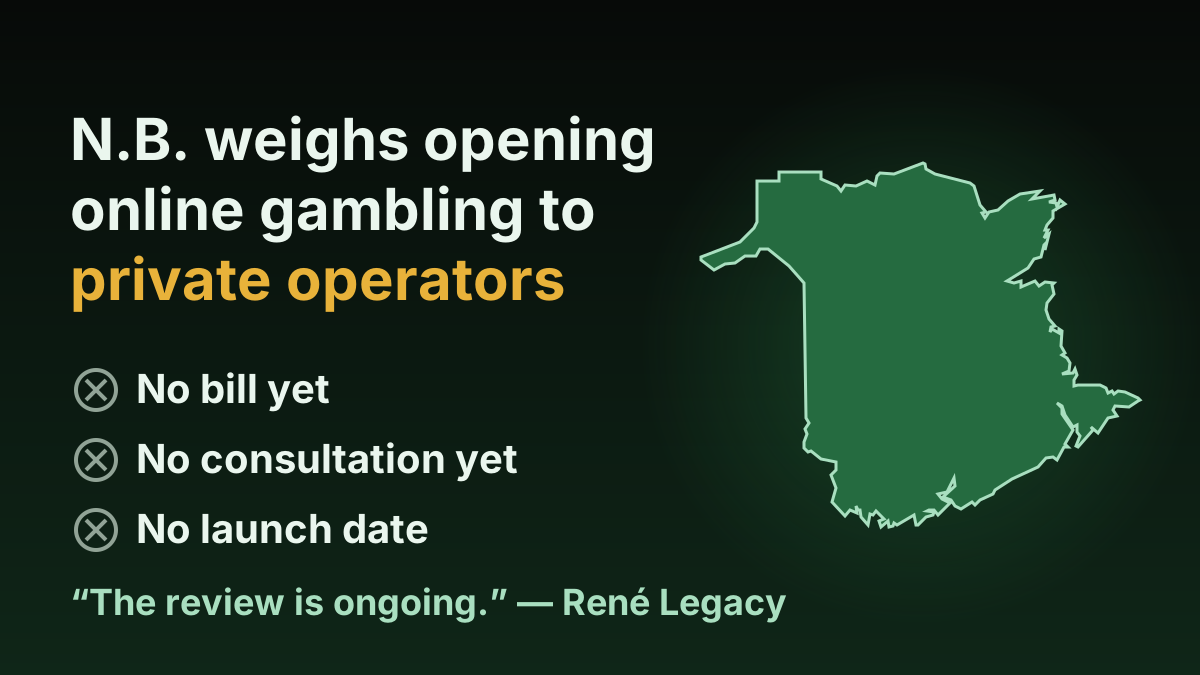
Finance Minister René Legacy says the province is "exploring options around regulating private online operators," as Atlantic Lottery estimates unregulated sites pull more than $250 million a year out of the region. There is no bill, consultation or date yet.
Turn on a national hockey broadcast in New Brunswick and the betting ads come one after another. Many are for companies licensed in Ontario or Alberta that cannot legally take a New Brunswicker's bet. Residents who go looking for those brands are often redirected to the same companies' international sites, Legal Sports Report reported.
Now the province says it may stop fighting that market and license it instead.
"Government is exploring options around regulating private online operators," Finance and Treasury Board Minister René Legacy said in a statement first reported by the Telegraph-Journal on Oct. 19.
"Online gaming is continuously evolving and the number of options – regulated and unregulated – continues to grow," Legacy told Canadian Gaming Business. "Government has a responsibility to ensure New Brunswick's legal and regulatory framework keeps pace with an evolving gaming environment."
"The review is ongoing," he said.
No bill, no date
Opening the market would end Atlantic Lottery's hold on online gambling in New Brunswick. The Crown corporation, owned by New Brunswick, Nova Scotia, Prince Edward Island and Newfoundland and Labrador, is the only legal online casino and sports betting site in the province.
Nothing changes for players yet. The government has not introduced a bill, opened a consultation, approved a private operator or set a launch date, Canada iGaming noted. Finance and Treasury Board spokesperson David Kelly said the province is watching other jurisdictions to "maintain a safe, responsible, and appropriately regulated gaming environment for New Brunswickers."
Betting on an offshore site is not a crime for residents under Canada's Criminal Code, Legal Sports Report noted.
Atlantic Lottery's $250-million problem
Atlantic Lottery's 2025-26 results, released Oct. 21, show what the province is up against.
"Atlantic Lottery is facing a level of disruption that is unprecedented in our 50-year history and the effect on our financial performance last year was clear," president and CEO Dallas McCready said. "The growth of illegal online gambling has fundamentally changed the competitive landscape."
The corporation estimates that unregulated sites take more than $250 million a year out of the Atlantic region. It says it now holds 35 per cent of online gambling in its four provinces, up from 34 per cent the year before.
"These operators are drawing significant gaming dollars out of Atlantic Canada, do not contribute to provincial revenues in our region and are not subject to the same requirements that govern Atlantic Lottery," spokesperson Greg Weston told Legal Sports Report.
Atlantic Lottery returned $492 million in profit to its four owners in 2025-26, including $148.9 million to New Brunswick. That was down from $154.6 million the year before. New Brunswick saw the biggest drop of the four provinces, down 3.7 per cent, Canadian Gaming Business reported. Provincial budget documents show government lottery revenue down $8 million from two years ago.
Online is growing, but not enough
Atlantic Lottery's own online business is still growing. Profit from its online games rose 15.4 per cent to $133.8 million, and it had more than 408,000 verified online player accounts, up from 372,000, Canadian Gaming Business reported.
But online sports betting volume fell 5.6 per cent, the first drop in 22 years. Atlantic Lottery blamed advertising from operators that cannot legally take bets in the region, and players using VPNs to reach sites licensed elsewhere.
McCready said in 2025 that the corporation is open to competing in an open market. "At some point we're hoping they'll allow us to compete," he told Canadian Gaming Business. "But it's a decision of the policymakers and what they think is best for their people."
The models next door
Ontario opened its online market to private operators in 2022, and Alberta followed in July. Ontario charges operators a $100,000 annual fee, places no cap on their number and takes 20 per cent of gaming revenue, Legal Sports Report reported.
Michael Naraine, an associate professor of sport management at Brock University, called Ontario's approach the "wild west." He said Alberta's system is slightly better because it dedicates money to research, education, and addiction and mental health services. He pointed to New York as a stricter model: the state limited mobile sports betting to a small group of operators and taxes their revenue at 51 per cent.
Ontario now says its regulated market captures more than 90 per cent of online gambling across more than 80 licensed sites, according to Canadian Gaming Business.
Who else is watching
Nova Scotia and Newfoundland and Labrador both told Canadian Gaming Business they are monitoring developments but have no immediate plans to open their markets.
"The issues CARG advocates for transcend any particular market model," said Molly Cormier, executive director of the Canadian Alliance for Regulated Gaming, the lottery-industry group that counts Atlantic Lottery as a member. She said governments must also go after operators that market in provinces where they are not authorized.
What a private market would need
A licensed market is as much a technology project as a policy one. New Brunswick would have to set rules for licensing and tax rates, advertising and geolocation, identity checks and anti-money-laundering controls, privacy and cybersecurity, dispute resolution and safer-gambling tools, Canada iGaming noted.
Today the New Brunswick Lotteries and Gaming Corporation conducts and manages gaming, while the Gaming Control Branch of the Department of Justice and Public Safety regulates it. The province has not said whether it would copy Ontario's system, create a new agency or keep Atlantic Lottery at the centre.
Sources
- Telegraph-Journal — New Brunswick 'exploring options' to allow private online gambling
- Canadian Gaming Business — Atlantic provinces exploring commercial iGaming expansion as Atlantic Lottery reports 35% market share
- Legal Sports Report — New Brunswick Weighs Opening Online Gambling Market to Private Operators
- Canada iGaming — New Brunswick Reviews Private Online Gambling, With No Launch Date
- Atlantic Lottery — 2025-26 results release (Oct. 21, 2026)
- Atlantic Lottery — 2025-26 annual report
- Gaming Today — New Brunswick Weighs Rules for Private Online Casinos
Related coverage
News · October 23, 2026
811 Callback Waits Went From 12 Minutes to Almost Four Hours
News · October 23, 2026
Grand Falls Wants a Freeze on New Data Centres
News · October 21, 2026
Protesters Press Holt as N.B. Promises Data-Centre Law