
News6 min read
Pabineau First Nation Launches Its Own Environmental Monitor


Mother Earth Watcher is owned and governed by the Mi'gmaq Nation in northern New Brunswick. It pairs sensors and AI with Elders' knowledge to track land, water, air and wildlife. A $714,000 ACOA contribution pays for the first phase, and the Nation plans a pilot valued at about $2.96 million for 2027.
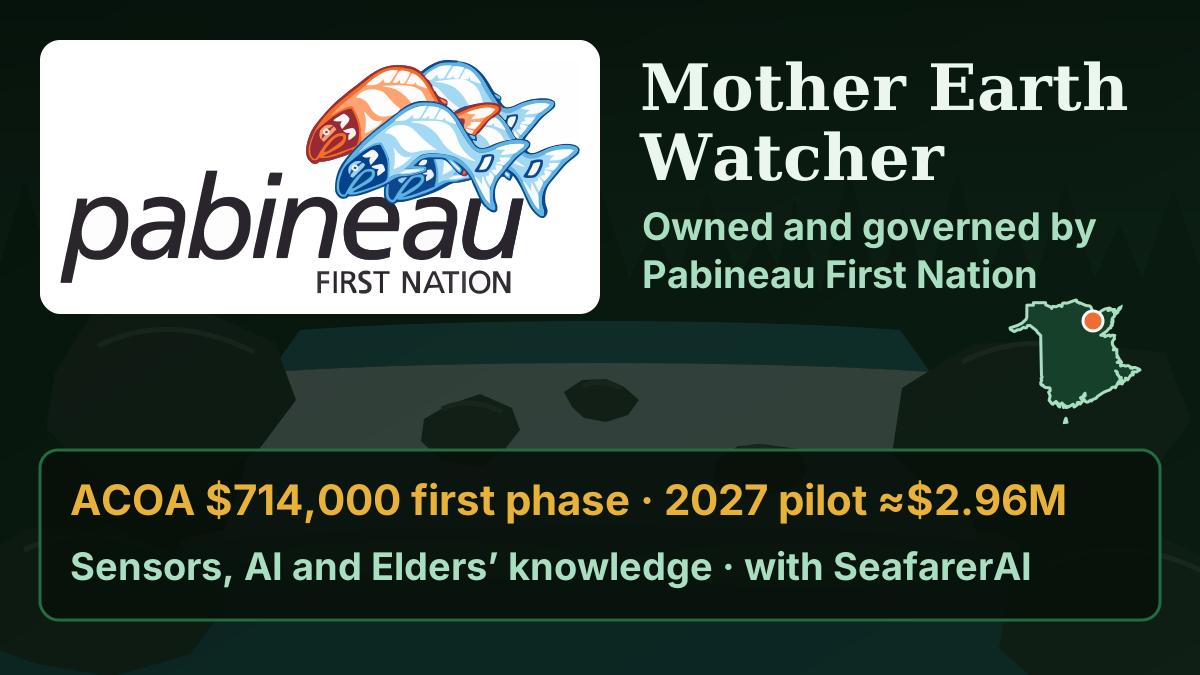
Pabineau First Nation, a Mi'gmaq community in northern New Brunswick, is building its own system for watching the land, water, air and wildlife of its territory. Called Mother Earth Watcher, it is owned and governed by the Nation, and the data it collects stays with the Nation.
The Nation announced the project on September 24, describing it as "an Indigenous-owned environmental intelligence initiative designed to provide trusted, real-time environmental monitoring for major projects across Canada." The technology comes from SeafarerAI, a New Brunswick company whose website lists its headquarters in Clifton Royal. The Atlantic Canada Opportunities Agency (ACOA) is contributing $714,000 that does not have to be repaid.
A record the Nation controls
The announcement puts ownership first. "Unlike traditional monitoring approaches, the system is owned and governed by the Nation," it says, "ensuring environmental information remains transparent, trusted, and responsive to community priorities." It calls the system a "community-owned source of truth on land, water, air quality, and wildlife conditions."
That matters because of how monitoring usually works around major projects. Chief Terry Richardson explained it in an October 5 interview with SustainableBiz Canada's Tyler Choi. Before construction, a developer normally hires an environmental consultant to measure a baseline. Once a project is built and running, he said, continuous monitoring is rare, so communities have little way to track change over time. Mother Earth Watcher is meant to fill that gap. Its readings can also be set against the data that project proponents publish.
The Nation has development on several sides. Richardson told SustainableBiz he is watching a proposed copper mine, a biochar facility in Quebec, and the Project Positive+ precursor cathode materials plant, in which the Nation is itself involved. The community has about 400 members. He said it wants economic opportunity, but not at the expense of the environment.
"I think this is a great tool that's going to enable First Nations to control our concerns and enable us to monitor projects as they move forward," Richardson said.
The Nation's own website frames its work in similar terms. It describes a commitment to "a safe environment while preserving and exercising our rights, language, culture and traditions." Its environmental and research projects include restoring salmon in the Nepisiguit River and Little River, both damaged by past mining, with a counting fence and published fisheries reports.
Elders' knowledge sets the baseline
Mother Earth Watcher does not start from sensor readings alone. The Nation is recording the knowledge, stories and language of its Elders and treating them as data in their own right. Richardson told SustainableBiz that this knowledge helps set the baseline the system measures against: where animals were hunted on the territory, for example, and whether populations have grown or shrunk.
He also said Indigenous communities are in real danger of losing their knowledge and language. So the system has a second job. It is meant to be an archive the community can keep and pass on to future generations, as well as a monitoring service.
In the announcement, Richardson put the two strands together:
"Mother Earth Watcher represents a transformational Nation-building opportunity for Indigenous communities to lead the future of environmental stewardship. By combining Indigenous knowledge with advanced Canadian technology, we are creating a model that can be replicated across the country, creating opportunities for partnerships and long-term economic growth while building confidence in responsible development."
Sensors, a field lab and an AI that watches for change
As Richardson described it to SustainableBiz, sensors track changes in air, water and soil. Readings come from drones, balloons, or people collecting samples by hand. Samples go to a lab built into a mobile shipping container. An AI tool then alerts the Nation when conditions move away from the baseline, for instance if water quality gets worse. The aim is to catch problems early, while they can still be dealt with.
SeafarerAI's TerraSphere page says the platform "powers Mother Earth Watcher, led by Pabineau First Nation." It says the system runs on site without depending on the public internet and that Indigenous Knowledge stays under community control.
The New Brunswick company behind the technology
SeafarerAI's co-founder and CEO, Ian Wilms, spent 10 years as a naval warfare officer and 14 at IBM before settling in Saint John, according to his Atlantic Canada Aerospace and Defence Association bio. The company's earlier work is maritime. In 2024, UNB described a pair of SeafarerAI-led PORT WATCH projects: one on dredging at the Port of Saint John, and one on underwater noise at the Port of Belledune whose listed partners included Eel River Bar and Pabineau First Nations. Richardson said the Nation had been developing Mother Earth Watcher for years, with SeafarerAI as its partner for less than two.
Pabineau is also a partner in a separate energy project nearby: the proposed transportable nuclear plant at Belledune, which we covered on October 5.
The funding and the 2027 pilot
ACOA's $714,000 pays for the first phase. According to the announcement, that phase "will establish the governance, data stewardship framework, and business model" needed to bring the system to market. In other words, it builds the rules for who controls the data before the system expands.
That phase "lays the foundation for a larger pilot project planned for deployment in 2027." The full pilot "is valued at approximately $2.96 million." Richardson told SustainableBiz the pilot is planned for early 2027 and that the Nation is still looking for partners.
Sean Fraser, the federal justice minister and minister responsible for ACOA, said the project shows "what's possible when Indigenous leadership, Canadian technology and responsible development come together."
Richardson wants the system to travel beyond Pabineau. Once it fits the Nation's own needs, he told SustainableBiz, it could be licensed to other First Nations. He hopes to see it "included in development right across Canada."
Sources
- SeafarerAI: Pabineau First Nation launches Mother Earth Watcher: September 24, 2026 announcement; Indigenous-owned and Nation-governed; data ownership with the Nation; ACOA $714,000 non-repayable contribution for governance, data stewardship and business model; 2027 pilot valued at about $2.96 million; quotes from Chief Richardson and Minister Fraser
- Newswire copy of the announcement: September 25 distribution by SeafarerAI Technology Inc., datelined Saint John
- SustainableBiz Canada: First Nation develops environmental monitoring tool for its needs: October 5, 2026 interview with Chief Richardson; about 400 members; nearby projects; sensors, drones, balloons, mobile lab and AI alerts; Elders' knowledge as baseline and archive; partnership under two years; early-2027 pilot; licensing idea
- Pabineau First Nation: the Nation's name, Mi'gmaq identity and mission statement
- Pabineau First Nation: Chief and Council: Saqmaw (Chief) Terry Richardson
- Pabineau First Nation: Environmental and special research projects: salmon restoration in the Nepisiguit River and Little River
- SeafarerAI: TerraSphere: platform behind Mother Earth Watcher; runs on site; Indigenous Knowledge under community control
- House of Commons: Sean Fraser: MP for Central Nova; Minister of Justice and minister responsible for ACOA
- Atlantic Canada Aerospace and Defence Association: Ian Wilms board bio (linked from SeafarerAI's news page): SeafarerAI co-founder and CEO; 10 years as a naval warfare officer, 14 at IBM; lives in Saint John
- UNB Newsroom: seaports projects, September 2024: SeafarerAI-led PORT WATCH projects at Port Saint John (dredging) and the Port of Belledune (underwater noise), with Eel River Bar and Pabineau First Nations among the Belledune partners
- SeafarerAI: Contact and LinkedIn page (linked from its website): headquarters in Clifton Royal
Related coverage
News · October 15, 2026
ACOA Opens a $40M AI Call. N.B. Firms Need a $1M Project to Apply
News · October 18, 2026
N.B. Power Has 10 Data-Centre Projects in Its Queue
News · October 18, 2026
Saint John Hospital Donors Back AI-Supported Genetic Testing