
News5 min read
The Potato on Your 2040 Table Is Being Sequenced Outside Woodstock


At Agriculture and Agri-Food Canada's Benton Ridge substation, genome sequencing and hyperspectral drones are compressing a breeding cycle that still runs 12 to 15 years — and pointing it at a warmer climate.
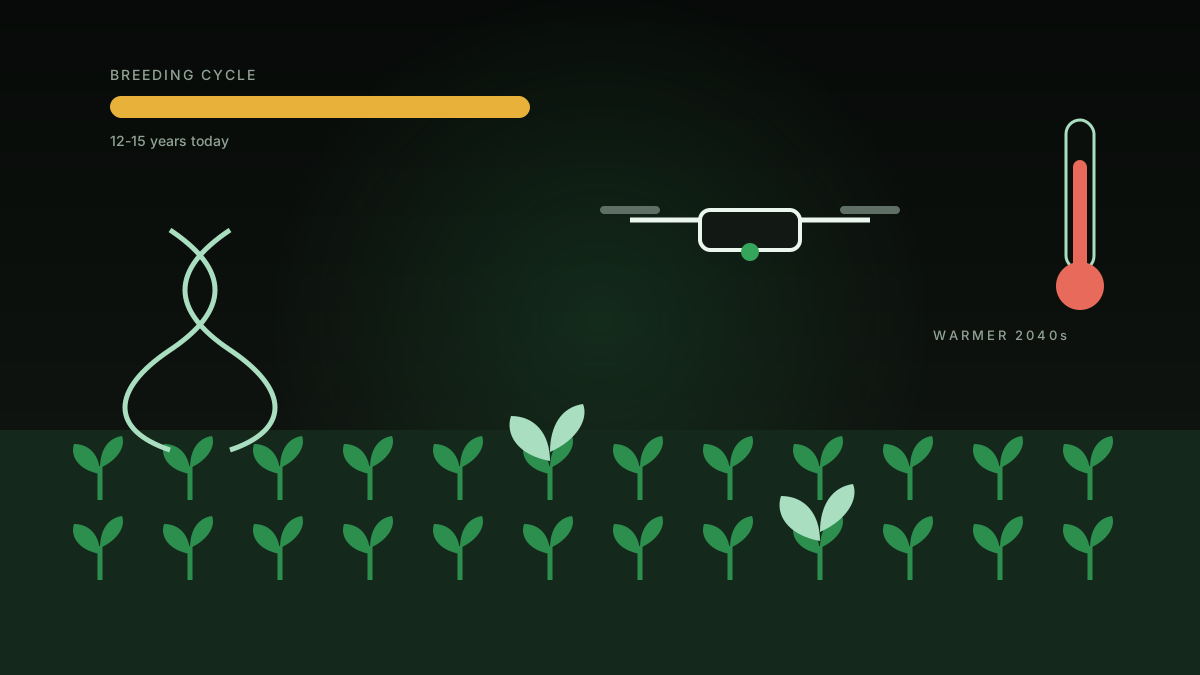
New Brunswick's most patient technology project is a potato field outside Benton, near Woodstock. Scientists at Agriculture and Agri-Food Canada's Benton Ridge Potato Breeding Substation are pairing genome sequencing with drone-mounted hyperspectral cameras to develop varieties that can survive the diseases and the climate of the 2040s — a beat the Telegraph-Journal reported this week from a recent open house at the site.
"What we're breeding today will be on your table in 12 to 15 years," said Josée Owen, associate director of research, development and technology at AAFC.
That timeline is the whole problem. Getting from a cross between two parent plants to a variety a grower will actually plant takes more than a decade, which means the people doing it have to guess what farmers, processors, consumers — and the weather — will want a decade and a half out. The technology arriving now does not remove the guesswork; it makes it far better informed.
Sequencing before the cross, not after the harvest
The older method was brute force: make crosses, plant the results, walk the rows, and keep whatever survived. Selection happened in the field, over years, by observation.
Now molecular geneticists and computational biologists read the DNA of the parent plants before any crossing happens, screening for the combinations most likely to yield the traits that matter — higher yields, better texture and appearance, resistance to pathogens, resistance to insects like the Colorado potato beetle. Sequencing an entire genome once meant a room of laboratory equipment and a matching budget; Owen said the equipment has become dramatically smaller, faster and cheaper, so researchers can now analyse far more genetic information than before.
"The numbers game was different," Owen said. "There was a lot more work in the field for the same effects than now we can do by sequencing the genetics and making more educated guesses so that we can get to the results faster."
The same drop in sequencing cost has opened up the soil. Researchers can now sequence thousands of microorganisms from a single soil sample, identifying the bacteria and other organisms that shape soil health, biodiversity and disease resistance — which in turn tells them which farming practices actually build resilient ground.
Every pixel loaded with data
Field work is changing too. Instead of inspecting plants one at a time, researchers increasingly fly drones carrying hyperspectral cameras and capture an entire field in a single pass.
"Every pixel in that image is loaded with data," Owen said, describing a method that cuts manual labour while producing far larger and more detailed datasets than hand phenotyping ever could.
That capability is being bought, not just described. In January, Public Services and Procurement Canada tendered Lidar and multispectral drone and sensor equipment for plant phenotyping research at the Fredericton centre, with New Brunswick as the region of delivery; the contract went to Hoskin Scientific in March. The province has its own research history here, too: UNB's Brigitte Leblon has held NSERC funding, with AAFC among her partners, to develop drone-based detection of early and late blight in potatoes for the New Brunswick and Prince Edward Island industries.
What aerial phenotyping mainly buys is earlier decisions. A German study of tetraploid breeding material, led from Heinrich Heine University Düsseldorf with the potato breeder SaKa Pflanzenzucht, found drone multispectral data predicted maturity, foliage development and emergence well — while cautioning that predictive ability varied widely by trait and growing environment. Its authors saw the clearest application in the earliest selection stages, where candidates are numerous and genotyping every one is too expensive. It is a data problem as much as an agronomic one, and it is being worked in a province where potatoes are a serious export.
Publicly funded, deliberately long-term
Benton Ridge is a satellite of AAFC's Fredericton Research and Development Centre, which was established in 1912 and is part of the federal agency's national network of research centres. The substation's role is germplasm enhancement: beyond developing new varieties, it maintains clean seed stocks and multiplies promising lines, and the Fredericton centre is custodian of the Canadian Potato Genetic Resources collection.
Owen said the work there is largely publicly funded by design, aimed at projects too long-term or too risky for private companies to shoulder alone.
"Our research is basically oriented towards ensuring that we have a really robust agricultural industry that produces high-quality food," she said. "Our food feeds not only Canadians but also gets exported and feeds the world."
The climate framing is explicit. Scientists at the site are selecting for varieties that need fewer pesticide applications and use water more efficiently while staying productive as growing conditions shift.
"These are genetics that are going to create less environmental footprint for agriculture," Owen said. "At the same time, it's also going to enable us to adapt as the climate changes, so that we're going to be able to continue to grow potatoes in Canada for a long time."
None of it makes the calendar disappear. A new variety will still take years. But the tools have changed what those years are spent on.
"The better the tools we have," Owen said, "the more effective we can be in what we're delivering."
Sources
- DNA, drones and data: New tech helping breed better potatoes, faster — Telegraph-Journal, August 3, 2026: Benton Ridge open house, all Josée Owen quotes, genomics and hyperspectral drone detail
- Fredericton Research and Development Centre — Agriculture and Agri-Food Canada: 1912 founding, Benton Ridge as germplasm-enhancement satellite
- Potato Gene Resources Newsletter 2022–2023 — AAFC: Canadian Potato Genetic Resources collection maintained and multiplied at Benton Ridge
- Lidar and Multispectral Unmanned Aerial — tender notice WS5495657264 — CanadaBuys: drone and sensor equipment for plant phenotyping research at the Fredericton RDC, New Brunswick delivery region, awarded to Hoskin Scientific on March 4, 2026
- UNB professor receives funding for drone research and development — UNB Newsroom: Brigitte Leblon's NSERC-funded drone work with AAFC on early and late blight detection in NB and PEI potatoes
- Using drone-retrieved multispectral data for phenomic selection in potato breeding — Maggiorelli et al., Theoretical and Applied Genetics, March 2024. A German study (Heinrich Heine University Düsseldorf and SaKa Pflanzenzucht, trials at Windeby) cited only for method: predictive ability for maturity, foliage development and emergence, the wide variation by trait and environment, and the early-stage use case. Not a Canadian result
Related coverage
News · September 2, 2026
UNB Names Its First Digital Agriculture Chair — and He Starts With Small Farms
News · October 12, 2026
Province Adds $1M to ResearchNB to Fund Discovery
News · September 24, 2026
UNB Joins $5M National Push to Keep AI Weather Forecasts Grounded in Physics