
News4 min read
UNB Joins $5M National Push to Keep AI Weather Forecasts Grounded in Physics


Science dean Sanjeev Seahra will lead UNB's slice of Concordia's WxAlliance: using AI to sharpen cheap, low-resolution runs so Atlantic storms are not a blur.
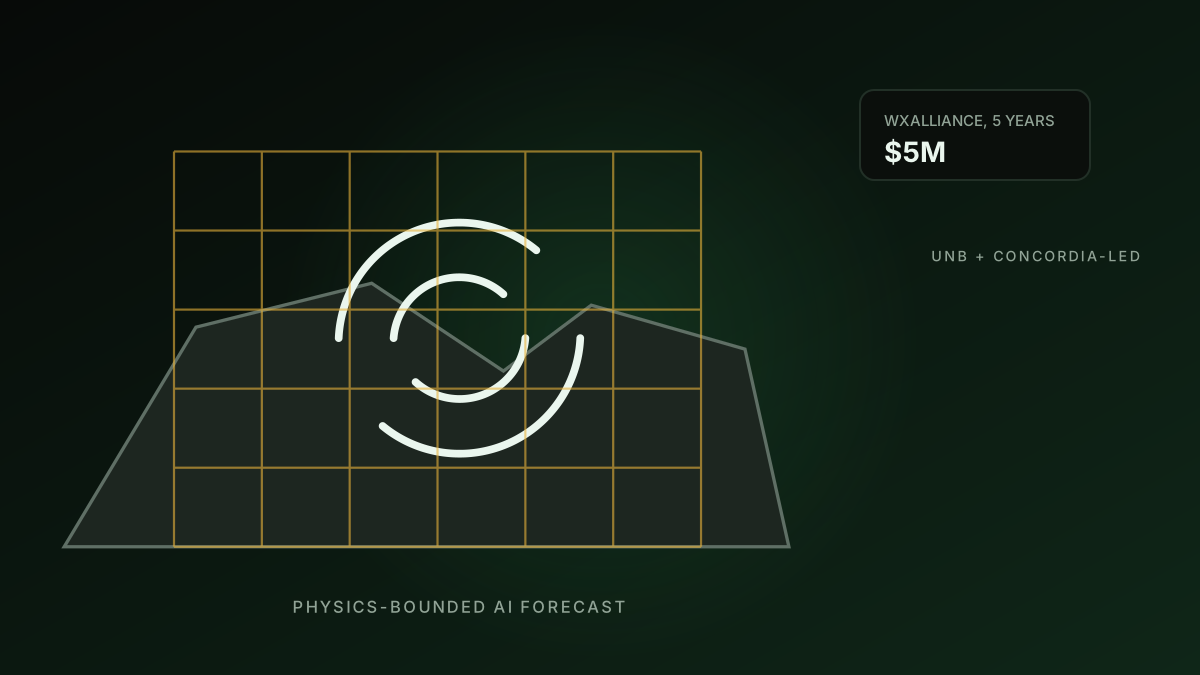
The University of New Brunswick is on a national weather-model project that is trying to stop AI forecasts from inventing weather that cannot happen.
WxAlliance, a Concordia University-led collaboration, has a $5 million, five-year grant from NSERC's Alliance Society program, Concordia announced September 21. UNB's newsroom confirmed its role September 24. The project is led by Brian Vermeire, an associate professor of mechanical, industrial and aerospace engineering at Concordia, and is scheduled to wrap in August 2031.
Nine universities are in, UNB among them, plus eight government and industry partners. The only partner either release names is Environment and Climate Change Canada. Concordia says the partners bring expertise in meteorology, emergency management, wildfire response, power grids, computing, insurance and climate adaptation.
Dr. Sanjeev Seahra — dean of science and a professor of mathematics and statistics in Fredericton — will lead UNB's share.
The models disagree about what is allowed
Physics-based forecasts solve approximate equations. Small errors grow with time, so a longer outlook costs more compute if you want it sharp. Machine-learning models skip a lot of that math: they train on huge archives and spit out a future weather field much faster.
UNB's write-up is blunt about the failure mode. A model that only copies patterns from data has no rule that says a storm has to obey the atmosphere. It can draw weather that is not physically possible. It also starves in places with thin local records — Northern Canada is the example the campus piece uses — because those networks need dense training data to stay precise.
WxAlliance's bet is a hybrid: keep the mathematical models for what nature allows, and use AI where the equations are too expensive to run at the resolution a town actually needs.
"If we have parts of the system we understand really well, let's use the classical technique there," Vermeire said in Concordia's release. "If there are parts of the system we don't understand, let's use the machine learning techniques to sort of fill those gaps."
The consortium splits that work into nine workstreams. Neither release names the other eight leads.
Downscaling is the Fredericton job
Seahra's stream is downscaling: inferring high-resolution weather from a cheap, low-resolution run.
The campus analogy is enlarging a photo. Stretch the pixels and it goes soft. A decent algorithm guesses the missing detail from neighbours and keeps the edges. Weather downscaling is the same trade, except the "pixels" are temperature, wind, and moisture, and a bad guess is a missed thunderstorm.
"Traditionally, to make accurate weather predictions relatively far into the future, you need to run high-resolution simulations that use up a lot of computer time," Seahra said. "That is, there is an inherent trade-off between accuracy and resource consumption. My work tries to get around this by using AI to infer localized weather patterns from low resolution computer simulations that are much faster to run."
"This kind of small-scale modelling is crucial for predicting the effects of extreme weather events, like thunderstorms and hurricanes, in Atlantic Canada."
UNB says the workstream funds one PhD student and one postdoctoral fellow. That is the only split either release gives. Neither says how much of the $5 million comes to Fredericton.
What this does not certify
Alliance Society is NSERC's stream for university projects whose main driver is societal impact, done with public, private, or not-for-profit partners.
Vermeire calls WxAlliance, "to my knowledge," the first research grant of this scale in Canada to use machine learning for weather prediction. That is his claim, not a ranking NSERC published.
The grant is not a new forecast product on a New Brunswicker's phone. It does not name a commercial spin-out. Neither release claims the hybrid models already beat Environment Canada's operational forecasts. UNB lists hoped-for payoffs — safer maritime operations, better storm planning — as goals, not results. The provincial fact is narrower: the science dean's group is being paid to make cheap, coarse runs locally sharp enough for Atlantic extremes, and two research positions come with it.
UNB's other recent AI research funding, the Machine Learning Health Vault, is a different problem: privacy-preserving health data rather than the atmosphere.
Sources
- Concordia-led research project receives $5M to transform weather forecasting in Canada — Concordia News, September 21, 2026: $5 million NSERC Alliance Society grant over five years; Brian Vermeire leads; nine academic institutions and eight societal partners; partner expertise areas; Vermeire quotes
- UNB researchers join $5M national effort to improve weather forecasting with AI — UNB Newsroom, September 24, 2026: WxAlliance; Concordia lead; eight other universities including UNB; eight partners including ECCC; $5 million NSERC Alliance Society, announced September 21; Seahra quotes; downscaling workstream; one PhD and one postdoc; five years to August 2031
- Sanjeev Seahra — UNB faculty directory — Dean of Science; professor of mathematics and statistics, Fredericton
- Faculty of Science — UNB — faculty home, mathematics and statistics department
- NSERC Alliance Society — program: university researchers with public, private, or not-for-profit partners; societal-impact stream; one to five years
- Concordia University — lead institution named by UNB
- Environment and Climate Change Canada — named partner
ChronologyUNB· 35 stories since Nov 20, 2024
- Gray Wolf Analytics Brings Scam-Detection Playbook to UNB's RBC Lunch & Learn
- McKenna Institute Pulls District Tech Leads to Chelmsford to Scale Teacher Upskilling
Chronology · show all 35 storiesShow fewer
- Sussex Elementary Opens a Saber STEAM Studio for Robotics and 3D Printing
- UNB Joins $5M National Push to Keep AI Weather Forecasts Grounded in Physics (this story)
- UNB's Fifth-Scale ATV Predicts the Ground Under Each Wheel — and Left AI Out of It
- Mastercard's Canada Security VP Keynoted CIC's Fredericton Summit — Then Toured the IoT Lab It Funds
- UNB Names Its First Digital Agriculture Chair — and He Starts With Small Farms
- UNB Sent Middle Schoolers Back to Class With Games, Websites and AI
- Review: UNB's Scott Bateman on the Three AI Myths That Won't Die
- UNB's Machine Learning Health Vault Wins CFI Infrastructure Funding
- UNB Co-Authors Confirm the First Native Sulfur Ever Found on Mars
- UNB Researchers Threat-Model the Protocols That Let AI Agents Act
- UNB Researchers Build a Practical Roadmap for the Post-Quantum Migration
- UNB Poster Weighs the Privacy Cost of Federated-Learning Aggregation
- UNB Researchers Deploy Collaborative AI Agents to Guard Power-Substation Networks
- UNB Researchers Build a Mixture-of-Experts Defence Against Adversarial AI Attacks
- UNB Researchers Make AI Malware Detection Explainable with a 'Dual Prototype' Framework
- UNB Researcher Takes a Geometric Axe to Optimization's Symmetry Problem
- UNB Researcher's 'Trust Passport' Would Stamp Every AI Reply with Its Risk Profile
- National Cyber Agencies and Big Banks Head to Fredericton for UNB's Cybersecurity Summit
- When the First Canadian Flew to the Moon, Fredericton Was Listening
- UNB Partners with Talent Innovation Canada to Put Grad Talent Inside Industry R&D
- McKenna Connect Puts UNB Mentors Beside 250 Rural Neighbours
- Cybersecurity Pioneer Ali Ghorbani Named to the Order of New Brunswick
- McKenna Institute's TeXplore Turns 17 Days Off School Into Soldering, Robots and AI
- SeaGreen Puts Seaweed Biochar in Ten Queen Street Flower Planters
- UNB Stitches Its Startup Machinery Into One Network
- Creduman Takes Top Spot at UNB’s MTME: NEXT 2026
- Four UNB MTME Startups Launch Next Week at MTME: NEXT
- The UNB Startup Pipeline: How a Fredericton Campus Keeps Minting Companies
- How Fredericton Became a Cybersecurity Town
- A Century of Circuits: UNB's Electrical Engineering Program Turns 100
- First Cheques: UNB's Fraser Fund Backs SpatialOne, Profitual, and AinaTest
- Gray Wolf Analytics: Crypto Forensics from a Fredericton Classroom
- Three Years In, the McKenna Institute Is Quietly Rewiring New Brunswick
Related coverage
News · August 21, 2026
UNB's Machine Learning Health Vault Wins CFI Infrastructure Funding
News · August 19, 2026
UNB Researchers Threat-Model the Protocols That Let AI Agents Act
News · August 19, 2026
UNB Poster Weighs the Privacy Cost of Federated-Learning Aggregation