
News1 min read
UNB Researchers Build a Practical Roadmap for the Post-Quantum Migration


A Canadian Institute for Cybersecurity poster uses real TLS traffic data and system dependency maps to turn cryptographic discovery into a staged post-quantum migration plan.
Quantum computers powerful enough to break today's public-key cryptography are no longer a distant hypothetical — they're a migration deadline. The hard part isn't the new math; it's knowing what to migrate, in what order, without breaking the systems people depend on.
A poster from UNB's Canadian Institute for Cybersecurity tackles that logistics problem directly. From Cryptographic Discovery to a Post-Quantum Migration Roadmap, by Amir Hassanpour Zarghani, Vikas Chouhan, and Ali A. Ghorbani — the institute's founding director and Order of New Brunswick recipient — will appear at the PST Cybersecurity Summit 2026 in Fredericton on Aug. 20.
The problem: cryptography is everywhere, and invisible
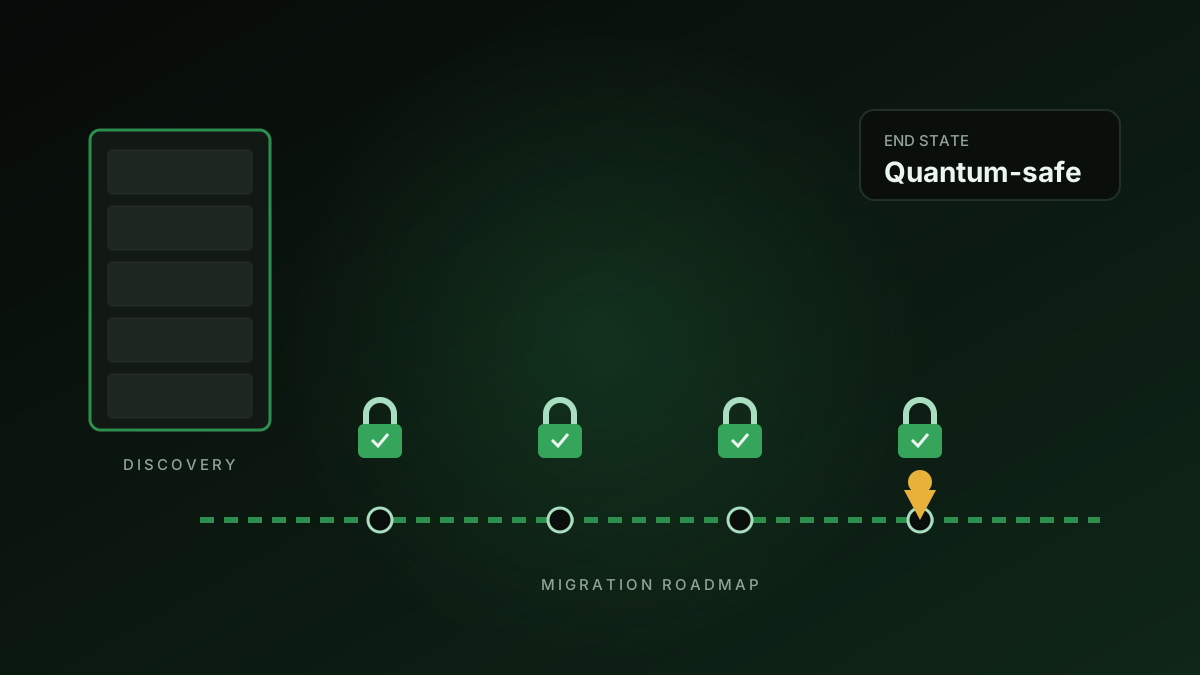
Organizations rarely know how many places RSA and ECC hide — TLS certificates, VPNs, code signing, firmware updates, hardware tokens. The researchers start from a "cryptographic discovery" pass: they analyze TLS data and system dependencies to inventory what actually uses vulnerable crypto and how the pieces depend on each other.
The approach: risk-ranked migration
From that inventory, the team assesses risk and produces a practical, staged migration roadmap — which systems to move first, which dependencies block others, and how to sequence the work so critical services keep running while keys and certificates are swapped for post-quantum algorithms.
That's the difference between the poster's framing and a research toy: discovery grounded in real traffic data, feeding a plan a CISO could actually execute.
Why it matters
Post-quantum standards are already landing, and mandates are following. New Brunswick firms holding government and defence contracts — and the province's cybersecurity cluster that serves them — will need exactly this kind of migration know-how long before the quantum deadline bites. Research like this is how the province keeps its edge as the crypto era turns over.
Sources
- Canadian Institute for Cybersecurity: Research Spotlight post — project summary, authors, and the TLS-data approach
ChronologyCIC· 11 stories since Aug 4, 2026
- Mastercard's Canada Security VP Keynoted CIC's Fredericton Summit — Then Toured the IoT Lab It Funds
- UNB Researchers Threat-Model the Protocols That Let AI Agents Act
Chronology · show all 11 storiesShow fewer
- UNB Researchers Build a Practical Roadmap for the Post-Quantum Migration (this story)
- UNB Poster Weighs the Privacy Cost of Federated-Learning Aggregation
- UNB Researchers Deploy Collaborative AI Agents to Guard Power-Substation Networks
- UNB Researchers Build a Mixture-of-Experts Defence Against Adversarial AI Attacks
- UNB Researchers Make AI Malware Detection Explainable with a 'Dual Prototype' Framework
- UNB Researcher Takes a Geometric Axe to Optimization's Symmetry Problem
- UNB Researcher's 'Trust Passport' Would Stamp Every AI Reply with Its Risk Profile
- National Cyber Agencies and Big Banks Head to Fredericton for UNB's Cybersecurity Summit
- Cybersecurity Pioneer Ali Ghorbani Named to the Order of New Brunswick
Related coverage
News · August 19, 2026
UNB Researchers Threat-Model the Protocols That Let AI Agents Act
News · August 19, 2026
UNB Poster Weighs the Privacy Cost of Federated-Learning Aggregation
News · August 19, 2026
UNB Researchers Deploy Collaborative AI Agents to Guard Power-Substation Networks