
News2 min read
UNB Researchers Build a Mixture-of-Experts Defence Against Adversarial AI Attacks


A Canadian Institute for Cybersecurity poster pairs adversarial training with a nine-expert Mixture-of-Experts architecture that holds up better than prior MoE defences against FGSM and PGD attacks.
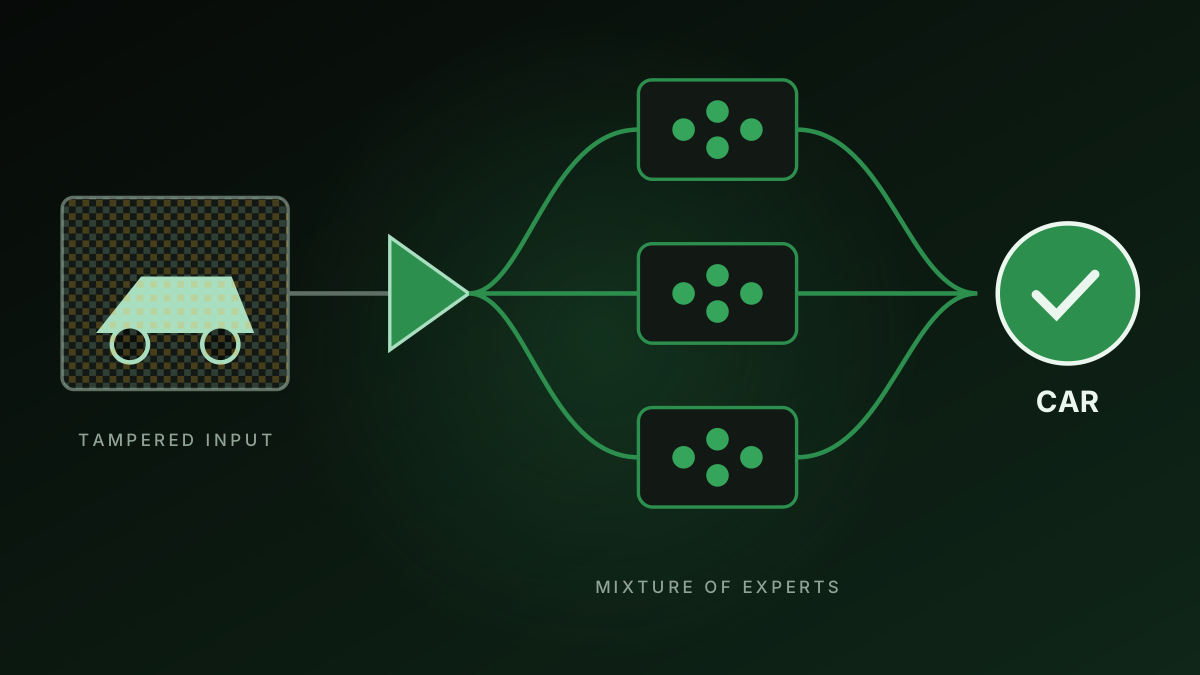
Tiny, nearly imperceptible changes to an input can be enough to fool a machine learning model into misclassifying almost anything — a car, a face, a network packet. Researchers at UNB's Canadian Institute for Cybersecurity are working on a defence that doesn't just patch one model, but spreads the job across several.
Adversarial Attack Mitigation via Mixture-of-Experts, a poster from researchers Mohammad Meymani and Roozbeh Razavi-Far, will be at the institute's PST Cybersecurity Summit 2026 in Fredericton on Aug. 20.
The problem: white-box evasion
The work targets white-box evasion attacks — where an attacker knows the model's internals and crafts inputs designed to push a classification over a wrong answer. The two standard stress tests are FGSM and PGD: fast gradient-sign attacks that perturb an image just enough to flip a model's verdict while remaining invisible to a human eye.
The approach: don't trust one expert
Rather than relying on a single network, the proposed system combines adversarial training with a Mixture-of-Experts (MoE) architecture — nine ResNet-18-based experts that specialise and are routed through a gating mechanism, so the model can lean on the expert best suited to a given input.
In testing on the CIFAR-10 and SVHN image datasets, the researchers report the approach outperformed state-of-the-art MoE-based defences under strong FGSM and PGD attacks.
The poster isn't preliminary work: the method behind it is published in the journal Information Sciences under the title "Divided We Fall", which gives the technique its full name — a soft-gated fractional Mixture-of-Experts trained with randomized adversarial training. The "soft-gated fractional" part matters: rather than handing an input to a single winning expert, the gate blends fractional contributions from several, so an attacker can't craft a perturbation that defeats one specialist and wins the whole verdict.
Why it matters
Adversarial robustness is a practical concern for any AI making security or safety decisions — from spam and malware classification to fraud detection and autonomous perception. New Brunswick's cybersecurity industry has been built on models that must not be easy to fool; the institute's research pipeline is where much of that technique is developed before it reaches local companies. A defence that survives stronger attacks than previous MoE approaches is one more building block for models deployed in hostile environments.
Sources
- Canadian Institute for Cybersecurity: Research Spotlight post — project summary, authors, results on CIFAR-10 and SVHN
- Divided We Fall: Defending against adversarial attacks via soft-gated fractional mixture-of-experts with randomized adversarial training — Meymani and Razavi-Far, Information Sciences, July 2026 (DOI 10.1016/j.ins.2026.123427); the peer-reviewed paper linked from the institute's post
ChronologyCIC· 11 stories since Aug 4, 2026
- Mastercard's Canada Security VP Keynoted CIC's Fredericton Summit — Then Toured the IoT Lab It Funds
- UNB Researchers Threat-Model the Protocols That Let AI Agents Act
Chronology · show all 11 storiesShow fewer
- UNB Researchers Build a Practical Roadmap for the Post-Quantum Migration
- UNB Poster Weighs the Privacy Cost of Federated-Learning Aggregation
- UNB Researchers Deploy Collaborative AI Agents to Guard Power-Substation Networks
- UNB Researchers Build a Mixture-of-Experts Defence Against Adversarial AI Attacks (this story)
- UNB Researchers Make AI Malware Detection Explainable with a 'Dual Prototype' Framework
- UNB Researcher Takes a Geometric Axe to Optimization's Symmetry Problem
- UNB Researcher's 'Trust Passport' Would Stamp Every AI Reply with Its Risk Profile
- National Cyber Agencies and Big Banks Head to Fredericton for UNB's Cybersecurity Summit
- Cybersecurity Pioneer Ali Ghorbani Named to the Order of New Brunswick
Related coverage
News · August 19, 2026
UNB Researchers Threat-Model the Protocols That Let AI Agents Act
News · August 19, 2026
UNB Poster Weighs the Privacy Cost of Federated-Learning Aggregation
News · August 19, 2026
UNB Researchers Deploy Collaborative AI Agents to Guard Power-Substation Networks