
News3 min read
National Cyber Agencies and Big Banks Head to Fredericton for UNB's Cybersecurity Summit


PST Cybersecurity Summit 2026 brings speakers from the Canadian Centre for Cyber Security, Public Safety Canada, DND/CAF Cyber Command, Scotiabank, TD and Mastercard to the Fredericton Convention Centre on Aug. 20 — alongside eight UNB research posters on adversarial AI, malware explainability, agent-protocol security and post-quantum migration.
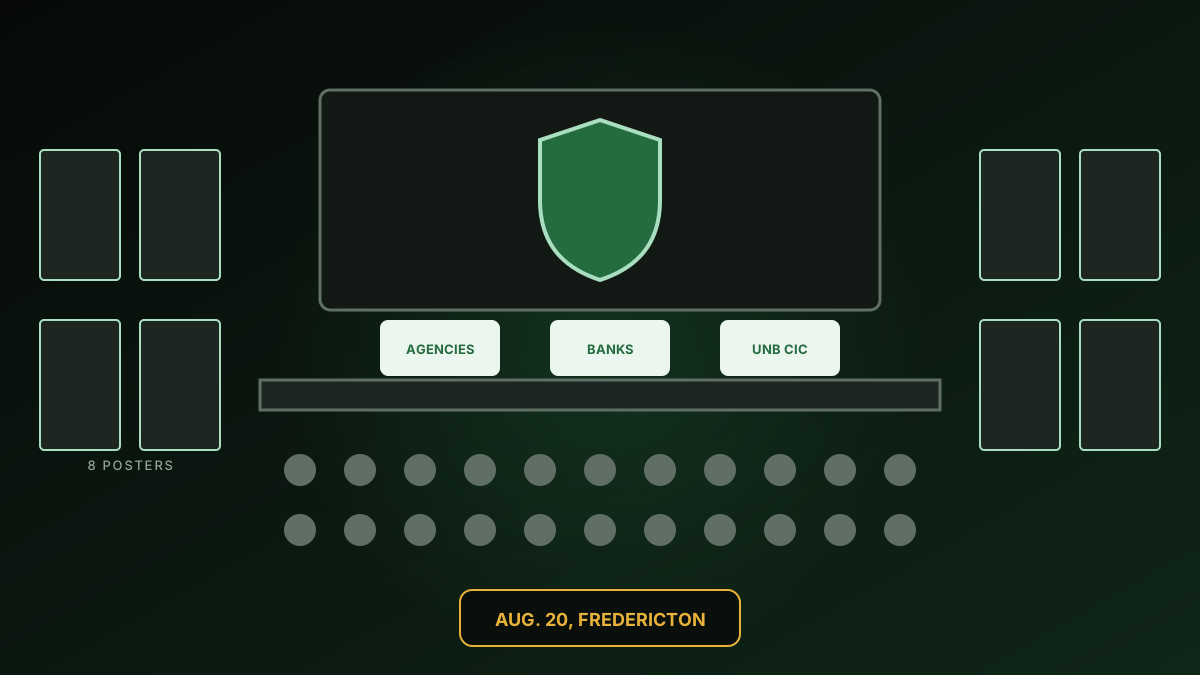
UNB's Canadian Institute for Cybersecurity — the research engine behind Fredericton's cybersecurity cluster — and the PST Network are hosting PST Cybersecurity Summit 2026 at the Fredericton Convention Centre (670 Queen St.) on Aug. 20, with registration open now.
The one-day summit is pitched at leaders from government, industry and academia, with keynotes, panels and networking on emerging threats, cyber resilience and the future of digital trust.
Alongside that programme runs a Research Poster Showcase introducing the institute's graduate students and faculty. The institute has now previewed the full lineup of eight posters on LinkedIn: adversarial AI defence, explainable malware detection, a "trust passport" for enterprise AI, optimization research, AI-agent protocol security, power-grid anomaly detection, privacy-preserving federated learning, and post-quantum migration. The showcase doubles as a window into the talent pipeline that keeps feeding local security firms — the same pipeline behind datasets and graduates that anchor the city's security industry.
Who's in the room
The organizers list speakers and panelists from the Canadian Centre for Cyber Security, Public Safety Canada, and DND/CAF Cyber Command on the government side; Scotiabank, TD Bank, Mastercard, Rogers, Loblaw, and ADGA from industry; plus AWS, the National Research Council, and other universities.
That is a federal-cyber-and-big-bank roster travelling to Fredericton for a single day — and it is the clearest measure of what the institute's presence has bought the city. The talent pipeline runs both directions: the poster wall shows the province's next security researchers, while the panel list shows the national employers and agencies who now treat Fredericton as a place worth flying to.
What's on the poster wall
The eight projects on the poster wall:
- Adversarial Attack Mitigation via Mixture-of-Experts — a defence combining adversarial training with a Mixture-of-Experts architecture, testing stronger against FGSM and PGD attacks than prior MoE defences (Mohammad Meymani and Roozbeh Razavi-Far).
- Prototype-Guided Dual Explanations for GNN-Based Malware Detection — an explainability framework that ties graph-neural-network verdicts to known benign and malicious behaviour patterns (Hossein Shokouhinejad, Razavi-Far, Griffin Higgins, and Ali A. Ghorbani).
- Trust Passport for Enterprise LLM Pipelines — a per-response risk snapshot for AI outputs, flagging shaky retrieval, sensitive-data exposure, risky tool use, and weak factual support (Vidushi Agarwal).
- Geometric Quadratic Separators for Symmetric Integer Programs — a geometric approach to cutting redundant search in symmetric optimization problems (Seyedeh Maryam Abbasnia).
- Security Threat Modeling for Emerging AI-Agent Protocols — hidden security risks in MCP, A2A, Agora, and ANP across their full lifecycles, with an experimental MCP case study showing how identity ambiguity can redirect agent actions (Zeynab Anbiaee, Mahdi Rabbani, Ghorbani, and Sajjad Dadkhah).
- Multi-Agent Anomaly Detection for MMS Communications in IEC 61850 Substations — collaborative AI agents combining structural, semantic, and behavioural analysis to catch anomalies in substation network traffic (Samane Bidabadi, Shokouhinejad, and Kwasi Boakye-Boateng).
- The Cost of Privacy: PRG and RLWE-Based Secure Aggregation Methods for Federated Learning — a head-to-head of the two dominant secure aggregation frameworks, with post-quantum resilience and up to an 8x local encoding speedup on the RLWE side (Abhijat Sharma and Kalikinkar Mandal).
- From Cryptographic Discovery to a Post-Quantum Migration Roadmap — TLS data and system dependencies used to assess risk and build a practical migration roadmap (Amir Hassanpour Zarghani, Vikas Chouhan, and Ghorbani).
How to attend
Registration is open on the summit site. The summit runs Aug. 20 at the Fredericton Convention Centre; the institute previewed the full eight-poster lineup in the days leading up to it.
It's a busy August for the institute: founding director Ali Ghorbani was named to the Order of New Brunswick earlier this month, and the Fredericton summit is the warm-up act for the academic side of the same network — the 23rd annual Privacy, Security and Trust (PST) conference runs Aug. 26–28 at the University of Ottawa, co-located this year with Selected Areas in Cryptography (SAC 2026).
Sources
- Canadian Institute for Cybersecurity: Research Spotlight post (first batch) — event details, first four posters, date and venue
- Canadian Institute for Cybersecurity: Research Spotlight post (second batch) — final four posters completing the lineup
- PST Cybersecurity Summit 2026 registration — official summit registration (linked from the post)
- PST Conference | Canadian Institute for Cybersecurity — institute's PST conference series page
- PST2026 — 23rd Privacy, Security, and Trust Annual International Conference — summit co-host, Aug. 20 Fredericton summit listing and speaker organizations; Ottawa conference format and SAC 2026 co-location
- PST2026 Industry Day — Fredericton Convention Centre — venue listing, date and street address
ChronologyCIC· 11 stories since Aug 4, 2026
- Mastercard's Canada Security VP Keynoted CIC's Fredericton Summit — Then Toured the IoT Lab It Funds
- UNB Researchers Threat-Model the Protocols That Let AI Agents Act
Chronology · show all 11 storiesShow fewer
- UNB Researchers Build a Practical Roadmap for the Post-Quantum Migration
- UNB Poster Weighs the Privacy Cost of Federated-Learning Aggregation
- UNB Researchers Deploy Collaborative AI Agents to Guard Power-Substation Networks
- UNB Researchers Build a Mixture-of-Experts Defence Against Adversarial AI Attacks
- UNB Researchers Make AI Malware Detection Explainable with a 'Dual Prototype' Framework
- UNB Researcher Takes a Geometric Axe to Optimization's Symmetry Problem
- UNB Researcher's 'Trust Passport' Would Stamp Every AI Reply with Its Risk Profile
- National Cyber Agencies and Big Banks Head to Fredericton for UNB's Cybersecurity Summit (this story)
- Cybersecurity Pioneer Ali Ghorbani Named to the Order of New Brunswick
Related coverage
News · August 19, 2026
UNB Researchers Threat-Model the Protocols That Let AI Agents Act
News · August 19, 2026
UNB Poster Weighs the Privacy Cost of Federated-Learning Aggregation
News · August 19, 2026
UNB Researchers Deploy Collaborative AI Agents to Guard Power-Substation Networks