
News1 min read
UNB Poster Weighs the Privacy Cost of Federated-Learning Aggregation


Canadian Institute for Cybersecurity research pits PRG masking against RLWE homomorphic encoding for secure aggregation, finding post-quantum resilience and an 8x local encoding speedup — plus a client-side privacy trade-off.
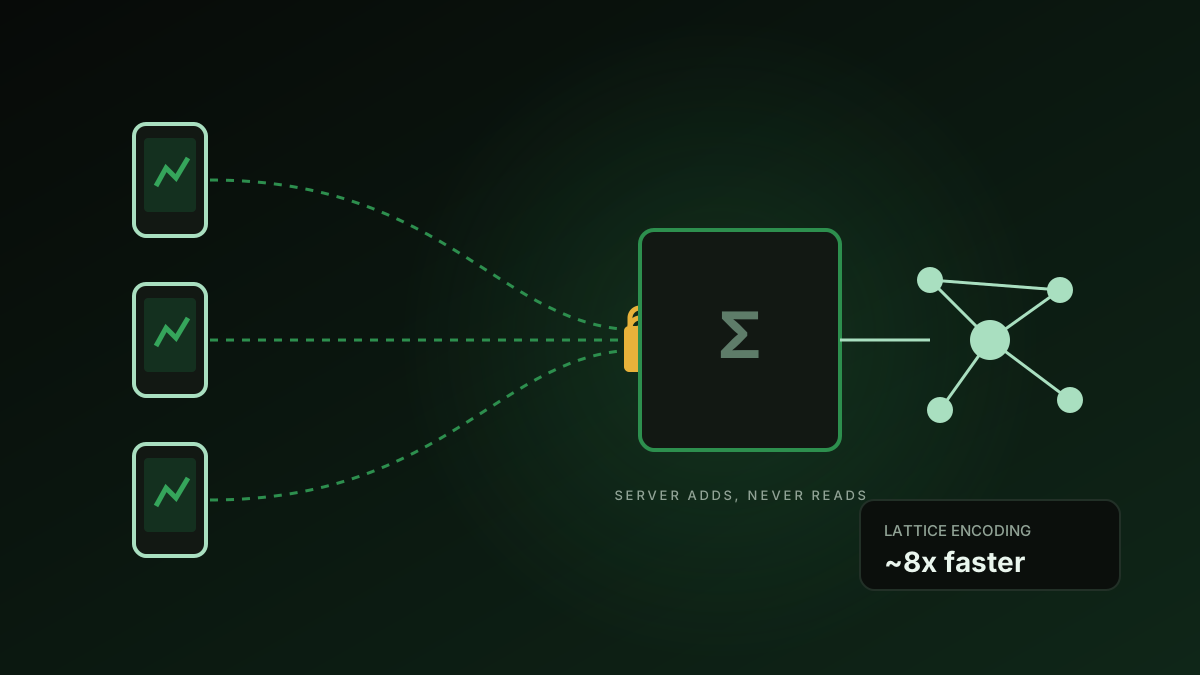
Federated learning lets many devices train one AI model without ever shipping their raw data to a central server. The catch: even aggregated model updates can leak private details — which is why secure aggregation exists. A poster from UNB's Canadian Institute for Cybersecurity asks what that privacy actually costs.
The Cost of Privacy: PRG and RLWE-Based Secure Aggregation Methods for Federated Learning, by Abhijat Sharma and Kalikinkar Mandal, compares the two dominant approaches head-to-head. It will be on the wall at the PST Cybersecurity Summit 2026 in Fredericton on Aug. 20.
Two ways to mask the updates
- PRG-SecAgg masks client updates with pseudo-random noise that cancels out when aggregated. It stays highly effective for low-compute mobile networks, but dropout — clients disconnecting mid-round — triggers complex reconstruction, and the approach offers no post-quantum security.
- RLWE-SecAgg encodes updates homomorphically using lattice-based cryptography. It brings post-quantum resilience and natural threshold decryption, and its optimal client complexity delivers up to an 8x local encoding speedup for dense model parameters.
The trade-off the poster names
The RLWE route isn't free. Adding non-interactive zero-knowledge proofs to validate client inputs introduces a real "privacy cost trade-off" through client-side overhead. In other words: the stronger the cryptographic guarantees, the heavier the load on the very devices doing the federated learning.
Why it matters
Federated learning is how hospitals, banks, and phone makers train on sensitive data without centralizing it — and New Brunswick has direct skin in that game: the institute's own researchers built the datasets and methods that anchor Fredericton's cybersecurity cluster. Choosing the wrong aggregation scheme today means either weak privacy or unusable mobile performance tomorrow — or a costly migration when quantum computers arrive.
Sources
- Canadian Institute for Cybersecurity: Research Spotlight post — project summary, authors, and the PRG vs. RLWE comparison
ChronologyCIC· 11 stories since Aug 4, 2026
- Mastercard's Canada Security VP Keynoted CIC's Fredericton Summit — Then Toured the IoT Lab It Funds
- UNB Researchers Threat-Model the Protocols That Let AI Agents Act
Chronology · show all 11 storiesShow fewer
- UNB Researchers Build a Practical Roadmap for the Post-Quantum Migration
- UNB Poster Weighs the Privacy Cost of Federated-Learning Aggregation (this story)
- UNB Researchers Deploy Collaborative AI Agents to Guard Power-Substation Networks
- UNB Researchers Build a Mixture-of-Experts Defence Against Adversarial AI Attacks
- UNB Researchers Make AI Malware Detection Explainable with a 'Dual Prototype' Framework
- UNB Researcher Takes a Geometric Axe to Optimization's Symmetry Problem
- UNB Researcher's 'Trust Passport' Would Stamp Every AI Reply with Its Risk Profile
- National Cyber Agencies and Big Banks Head to Fredericton for UNB's Cybersecurity Summit
- Cybersecurity Pioneer Ali Ghorbani Named to the Order of New Brunswick
Related coverage
News · August 19, 2026
UNB Researchers Threat-Model the Protocols That Let AI Agents Act
News · August 19, 2026
UNB Researchers Deploy Collaborative AI Agents to Guard Power-Substation Networks
News · August 18, 2026
UNB Researchers Build a Mixture-of-Experts Defence Against Adversarial AI Attacks