
News4 min read
Mastercard's Canada Security VP Keynoted CIC's Fredericton Summit — Then Toured the IoT Lab It Funds


Amisha Parikh spoke at UNB's Aug. 20 cybersecurity summit, sat on a panel with CIC and the NRC, and walked the Mastercard-CIC IoT laboratory the company has backed since 2022.
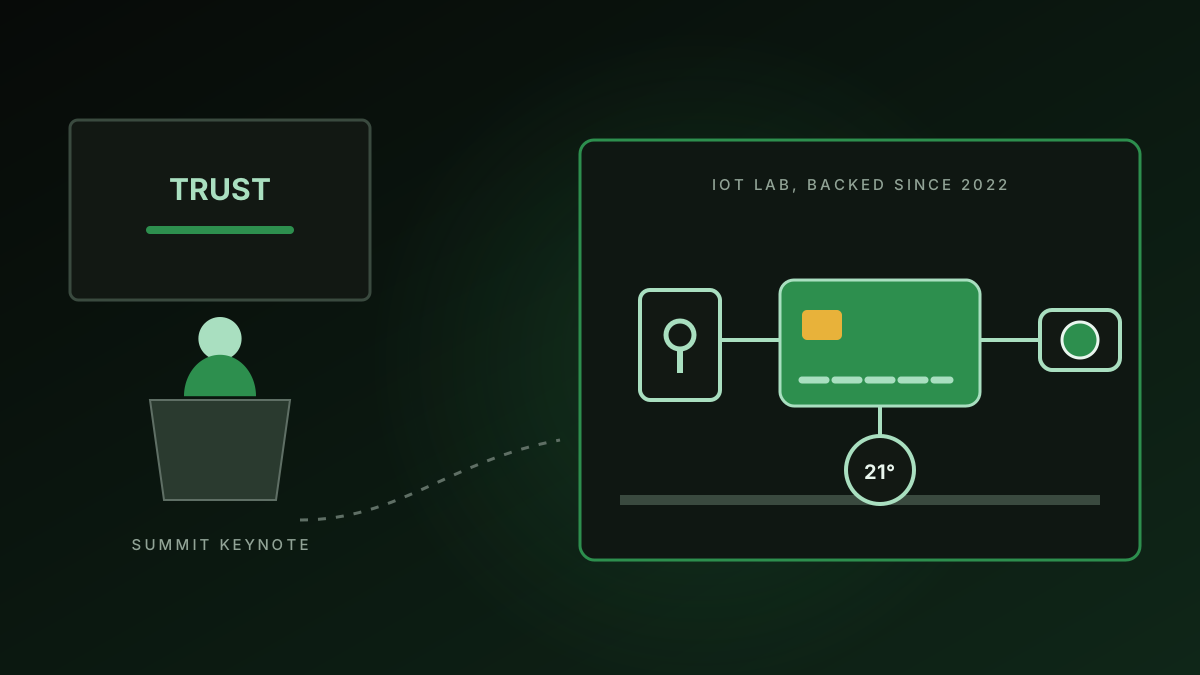
Mastercard has posted a recap of this year's Cybersecurity Summit in Fredericton, hosted by UNB's Canadian Institute for Cybersecurity. Amisha Parikh, the company's vice-president of security solutions in Canada, gave a keynote on how embedded intelligence is changing the trust equation — and why, in Mastercard's telling, cybersecurity is now a strategic enabler of innovation and growth, not only a risk control.
She also sat on a panel with leaders from TD, the institute, and the National Research Council. After the programme, the Mastercard team toured CIC labs supported by Mastercard. That last detail is the New Brunswick story: this was not a fly-in logo on a speaker slide. The company already pays for a lab on that campus.
We previewed the summit before Aug. 20 as a federal-cyber-and-big-bank day at the Fredericton Convention Centre. Mastercard was on the industry list. The recap names the person who actually spoke, the panel she joined, and the lab walk that followed.
What Mastercard says it said
The company did not publish a transcript. Its own framing is that AI-era systems have to be secure, accountable, and trusted under real-world conditions, and that trust now shapes adoption, partnership, and investment. Treat that as the sponsor's summary of its own keynote, not independent reporting of the room.
The panel composition matches the summit's original pitch: banks, the institute, and a federal lab in the same conversation. TD and the NRC were already on the organizers' speaker roster.
The lab they walked
CIC's site calls it the Mastercard-CIC IoT Laboratory — a testbed for consumer and industrial connected devices, with wearable, smart-home, and smart-grid bays, a Faraday cage, and the protocol mix (Wi-Fi, Bluetooth, Z-Wave, ZigBee, plus industrial buses) that those devices actually use. Researchers replicate networks in the room, generate datasets, and run AI against the traffic. The lab also feeds the institute's Master of Applied Cybersecurity and RICS training programmes.
UNB and Mastercard announced $1.75 million for that work in April 2022: lab sponsorship, an IoT research chair, and student scholarships. ACOA had already put money into the physical build. The first chair was Rongxing Lu. Sajjad Dadkhah — a CIC research lead who appeared on the summit's AI-agent protocol poster — took the chair in January 2025. His stated brief is IoT security in finance, health, and infrastructure, plus phishing detection, identity on financial platforms, and training.
Mastercard's recap also pointed at its Global Intelligence and Cyber Centre of Excellence in Vancouver — a company hub in B.C., not the Fredericton firm of a similar name. UNB's 2022 release put that Canadian investment at $510 million. The Fredericton piece of the same network is smaller and more specific: a named lab and chair inside CIC.
What a sponsored lab buys
The arrangement CIC has with Mastercard is the one most university research centres want and few get: not a one-off project grant, but a named facility, a funded chair, and a standing research relationship that a corporate sponsor keeps choosing to renew.
It is also a relationship with obligations in both directions. Mastercard gets a testbed it does not have to build, run by people who publish — CIC's datasets are used well beyond Fredericton — and a recruiting channel into the Master of Applied Cybersecurity cohort. The institute gets equipment, a chair line it does not have to fund from operating budget, and a sponsor whose problems are real ones. Dadkhah's stated brief, IoT security in finance and health plus identity on financial platforms, reads exactly like a payments company's concern list.
The risk in that trade is the obvious one, and it is worth naming rather than assuming away: research priorities set by a sponsor's product roadmap are narrower than research priorities set by a field. CIC is large enough — Ali Ghorbani, its founding director, was named to the Order of New Brunswick earlier this summer — that the Mastercard lab is one program among many rather than the institute's centre of gravity. That is what makes the arrangement sustainable rather than captive.
What the recap does not establish is anything about the keynote's content beyond what Mastercard chose to say about it. The company published no transcript, and the summit's organizers have not posted one. The verifiable facts are the attendance, the panel, and the tour.
Sources
- Mastercard: Cybersecurity Summit 2026 recap — Parikh keynote framing, TD / CIC / NRC panel, lab tour of Mastercard-supported CIC facilities
- PST Cybersecurity Summit 2026 — NB Tech News preview — Aug. 20 Fredericton Convention Centre event, industry roster including Mastercard
- Mastercard-CIC IoT Laboratory — lab name, purpose, wearable / smart-home / smart-grid bays, Faraday cage, training programmes
- UNB and Mastercard announce $1.75 million — April 11, 2022 funding, chair, scholarships, Vancouver centre figure
- Meet the chair: Sajjad Dadkhah — Mastercard IoT Research Chair from January 2025; research brief
- Mastercard Vancouver Tech Hub — company page for the Global Intelligence and Cyber Centre of Excellence
- PST2026 conference site — summit co-host listing and speaker organizations
ChronologyCIC· 11 stories since Aug 4, 2026
- Mastercard's Canada Security VP Keynoted CIC's Fredericton Summit — Then Toured the IoT Lab It Funds (this story)
- UNB Researchers Threat-Model the Protocols That Let AI Agents Act
Chronology · show all 11 storiesShow fewer
- UNB Researchers Build a Practical Roadmap for the Post-Quantum Migration
- UNB Poster Weighs the Privacy Cost of Federated-Learning Aggregation
- UNB Researchers Deploy Collaborative AI Agents to Guard Power-Substation Networks
- UNB Researchers Build a Mixture-of-Experts Defence Against Adversarial AI Attacks
- UNB Researchers Make AI Malware Detection Explainable with a 'Dual Prototype' Framework
- UNB Researcher Takes a Geometric Axe to Optimization's Symmetry Problem
- UNB Researcher's 'Trust Passport' Would Stamp Every AI Reply with Its Risk Profile
- National Cyber Agencies and Big Banks Head to Fredericton for UNB's Cybersecurity Summit
- Cybersecurity Pioneer Ali Ghorbani Named to the Order of New Brunswick
Related coverage
News · August 19, 2026
UNB Researchers Threat-Model the Protocols That Let AI Agents Act
News · August 19, 2026
UNB Poster Weighs the Privacy Cost of Federated-Learning Aggregation
News · August 19, 2026
UNB Researchers Deploy Collaborative AI Agents to Guard Power-Substation Networks