
News1 min read
UNB Researchers Deploy Collaborative AI Agents to Guard Power-Substation Networks


A Canadian Institute for Cybersecurity poster pairs specialized AI agents that read structure, semantics, and behaviour to catch anomalies in IEC 61850 substation traffic that single detectors miss.
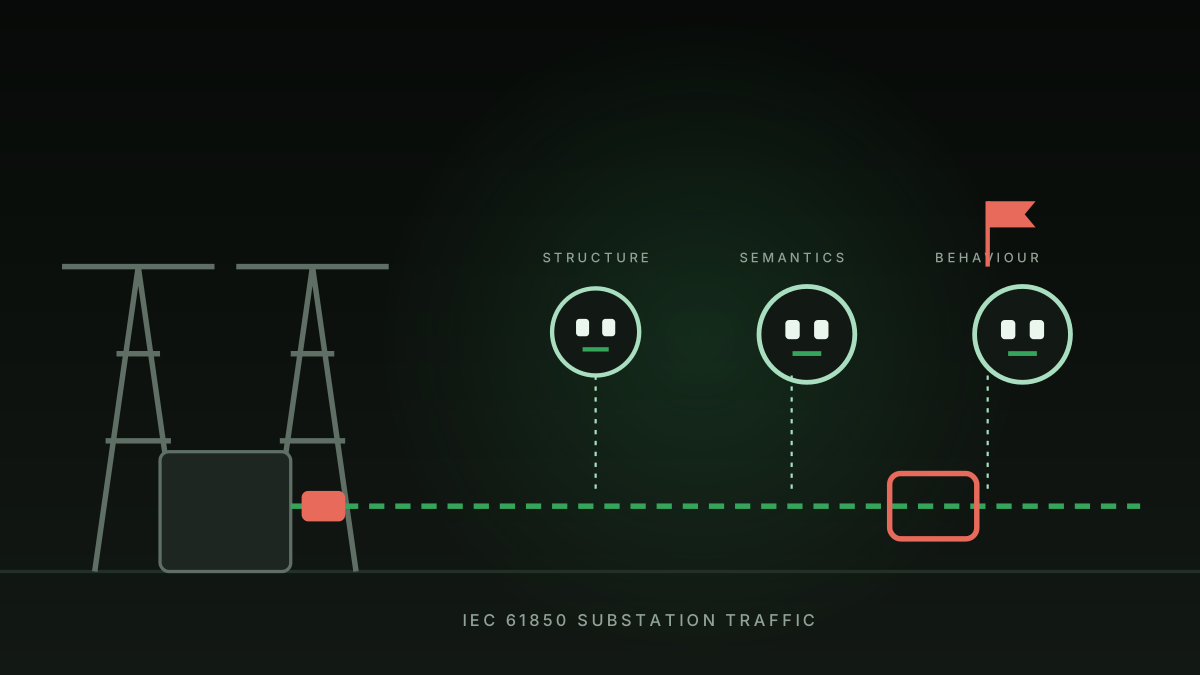
Power substations are becoming networked computers, and their network traffic is now a security battleground. A poster from UNB's Canadian Institute for Cybersecurity argues the best defence may be a team of specialized AI agents working together.
Multi-Agent Anomaly Detection for MMS Communications in IEC 61850 Substations, by Samane Bidabadi, Hossein Shokouhinejad, and Kwasi Boakye-Boateng, will be on the wall at the PST Cybersecurity Summit 2026 in Fredericton on Aug. 20.
The problem: traffic that only makes sense in context
Modern substations run on IEC 61850, the standard that lets protection relays, meters, and control systems exchange messages over networks using MMS (Manufacturing Message Specification). Monitoring that traffic is hard: a packet is only meaningful when you understand the network it travels on and what the substation is trying to do operationally. Conventional detectors that look at one layer at a time miss suspicious activity that only shows up across all of them.
The approach: agents that split the work
The proposed framework assigns the job to specialized AI agents, each responsible for a different lens:
- a structural agent reads the network traffic itself
- a semantic agent understands what the messages mean
- a behavioural agent tracks operational intent — what the substation is supposed to be doing
Working together, the agents combine those views into a single anomaly verdict. The researchers report the collaborative setup outperforms individual agents, catching suspicious activities that conventional methods overlook.
Why it matters
Grid operators are digitizing the same critical infrastructure that New Brunswick utilities are already interconnecting across the region — and anomaly detection that understands both the network and the operation is exactly what a modern control room needs. It's also a reminder that Fredericton's security research cluster is reaching well beyond the IT perimeter into industrial and operational technology.
Sources
- Canadian Institute for Cybersecurity: Research Spotlight post — project summary, authors, and the multi-agent approach
ChronologyCIC· 11 stories since Aug 4, 2026
- Mastercard's Canada Security VP Keynoted CIC's Fredericton Summit — Then Toured the IoT Lab It Funds
- UNB Researchers Threat-Model the Protocols That Let AI Agents Act
Chronology · show all 11 storiesShow fewer
- UNB Researchers Build a Practical Roadmap for the Post-Quantum Migration
- UNB Poster Weighs the Privacy Cost of Federated-Learning Aggregation
- UNB Researchers Deploy Collaborative AI Agents to Guard Power-Substation Networks (this story)
- UNB Researchers Build a Mixture-of-Experts Defence Against Adversarial AI Attacks
- UNB Researchers Make AI Malware Detection Explainable with a 'Dual Prototype' Framework
- UNB Researcher Takes a Geometric Axe to Optimization's Symmetry Problem
- UNB Researcher's 'Trust Passport' Would Stamp Every AI Reply with Its Risk Profile
- National Cyber Agencies and Big Banks Head to Fredericton for UNB's Cybersecurity Summit
- Cybersecurity Pioneer Ali Ghorbani Named to the Order of New Brunswick
Related coverage
News · August 19, 2026
UNB Researchers Threat-Model the Protocols That Let AI Agents Act
News · August 19, 2026
UNB Poster Weighs the Privacy Cost of Federated-Learning Aggregation
News · August 18, 2026
UNB Researchers Build a Mixture-of-Experts Defence Against Adversarial AI Attacks