
News3 min read
Ottawa Funds PEI–NB Cable Prep as Maritime Premiers Sign an Electricity Pact


$5.9 million starts engineering for two new 200 MW subsea links, while NB, NS, and PEI agree to plan the regional grid together through spring 2027.
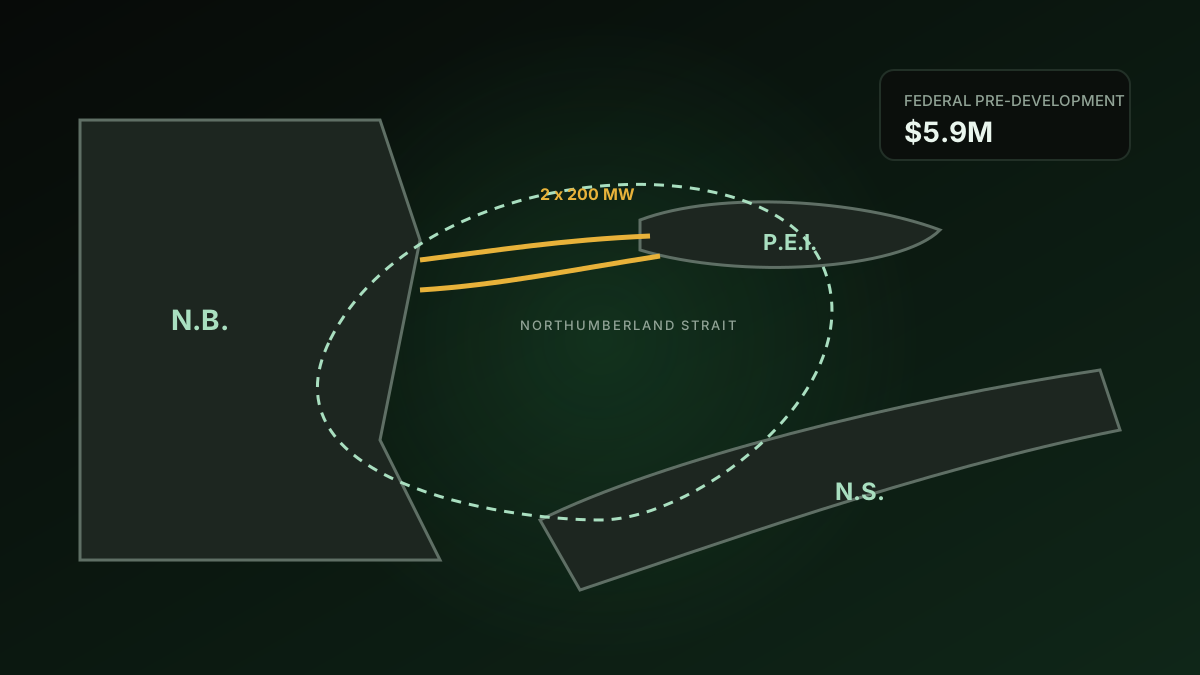
On the same day in Charlottetown, New Brunswick got two pieces of electricity news that belong together: federal money to prepare new underwater cables to Prince Edward Island, and a three-province memorandum of understanding to plan the Maritime grid as a region.
Two new cables, $5.9 million to start
Ottawa is putting $5.9 million into pre-development work on the Prince Edward Island–New Brunswick Interconnection Expansion Project — two new 200 MW, 138 kV submarine cables plus transmission and substation upgrades on both sides of the Northumberland Strait.
The money flows to the PEI Energy Corporation from the federal Smart Renewables and Electrification Pathways program. It pays for engineering studies, marine surveys, environmental assessments, Indigenous and stakeholder engagement, regulatory work, and preliminary route and substation design — not the full build. Construction groundwork is targeted to begin by 2028, according to the joint federal–provincial materials. The total project cost has not been published; Premier Rob Lantz told CBC the exact scope will firm up during pre-development.
PEI already depends on four subsea cables to New Brunswick. The Cape Tormentine–Borden-Carleton pair was replaced in 2017; the older Murray Corner–Richmond Cove pair dates to the late 1970s and is nearing end of life. Premier Susan Holt, welcoming the federal investment, cast New Brunswick as the Maritimes’ “energy hub” and stressed securing and strengthening interties with PEI.
A Maritime electricity MOU
Also on July 23, Holt signed an MOU with Nova Scotia Premier Tim Houston and PEI’s Lantz — with Natural Resources Canada as a partner — on Maritime regional electricity co-operation and system integration.
The agreement is planning infrastructure, not a new generating station. The provinces will develop a Maritime Regional Resource and Transmission Roadmap, weigh closer operational co-ordination, and study options that include a regional balancing authority and a possible Maritime Independent Electricity System Operator (MIESO). GNB’s release targets a roadmap and implementation plan by spring 2027; the fuller MOU text phases work through fall 2026 and spring 2027. Utilities expected to feed the process include NB Power, NS Power, Maritime Electric, and IESO Nova Scotia.
Holt’s public framing leaned on New Brunswick’s “leadership in nuclear energy” and stronger electricity interties — language that positions the province as a regional hub without announcing a new reactor or a new NB–NS line in this package.
Why it is a tech story
Cables and control rooms are not startups, but they are the substrate every data centre, factory, and electrification plan eventually hits. For New Brunswick, the July 23 package is concrete on the PEI interconnect path and procedural on the regional market design — both of which will decide how much spare capacity exists when the next large load asks for a hookup.
Sources
- Federal government spending $5.9M for prep work on 2 new P.E.I.-N.B. subsea power cables — CBC — funding amount, 2028 construction groundwork, PEI cable context, Lantz comments
- Canada invests in the Prince Edward Island–New Brunswick Interconnection Expansion Project — PEI / federal joint release — 2×200 MW / 138 kV scope, SREPs funding, Holt quote, prep-work uses
- Canada invests in the PEI–NB Interconnection Expansion Project — NRCan via Cision — federal release mirror
- New Brunswick advances Maritime co-operation to build Canada's electricity future — GNB — MOU signing, Holt quotes, spring 2027 roadmap framing
- Maritime Regional Electricity Co-operation and System Integration — GNB MOU page — MIESO / balancing-authority study language, phase timing
- Maritime provinces, federal government explore electricity co-operation — Nova Scotia — joint provincial framing
Related coverage
News · July 26, 2026
Cookville’s 150 MW Solar Plan Still Needs a Buyer for the Electrons
News · October 9, 2026
Fredericton Firm Pitches Miramichi a 375-Megawatt Data Centre Campus
News · October 5, 2026
Belledune Partners Pick BWXT's BANR for a Transportable Nuclear Plant