
News7 min read
Fredericton Firm Pitches Miramichi a 375-Megawatt Data Centre Campus


Faster Than Light told council a 100-megawatt first phase could be running by the end of 2027. A separate 50-megawatt request for Saint John was already in provincial files.
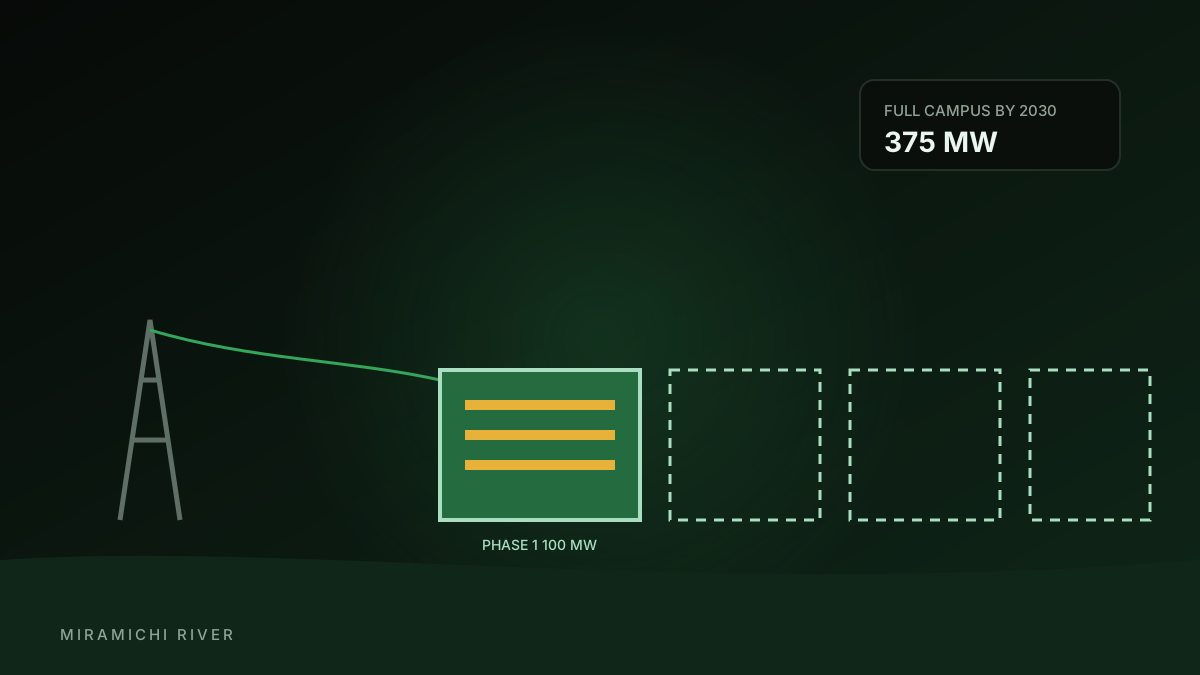
Faster Than Light, a Fredericton company that sells itself as Canadian sovereign AI colocation, presented a 375-megawatt data-centre campus to Miramichi city council this week. Chief executive Josh Vautour told council the first phase would be a 100-megawatt data centre, aimed at operation by the end of 2027, with the full campus targeted for 2030. CBC and the Telegraph-Journal both reported the presentation. The company has not named a site.
The numbers on the slide deck
Vautour calls the project a colocation data centre: an AI-capable building that would rent space to tenants, including governments, banks, and defence-related customers. He told CBC he would not group it with a hyperscale build run by a company such as Meta. The Telegraph-Journal's lede still describes the pitch as a $2.7 billion hyperscale data centre. The $2.7 billion figure, 600 permanent jobs at full buildout, and $50 million a year in municipal property tax are the proponents' claims, as the Telegraph-Journal reported them. Phase one, Vautour told council, would mean 150 permanent jobs. The second phase would add 2,000 temporary construction jobs and bring the permanent total to 600, CBC reported. The company's own deck splits the money as $700 million for phase one and $2.7 billion for the full campus, and puts municipal tax at $13 million a year after phase one. One slide in the same deck says "500+ permanent jobs"; the next says 600.
The written presentation, as the Telegraph-Journal describes it, looks for more than 100 acres of brownfield already zoned heavy industrial, with roads, utilities, and highway or rail access, "to limit impact on habitats, wetlands and watercourses." Vautour told the paper he is also looking at other New Brunswick campuses on former industrial land. He said NB Power had pointed the company toward the northeast, "between here and Dalhousie." The deck says the campus would add demand "in an area where power infrastructure is underutilized" and promises more than $250 million a year to NB Power at full buildout. Vautour told council there would be "no impact" on NB Power customers, and told CBC the project would "significantly contribute to rate stabilization" for the utility. The pitch includes on-site backup so the utility could curtail the load: "If for two hours on a really cold Tuesday morning in February NB Power starts facing a challenge of a blackout, they can turn us off as a customer and we have a full back-up system that they can run." He told Brunswick News that first-phase backup would likely be multi-fuel generators running on natural gas or diesel, and that the fuel is not decided. Later expansion, he said, would mean working with clean-energy developers.
CBC reported a water line from the same deck: the initial 100-megawatt centre would use about two million litres over five years. Spread evenly, that is on the order of 1,100 litres a day. The deck's explanation is a closed loop — water "circulated, not evaporated," topped up like a car radiator — and it charts the figure against a single home (one million litres over five years) and an Olympic pool (20 million). It also offers up to 300 megawatts of surplus heat at 45 to 60 degrees Celsius, at no cost, for greenhouses, district heating, or light industry. Those are the company's design claims.
Vautour also told CBC the centre would be inaudible beyond 150 metres, and that a shareholder agreement gives Canadians voting control and requires a board that is more than half Canadian. Proponents have committed that at least 25 percent of the project will be owned by one or more Indigenous partners. Jim Ward, general manager of the North Shore Mi'kmaq Tribal Council, appeared with Vautour at council and backed the regional economic case. That appearance is support. It is not, in the reporting, a signed ownership agreement with a named nation.
City staff told CBC the presentation was informational and that there is "no impetus for public engagement at this time." Coun. Lori Matchett wrote on Facebook that council has not decided to rezone land to heavy industry for AI data centres. In July, the same council paused a bylaw that would have allowed data centres in heavy-industrial zones and cancelled an August hearing. Vautour told Brunswick News he hopes to announce a site in the coming month, but wants public consultation done before site selection is final.
A second Saint John file, already in April
The same Telegraph-Journal story pairs Miramichi with a proposal Lorneville residents pulled out of an Opportunities New Brunswick file. On April 28, Cross River Infrastructure Partners managing director Rishi Jain wrote ONB minister Luke Randall about a "new large-scale data centre campus" in Saint John, "structured around an initial request for 50 MW of network-firm power service," with room to expand. Jain's email said the project could offer "sovereign hosting capacity and future transatlantic connectivity opportunities." A February note from the Regional Development Corporation said the company wanted a site walk of the Spruce Lake Industrial Park expansion and was watching the Beacon AI Centres and VoltaGrid project. That 390-megawatt proposal, already in environmental review, is the one the September policy consultation sat beside.
Randall confirmed to Brunswick News that ONB is "aware of interest in developing a large-scale data centre in the Saint John Industrial Park," and added that "discussions with a company do not necessarily mean that a project will move forward." The email names the Saint John Industrial Park, not a specific park within it. Saint John mayor Donna Reardon told CBC that if a buyer purchases industrial land without needing a zoning change, the city may not know until there is a permit application. Cross River, which has offices in the United States and Canada, did not answer CBC or Brunswick News. Chris Watson of Save Lorneville called the right-to-information route "very concerning" and said cumulative effects — power, noise, lighting, wetlands — have to be assessed together.
The comment window is already shut
Public input on the province's draft data-centre framework closed October 2. Megan Mitton, the Green Party's deputy leader and MLA for Tantramar, wants the province to publish how many AI data-centre proposals it is looking at, and where, at what size, and with what power plan. "The Holt government has claimed they're going to be extremely transparent and we're seeing the opposite of that in many cases, including when it comes to data centres," she told the Telegraph-Journal. She has also asked for a moratorium on hyperscale projects until legislation covers electricity prices, the environment, and host communities, CBC reported.
ONB did not give Brunswick News the list. Randall pointed back at the framework and said a more detailed update is expected by November, once the comments are reviewed. Rebecca Howland, speaking for the Department of Post-Secondary Education, Training and Labour, gave CBC the same timeline.
None of this is a permit, a power contract, or a tax assessment. Miramichi has a slide deck and no address. Saint John has an April email, a minister who says talks are not a project, and a mayor who says the city might not hear of a sale until someone applies for a permit. The 600 jobs, the $50 million tax figure, the rate-stabilization promise, and the two-million-litre water claim are the company's account of a campus that has not been sited.
Sources
- Miramichi data centre would eventually create 600 permanent jobs, company says — CBC — October 9, 2026: Vautour; 100 MW by the end of 2027 and 150 permanent jobs; 375 MW and 600 permanent jobs plus 2,000 construction jobs by 2030; $2.7 billion local investment; colocation framing; rate-stabilization claim; about two million litres of water over five years; 150-metre noise claim; Canadian voting control; 25 percent Indigenous ownership commitment; staff call the presentation informational; Matchett on zoning
- Two more data centre proposals come to light in N.B. — Telegraph-Journal — October 9, 2026: $50 million annual municipal property-tax claim; NB Power siting between Miramichi and Dalhousie; "no impact" on customers; curtailment and gas-or-diesel backup; brownfield search; Jim Ward; site announcement hoped for in the coming month; Cross River's April 28 email and Rishi Jain; Randall's caveat; Mitton on disclosure; November update
- FTL Miramichi city council presentation (PDF) — company deck dated October 2026: $700 million phase one and $2.7 billion full campus; $13 million and $50 million annual municipal tax claims; "500+" and 600 permanent-job slides; closed-loop water comparison; surplus-heat offer; $250 million-plus a year to NB Power; brownfield site criteria
- Saint John residents concerned about prospect of 2nd large-scale data centre — CBC — October 5, 2026: 50 MW firm-power request; Randall confirms discussions; Reardon says the city may not know of an industrial-land purchase until a permit application; Watson on cumulative effects; Lauren Smith on water and regulation
- Deputy Green leader wants province to reveal number of data centre proposals — CBC — October 8, 2026: Mitton on a moratorium and enforceability; Howland says a fuller update is expected by November; ONB had not provided a count by publication
- Miramichi pauses a data-centre bylaw — July 2026: council shelved the heavy-industrial amendment and cancelled the August 4 hearing
- Province asks for comment on how data centres get built here — September 1 to October 2 consultation, including the Spruce Lake 390 MW context
Related coverage
News · September 1, 2026
Province Asks for Comment on How Data Centres Get Built Here
News · July 26, 2026
Miramichi Hits Pause on Zoning That Would Let Data Centres Into Heavy Industry
News · October 2, 2026
McKenna Institute Pulls District Tech Leads to Chelmsford to Scale Teacher Upskilling