
News4 min read
McKenna Institute Pulls District Tech Leads to Chelmsford to Scale Teacher Upskilling


Tech coordinators and coaches from every anglophone district spent two days with the McKenna Institute, EECD, and the Centre of Excellence for Digital Innovation on the Miramichi.
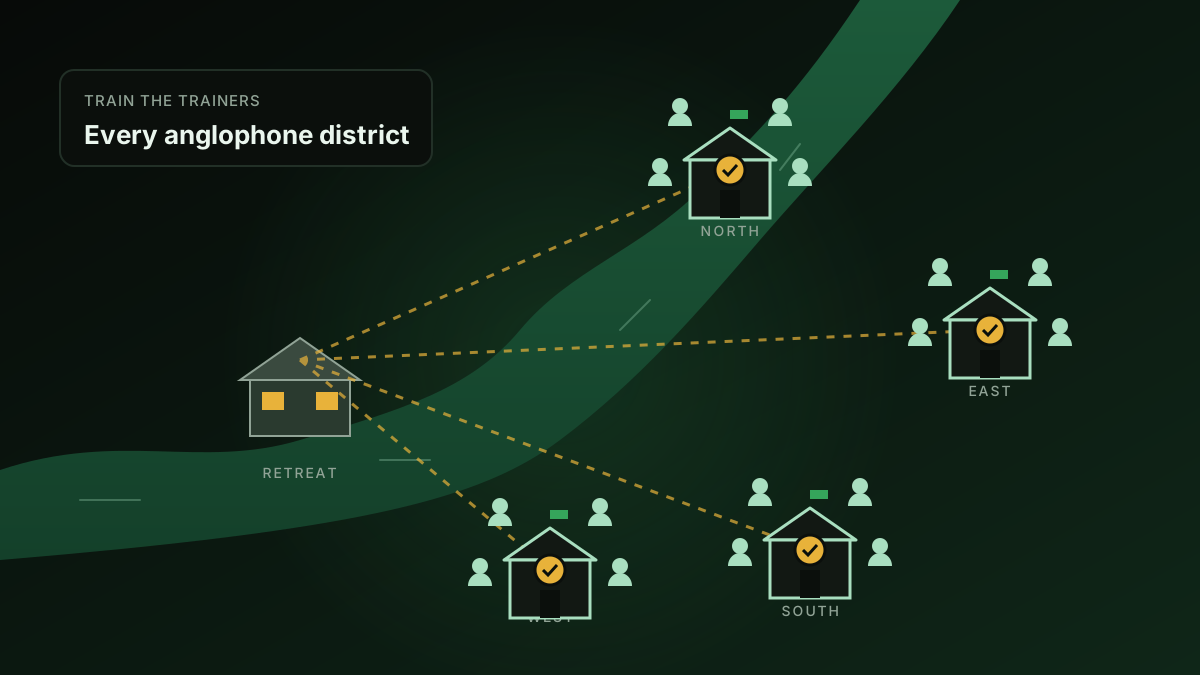
Tech coordinators and tech coaches from every anglophone school district spent two days on the Southwest Miramichi with the McKenna Institute, the Department of Education and Early Childhood Development, and the New Brunswick Centres of Excellence in Digital Innovation. The institute posted the recap Friday as the 2026 Tech Leads Retreat, held at Four Nature Resort in Chelmsford — a 150-acre property about twenty minutes from the City of Miramichi, not the English one.
The room was the people who train the trainers. The institute says the group reviewed last year’s progress and planned how district tech teams will support teachers on classroom technology and AI. The highlight it named was the Educator Up-Skilling Program: success stories from the last year, and “ambitious plans” to expand the work so every district tech team can deliver the professional learning teachers are supposed to get.
Not the August teacher conference
This is a different event from Tech for Teaching, the August session that drew 70 educators to Sussex on August 26–27. That conference is the annual open invite. The fall retreat is the smaller layer: coordinators and coaches from Anglophone North, South, East, and West.
It is also not a new habit. In January 2025, strategic program director Abby David wrote that EECD had already hosted a tech-leads retreat “earlier in the fall” for leads and coordinators from the province’s four school districts “to discuss how they can support one another.” Friday’s post puts the 2026 edition at a rural resort and adds the institute’s upskilling program as the centrepiece.
The Centre of Excellence for Digital Innovation is one of six EECD centres — health, energy, entrepreneurship, skilled trades, language learning, and digital innovation. Its public mandate is student digital literacy, cybersecurity, and ICT career pathways. UNB’s November 2024 newsroom piece already described it as a partner on Digital Innovation Community Events and classroom digital-literacy work.
What “upskilling” has meant so far
The institute does not publish a headcount or an agenda for this retreat. The program it says it showcased does have a paper trail.
The 2024–25 impact report describes a Teacher Digital Upskilling Bursary in Anglophone North: more than 75 educators in sessions on Canva, Adobe Creative Suite, GarageBand, and AI applications — almost 10 percent of ASD-N teachers — at no cost, with supply coverage and travel. The report said the institute had expanded the initiative to Anglophone West and would expand it to Anglophone East. The same partnership with EECD, started in 2022 and backed as a sector strategy by Post-Secondary Education, Training and Labour, is the one that launched the Digital Learning Network and Tech for Teaching.
By April 2026, the institute was already in Anglophone East under the Educator Up-Skilling name: a second gathering of the district’s AI Supergroup cohorts. Teachers there talked about leading professional learning, building classroom AI resources, assessment, and AI literacy. Elementary and middle-school groups also ran a cybersecurity activity with EECD’s CyberEd program, Thales, and the institute.
David told UNB’s newsroom in 2024 that the institute “advocated for educators as a priority sector” and “got funding for upskilling in technology for teachers and teachers-in-training.” Friday’s post is the district-lead version of that argument: if every anglophone tech team can run the professional learning, the institute does not have to be in the room for every teacher.
What the post does not settle
The expansion is a plan, not a budget line. The institute did not attach a dollar figure, a start date, or a francophone counterpart. The post names anglophone districts only. Classroom outcomes — whether students in Dalhousie or St. Stephen actually get different AI or cybersecurity instruction this year — are not in the recap.
The venue choice is the provincial fact that is. Four Nature Resort sits on Route 118 in Chelmsford, on the tidal Southwest Miramichi, with an event centre that lists corporate retreats as a use. That matches the institute’s longer habit of putting school-facing work outside Fredericton: TeXplore on non-instructional days, McKenna Connect in rural libraries, a STEAM studio in Sussex. A two-day meeting of district tech leads does not, by itself, change any of those classrooms. It is the meeting of the people who are supposed to.
Sources
- McKenna Institute: 2026 Tech Leads Retreat — October 2, 2026: two-day retreat at Four Nature Resort; tech coordinators and coaches from every anglophone district; McKenna Institute, EECD, and New Brunswick Centres of Excellence in Digital Innovation; Educator Up-Skilling success stories and expansion plans; classroom technology and AI
- FOUR Nature Resort — Chelmsford, N.B., 2655 Route 118; Southwest Miramichi; 20 minutes from the City of Miramichi; event centre and corporate retreats
- FOUR Nature Resort — Tourism New Brunswick — 2655 Route 118, Chelmsford listing
- Abby David: Building a Digital Future for New Brunswick’s Classrooms — January 16, 2025: prior fall tech-leads retreat hosted by EECD for leads from the four school districts; Tech for Teaching as the larger August conference
- The McKenna Institute: Preparing students and teachers for today’s tech-driven world — November 15, 2024: EECD five-year roadmap; Digital Learning Network; educator-sector upskilling funding; Centre of Excellence for Digital Innovation as a DICE partner
- McKenna Institute Impact Report 2024–25 — Teacher Digital Upskilling Bursary in ASD-N (75+ educators, ~10 percent of district teachers); expansion to ASD-W and planned ASD-E; 2022 EECD partnership; PETL sector strategy
- McKenna Institute: ASD-E AI Supergroup — April 17, 2026: second Educator Up-Skilling gathering in Anglophone East; AI literacy, assessment, professional learning; CyberEd with EECD and Thales
- McKenna Institute: Tech for Teaching 2026 recap — August 28, 2026: 70 educators, two days in Sussex; distinct from the Tech Leads Retreat
- Centres of Excellence — Centre of Excellence for Digital Innovation mandate (digital literacy, cybersecurity, ICT pathways)
- The McKenna Institute — institute mandate
ChronologyMcKenna Institute· 7 stories since Nov 20, 2024
- McKenna Institute Pulls District Tech Leads to Chelmsford to Scale Teacher Upskilling (this story)
- Sussex Elementary Opens a Saber STEAM Studio for Robotics and 3D Printing
Chronology · show all 7 storiesShow fewer
- UNB Names Its First Digital Agriculture Chair — and He Starts With Small Farms
- McKenna Connect Puts UNB Mentors Beside 250 Rural Neighbours
- McKenna Institute's TeXplore Turns 17 Days Off School Into Soldering, Robots and AI
- UNB Stitches Its Startup Machinery Into One Network
- Three Years In, the McKenna Institute Is Quietly Rewiring New Brunswick
Related coverage
News · September 24, 2026
Sussex Elementary Opens a Saber STEAM Studio for Robotics and 3D Printing
News · August 4, 2026
McKenna Institute's TeXplore Turns 17 Days Off School Into Soldering, Robots and AI
News · August 30, 2026
UNB Sent Middle Schoolers Back to Class With Games, Websites and AI