
News5 min read
Province Asks for Comment on How Data Centres Get Built Here


A Sept. 1–Oct. 2 consultation puts a five-point framework in front of the public. The draft behind the release has teeth: pass-every-criterion approval, curtailment during grid strain — and one large carve-out.
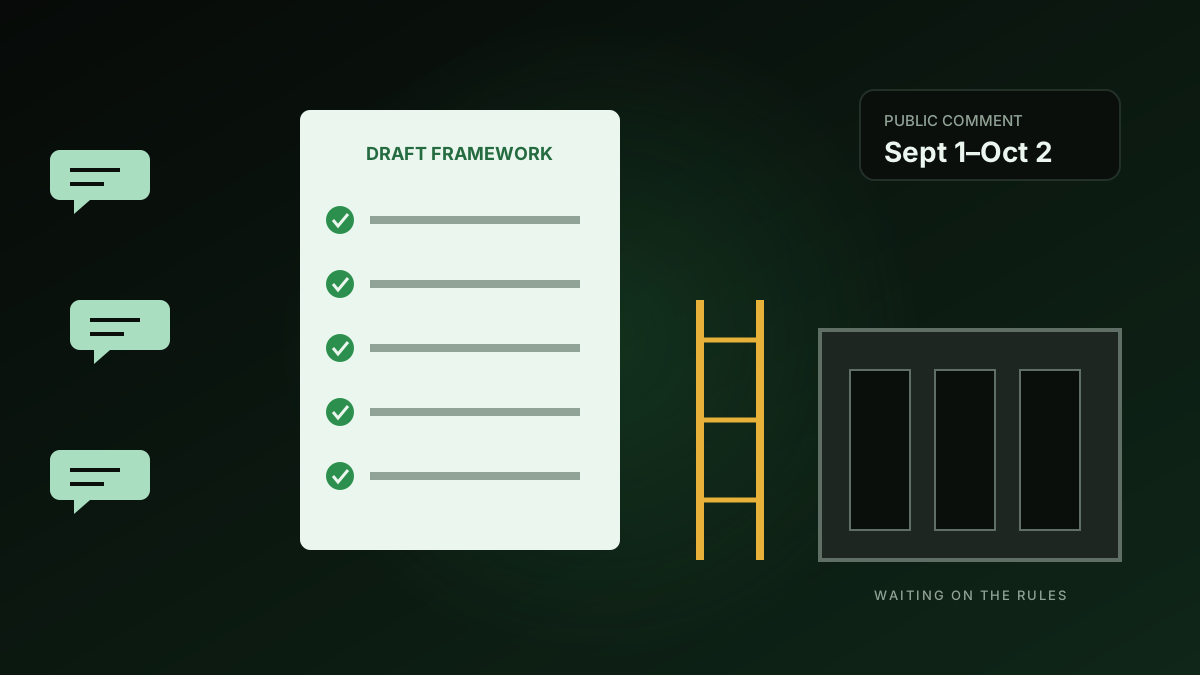
The province opened a public comment window on September 1 on a draft policy framework for data-centre development. The consultation is run by the New Brunswick Growth Office, inside the Department of Post-Secondary Education, Training and Labour, and closes to new input on October 2. Preliminary stakeholder consultations are already underway, and any legislative or regulatory changes would begin in the 2026–27 session.
This is not a project approval. It is the province drafting the test that future halls of servers would have to pass. Comments go through an Alchemer form linked from the consultation page.
Five tests, one hard electricity line
The news release and the consultation page set out five guidelines:
- Protecting ratepayers. A project must pay for the costs it creates and cannot lead to higher electricity rates for New Brunswickers.
- Sustainable development. Minimize impacts on water, land, local infrastructure, and the environment.
- Economic benefits. Investment, jobs, training, innovation, and opportunities for local and Indigenous businesses.
- Long-term impact. Technically and financially sound projects that align with provincial and national priorities, including data sovereignty and AI growth.
- Community engagement and benefits. Local governments, First Nations, and communities stay in the process, with measurable benefits.
Departments and agencies are to apply a common evaluation approach. No financial support, incentives, land transactions, or asset transfers below fair market value unless expressly authorized by government policy.
Post-Secondary Education and Training Minister Jean-Claude D'Amours said the policy will guide "any proposed data centre in New Brunswick" and support "the foundations of sovereign Canadian artificial intelligence." Kathryn Lockhart, executive director of the McKenna Institute, said the province has "the talent and ambition to compete," and that "a responsible, community-aligned approach is exactly what we need."
What the actual framework says
The five bullets are the summary. The three-page framework itself — posted on the consultation page, and the thing readers are actually being asked to comment on — is more specific, and in places more demanding:
- Every criterion is a gate, not a score. A proposal "will receive a positive recommendation under this policy only where it satisfies each of the core criteria."
- Scarcity gets rationed by benefit. Where multiple qualifying proposals compete for limited electricity or infrastructure capacity, preference goes to whichever demonstrates greater overall community benefit and economic value.
- Developers must curtail. Anyone connecting to the grid must pay new system costs and "agree to manage demand during periods of electricity system constraint."
- No walking away cheaply. Developers must post "financial assurances and contractual commitments" against project delay, reduced demand, closure, or cancellation.
- Behind-the-meter generation must be clean. On-site generation has to use clean sources, mitigate the emissions, or show a credible transition pathway.
- Water gets disclosed, and First Nations get told. Developers must disclose anticipated withdrawal, consumption, discharge, sources, and treatment; design in efficiency measures such as closed-loop cooling; and share water-use and mitigation information with First Nations communities, "in acknowledgement of their unique cultural relationship to water resources."
- The incentive ban is explicit. No financial support, below-market land or assets, payroll rebates, or other investment incentives for new data-centre projects.
- Waste heat is a tiebreaker. Projects are prioritized if they bring a business case or partnership for the economic use of excess heat.
- Commitments are meant to be enforceable. All of them "measurable, monitored, publicly reported, and independently auditable where appropriate, with consequences and enforcement mechanisms for non-compliance." Environmental performance targets — such as greenhouse gas emissions per unit of provincial GDP — are listed as still to be determined.
Two limits are worth reading closely. The policy "complements, and does not replace" existing legislative, regulatory, environmental, municipal, utility, and permitting requirements — so it adds a provincial gate rather than consolidating the ones that already exist. And colocation customers are not assessed under this policy: the framework tests whoever builds the hall, not the AI companies that rent racks inside it. Government says only that it "may consider future measures" to capture benefits from major users operating in the province.
Why this file is open now
Canadian Press, in Global News, tied the comment period to a live southwest-New Brunswick proposal: the 390-megawatt Spruce Lake AI Hub west of Saint John, pitched by Beacon Data Centres and VotaGrid, still under regulatory review. That is context, not a verdict in the framework itself — but 390 MW is precisely the scale at which the framework's rationing clause, curtailment requirement, and financial-assurance rule would bite.
The province has been arguing the same electricity-and-water points at the municipal level for months. Miramichi paused a zoning amendment in July after residents pushed back. Energy Minister René Legacy told CBC then that projects should not lift rates, should use closed-loop water, put waste heat to work, and deliver real local jobs. Every one of those four now appears in the draft framework — the first three as requirements, the fourth as a preference. Meanwhile the region's own supply picture is being replanned across three provinces.
A comment form is not a moratorium and it is not a green light. It is the government asking, until October 2, whether these are the right tests before the next large load asks for a hookup.
Sources
- Public input sought on development of data centres — GNB — September 1, 2026: five guidelines, D'Amours and Lockhart quotes, Oct. 2 deadline, preliminary stakeholder consultations, 2026–27 legislative session
- Data centre development in New Brunswick — consultation — open Sept. 1–Oct. 2; run through the New Brunswick Growth Office, Department of Post-Secondary Education, Training and Labour; framework purpose; First Nations engagement
- Policy framework for data centre development (PDF) — three-page draft: pass-every-criterion recommendation, prioritization under constrained capacity, demand management, financial assurances, clean on-site generation, water disclosure and First Nations information-sharing, incentive and payroll-rebate prohibition, excess-heat prioritization, auditable commitments, colocation carve-out, "complements and does not replace" scope
- Consultation form — Alchemer survey linked from the GNB page
- New Brunswick wants public feedback on data centre plan — Global News / Canadian Press — September 1, 2026: Spruce Lake 390 MW, Beacon Data Centres and VotaGrid, under regulatory review
Related coverage
News · October 9, 2026
Fredericton Firm Pitches Miramichi a 375-Megawatt Data Centre Campus
News · September 10, 2026
WorkSafeNB: AI Is Writing Safety Policies That Cite the Wrong Province
News · September 9, 2026
Saint John's Versos Puts NVIDIA Agents on Video Libraries — and Takes Them to Amsterdam