
News1 min read
UNB Researcher's 'Trust Passport' Would Stamp Every AI Reply with Its Risk Profile


A Canadian Institute for Cybersecurity poster proposes a per-response risk snapshot for enterprise LLM pipelines, flagging unreliable retrieval, sensitive-data exposure, risky tool use, and weak factual support.
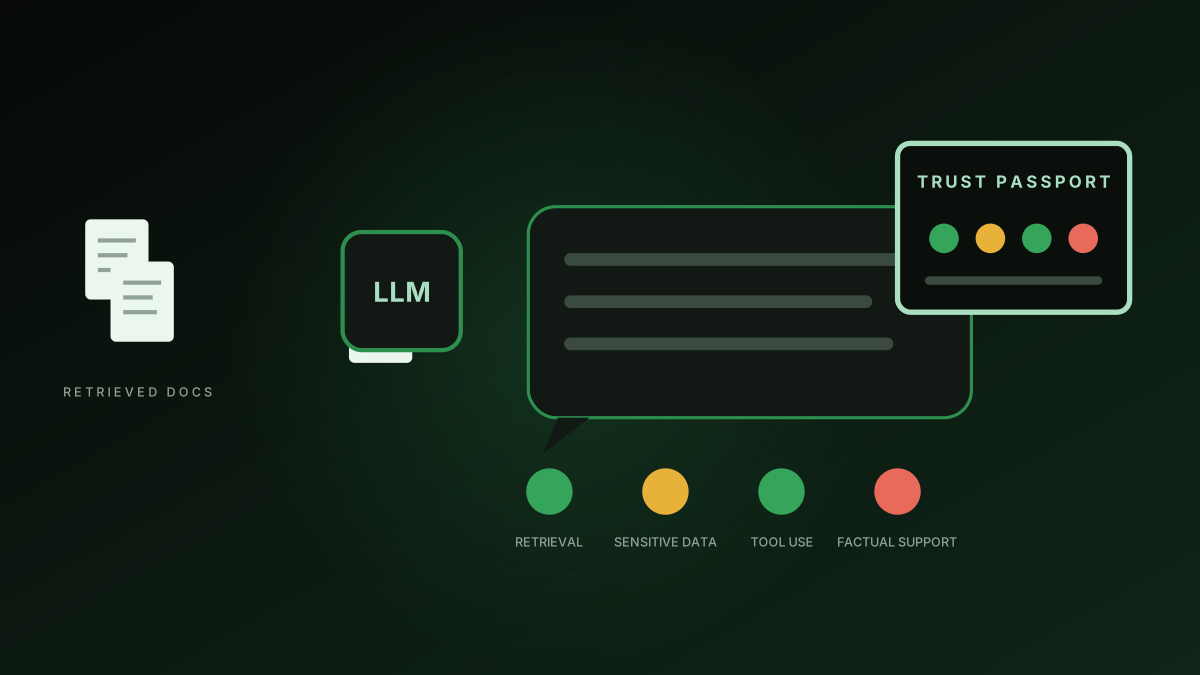
What if every AI-generated reply came with its own Trust Passport — a stamp-sized summary of how much confidence you should actually place in it?
That's the idea behind a poster from UNB's Canadian Institute for Cybersecurity researcher Vidushi Agarwal, set to appear at the PST Cybersecurity Summit 2026 in Fredericton on Aug. 20.
The problem: confident, unverifiable answers
Enterprises are wiring large language models into pipelines that retrieve documents, call tools, and answer directly to employees and customers. LLMs deliver those answers with uniform confidence — whether the underlying retrieval was solid, the tool call was risky, or the model is improvising. For a business deciding whether to act on an AI answer, that flat confidence is the problem.
The approach: a risk snapshot per response
The Trust Passport concept gives each AI response a clear snapshot of potential risks across four signals:
- Unreliable retrieved information — did the sources the model leaned on actually support the answer?
- Sensitive-data exposure — did the pipeline surface confidential or personal data it shouldn't have?
- Risky tool use — did the model invoke tools or actions that carry consequence?
- Weak factual support — is the answer grounded, or is it plausible-sounding filler?
By bringing those signals together, the passport lets users quickly gauge how much confidence a response deserves — and, the poster argues, make better-informed decisions when working with LLMs.
Why it matters
"Trust but verify" is the operating principle of most security-conscious AI deployments, and verification is currently manual and ad hoc. A standardised per-response risk label is the kind of infrastructure that could make enterprise LLM adoption safer — and it's a research direction squarely in the wheelhouse of the institute that anchors Fredericton's security cluster.
Sources
- Canadian Institute for Cybersecurity: Research Spotlight post — project summary, author, and the four risk signals
ChronologyCIC· 11 stories since Aug 4, 2026
- Mastercard's Canada Security VP Keynoted CIC's Fredericton Summit — Then Toured the IoT Lab It Funds
- UNB Researchers Threat-Model the Protocols That Let AI Agents Act
Chronology · show all 11 storiesShow fewer
- UNB Researchers Build a Practical Roadmap for the Post-Quantum Migration
- UNB Poster Weighs the Privacy Cost of Federated-Learning Aggregation
- UNB Researchers Deploy Collaborative AI Agents to Guard Power-Substation Networks
- UNB Researchers Build a Mixture-of-Experts Defence Against Adversarial AI Attacks
- UNB Researchers Make AI Malware Detection Explainable with a 'Dual Prototype' Framework
- UNB Researcher Takes a Geometric Axe to Optimization's Symmetry Problem
- UNB Researcher's 'Trust Passport' Would Stamp Every AI Reply with Its Risk Profile (this story)
- National Cyber Agencies and Big Banks Head to Fredericton for UNB's Cybersecurity Summit
- Cybersecurity Pioneer Ali Ghorbani Named to the Order of New Brunswick
Related coverage
News · August 19, 2026
UNB Researchers Threat-Model the Protocols That Let AI Agents Act
News · August 19, 2026
UNB Poster Weighs the Privacy Cost of Federated-Learning Aggregation
News · August 19, 2026
UNB Researchers Deploy Collaborative AI Agents to Guard Power-Substation Networks