
News1 min read
UNB Researcher Takes a Geometric Axe to Optimization's Symmetry Problem


A Canadian Institute for Cybersecurity poster introduces quadratic separators based on invariant subspaces to cut redundant search in symmetric integer programming — the class of problem behind scheduling and logistics.
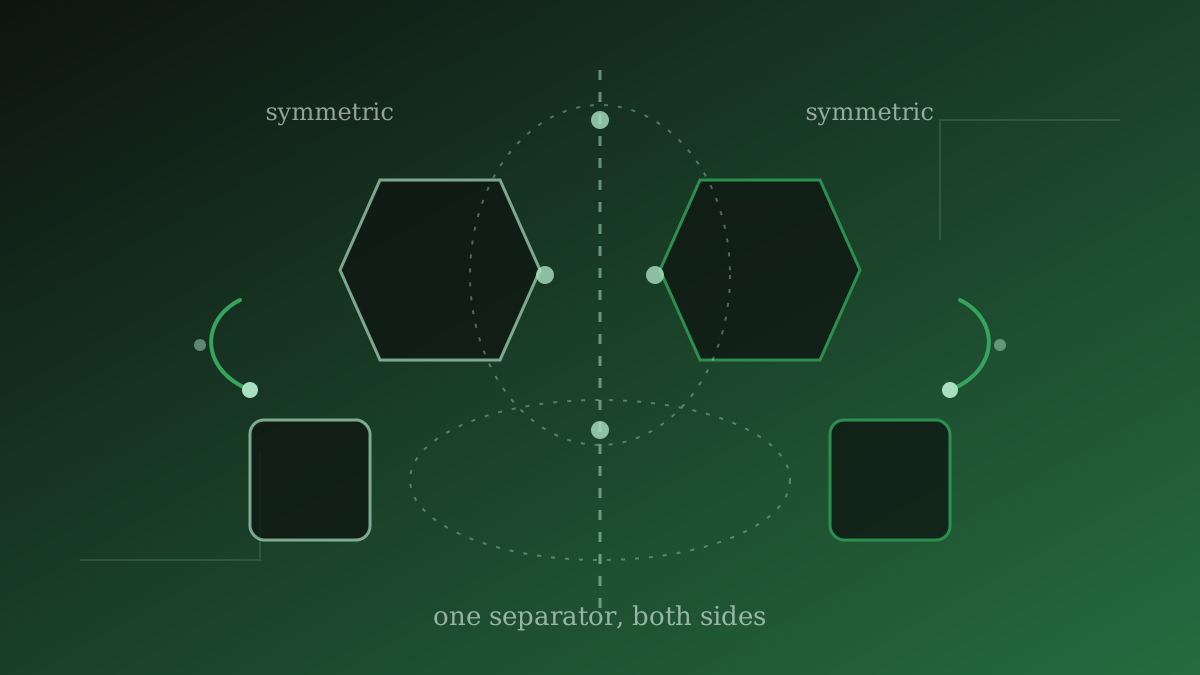
Optimization solvers have a wasteful habit: when a problem looks the same from several angles, they happily solve every mirrored copy of the answer instead of one.
Geometric Quadratic Separators for Symmetric Integer Programs, a poster from Canadian Institute for Cybersecurity researcher Seyedeh Maryam Abbasnia, takes a geometric approach to that problem — and it will be on display at the PST Cybersecurity Summit 2026 in Fredericton on Aug. 20.
The problem: symmetry breeds redundant search
Many real-world planning problems — scheduling, routing, resource allocation — are Integer Linear Programming (ILP) problems, where solvers search for the best integer-valued solution. When a problem has cyclic symmetry (rotations or permutations that map one feasible solution onto an equivalent one), solvers can spend enormous effort re-exploring equivalent solutions, one mirror image at a time.
The approach: cut through the symmetry
The research introduces a quadratic separator based on invariant subspaces — a geometric construction that slices through the search space so that symmetric copies collapse into one region. The framework pairs geometric reasoning with modern optimization solvers, giving a new way to reduce redundant search in symmetric problems.
It's the kind of foundational mathematics that quietly underpins applied work: better symmetry handling means solvers spend their time on new solutions rather than re-discovering the same one, which pays off anywhere scheduling and logistics meet the institute's broader security and AI research.
Sources
- Canadian Institute for Cybersecurity: Research Spotlight post — project summary, author, and approach
ChronologyCIC· 11 stories since Aug 4, 2026
- Mastercard's Canada Security VP Keynoted CIC's Fredericton Summit — Then Toured the IoT Lab It Funds
- UNB Researchers Threat-Model the Protocols That Let AI Agents Act
Chronology · show all 11 storiesShow fewer
- UNB Researchers Build a Practical Roadmap for the Post-Quantum Migration
- UNB Poster Weighs the Privacy Cost of Federated-Learning Aggregation
- UNB Researchers Deploy Collaborative AI Agents to Guard Power-Substation Networks
- UNB Researchers Build a Mixture-of-Experts Defence Against Adversarial AI Attacks
- UNB Researchers Make AI Malware Detection Explainable with a 'Dual Prototype' Framework
- UNB Researcher Takes a Geometric Axe to Optimization's Symmetry Problem (this story)
- UNB Researcher's 'Trust Passport' Would Stamp Every AI Reply with Its Risk Profile
- National Cyber Agencies and Big Banks Head to Fredericton for UNB's Cybersecurity Summit
- Cybersecurity Pioneer Ali Ghorbani Named to the Order of New Brunswick
Related coverage
News · August 19, 2026
UNB Researchers Threat-Model the Protocols That Let AI Agents Act
News · August 19, 2026
UNB Researchers Build a Practical Roadmap for the Post-Quantum Migration
News · August 19, 2026
UNB Poster Weighs the Privacy Cost of Federated-Learning Aggregation