
Analysis8 min read
Review: UNB's Scott Bateman on the Three AI Myths That Won't Die


The summer alumni-magazine Q&A is sharpest on mimicry, chatbot liability, and the productivity paradox — and thinnest when it turns into a campus brochure.
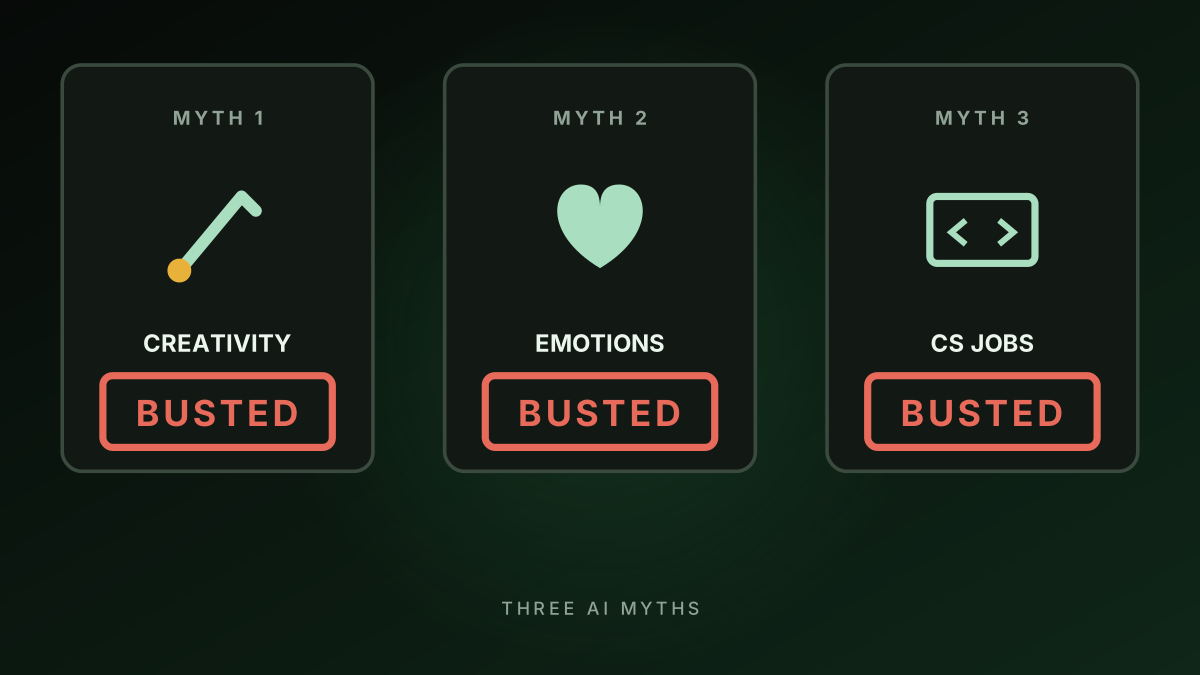
The University of New Brunswick summer alumni magazine asked Dr. Scott Bateman to bust three myths about artificial intelligence. He is the right person to ask. UNB's faculty directory lists him as a professor of computer science and research director of the Research Institute in Data Science and Artificial Intelligence, director of the SPECTRAL Spatial Computing Research Centre, and co-director of the Human-Computer Interaction Lab. (The institute is mid-rename: its own people page now calls it DAIR, "formerly RIDSAI," and lists Bateman as scientific director. Its contact address is already dair@unb.ca.)
The Q&A anchors an issue built around AI — the Summer 2026 cover line promises alumni "exploring how to harness its potential while preserving the human qualities it can't replicate," and the rest of the issue is alumni profiles on the same theme.
It is not a research paper. It is a campus magazine interview aimed at alumni who have been told, for two years running, that chatbots will replace artists, feel our feelings, and empty the computer-science job market. Bateman's answers on those three claims are useful. The second half of the piece — UNB as industry partner, students who will "code our future" — is the usual brochure, and it is the weaker half.
Myth 1: AI will replace human creativity
This is the cleanest section, and the one that will age best.
Bateman narrows "AI" to large language models, then draws a line most HCI researchers would sign: models "use a huge amount of data that already exists," find connections, and summarize. They "are good at mimicking what people have already created." That "can seem like creativity, but it's a shallow type of creativity because it doesn't invent."
That is not a new argument. It is the correct one for this audience. The useful distinction is not "AI is dumb" versus "AI is magic." It is remix versus invention. A model can produce something that sounds new because it has seen enough adjacent examples. It does not decide, from emotion or from a constraint nobody put in the training set, that the problem itself is the wrong problem.
Where the answer stays honest is the hedge he does not overplay. He does not claim models are useless. He claims they are not a substitute for the kind of creativity that has to understand whether other people will accept the idea — the part that still requires "human emotion and our understanding of larger contexts and constraints."
Myth 2: AI will become more emotionally intelligent than people
This is the strongest journalistic move in the interview, and also a slight dodge of the myth as stated.
Bateman does not really argue about machines having (or faking) feelings. He argues about accountability. He points at a Canadian airline chatbot that gave a passenger bad information about bereavement fares — "a situation where human sensitivity and compassion would have been appreciated" — and says the company had to honour the mistake. He does not name the airline or the case. The details match Moffatt v. Air Canada, 2024 BCCRT 149, decided February 14, 2024: Jake Moffatt, booking travel after a death in the family, relied on Air Canada's website chatbot, which said a bereavement rate could be claimed retroactively within 90 days of the ticket being issued. The airline's own policy page said the opposite. The B.C. Civil Resolution Tribunal found negligent misrepresentation and awarded Moffatt $650.88 in damages, plus $36.14 in pre-judgment interest and $125 in tribunal fees.
"Had to honour" is doing quiet work in Bateman's telling. Air Canada did not absorb the mistake; it fought the claim, and argued that the chatbot was "a separate legal entity that is responsible for its own actions." Tribunal member Christopher C. Rivers called that "a remarkable submission": the chatbot was still just part of Air Canada's website, and it made no difference whether the bad information came from a static page or a bot. The accountability Bateman describes is not something the company volunteered. It is something a tribunal imposed for the price of a discounted fare.
That is a liability story, not an emotional-intelligence story. It still does the work Bateman needs. The lesson he draws is the right one: "those who take advantage of AI must be held accountable," and "human oversight is required." New Brunswick already has the local versions. A Kings Centre MLA read what sounds like a chatbot's rewrite instruction into the legislative record. A defence lawyer admitted to the Law Society that he filed a Provincial Court brief in which 10 of 12 citations were fictitious, and faces a discipline hearing next month. In both cases the failure was not that the model had no feelings. It was that a human treated generated text as finished work.
The myth as headline — machines will out-feel us — is sci-fi. The myth as practice — a chatbot can handle the hard conversation because it sounds patient — is how Air Canada ended up in front of a tribunal. Bateman's example lands because it is already law, not speculation.
Myth 3: AI will take computer science jobs
"I believe that humans will never be obsolete in the workforce" is a belief, and the piece should have left it as one. The rest of the answer is better than the slogan.
Bateman's real claim is about oversight load. Calculators, PCs, the internet, and smartphones did not delete work; they raised expectations. He calls that the "productivity paradox": a customer-service rep who once handled dozens of phone calls now "must provide oversight on hundreds of cases that were filtered through a chatbot." Speed goes up. Quality, and the chance of a critical miss, can go down.
The evidence, though, is asserted rather than shown. "Reports like this one have been well documented," the answer says, and "many of these reports suggest that people across a wide range of fields already feel overburdened" — but "this one" points at nothing. There is no link, no title, no author in the published piece. A single named study on AI-era workload would have made the strongest empirical claim in the interview checkable.
Economists usually reserve "productivity paradox" for a different puzzle — new technology that does not show up in the productivity statistics. Bateman is using the phrase for workload inflation. The observation still holds. If the human's job becomes reviewing machine output at machine volume, the oversight is decorative. That is the through-line to the lawyer file: the tool was not banned; incompetent use was.
What he will not say, and what a campus magazine probably would not print, is the narrower labour-market version. Entry-level implementation work is being compressed. UNB can still be right that graduates who keep the fundamentals — the people who can tell when the model is wrong — are the ones employers will pay for. That is an argument for curriculum, not a guarantee that headcount holds.
The brochure half
Asked how UNB is preparing students, Bateman gives a three-part answer that is more concrete than the industry section that follows:
- Keep teaching computer-science fundamentals so graduates can recover when a model is wrong.
- Change assessment so students do not become "overly reliant on AI," while still showing "appropriate AI uses."
- Add courses that go past coding — machine learning, cybersecurity, software engineering, systems architecture, human-computer interaction, social issues, and ethics.
That is a real syllabus argument. The industry-collaboration answers are not. UNB is "second to none" for partner access. The culture is "unlike any other university I have worked with." Partnerships are "baked into the culture." Students "almost always work directly with industrial partners." No company is named. No project is named. Not even his own: Bateman leads the Machine Learning Health Vault, a $97,026 Canada Foundation for Innovation award announced August 20 for privacy-preserving synthetic health data, with co-applicants in chemistry and in DataNB. That is a concrete, checkable example of researchers and partners working on an AI problem that matters in this province. A named project of that kind would have done more for the "human-AI collaboration" brief than another paragraph about synergistic talent pipelines.
The closer is the standard optimistic-HCI future: assistants that sort email and find documents so people can "focus on deeper and more creative pursuits." Fine as a hope. It is also the claim every vendor slide already makes. The interview earns more when it stays with mimicry, liability, and oversight load.
Verdict
Read it for the first three answers. Skip the adjectives in the second half, or treat them as fundraising copy.
What Bateman gets right is the part New Brunswick keeps learning the hard way. Generative tools remix. They do not invent, they do not feel, and they do not absorb responsibility. The human who ships the output still owns it — in a tribunal, in Hansard, and in a court brief. That is a less exciting story than replacement or singularity. It is the one that matches the record.
Sources
- Busting myths about AI — UNB Alumni News, Summer 2026 — Bateman Q&A; three myths; education and industry answers
- UNB Alumni News Magazine, Summer 2026 issue — AI-themed issue the Q&A anchors
- Scott Bateman — UNB faculty directory — professor, computer science; research director, RIDSAI; director, SPECTRAL; co-director, HCI Lab
- Research Institute in Data Science and Artificial Intelligence — institute home (RIDSAI; contact under dair@unb.ca)
- RIDSAI / DAIR people — Bateman as scientific director; DAIR-formerly-RIDSAI wording
- SPECTRAL Spatial Computing Research Centre — centre home
- SPECTRAL team — Bateman as SPECTRAL director
- Moffatt v. Air Canada, 2024 BCCRT 149 — Feb. 14, 2024 ruling; negligent misrepresentation; $650.88 damages plus interest and fees; the chatbot case Bateman alludes to
- UNB's Machine Learning Health Vault Wins CFI Infrastructure Funding — NB Tech News — Bateman-led project announced Aug. 20, 2026
- N.B. Lawyer Admits Filing AI Briefs With Fake Citations — NB Tech News — local oversight failure
- A Kings Centre MLA Read an AI Rewrite Prompt Aloud in the Legislature — NB Tech News — local drafting failure
ChronologyUNB· 35 stories since Nov 20, 2024
- Gray Wolf Analytics Brings Scam-Detection Playbook to UNB's RBC Lunch & Learn
- McKenna Institute Pulls District Tech Leads to Chelmsford to Scale Teacher Upskilling
Chronology · show all 35 storiesShow fewer
- Sussex Elementary Opens a Saber STEAM Studio for Robotics and 3D Printing
- UNB Joins $5M National Push to Keep AI Weather Forecasts Grounded in Physics
- UNB's Fifth-Scale ATV Predicts the Ground Under Each Wheel — and Left AI Out of It
- Mastercard's Canada Security VP Keynoted CIC's Fredericton Summit — Then Toured the IoT Lab It Funds
- UNB Names Its First Digital Agriculture Chair — and He Starts With Small Farms
- UNB Sent Middle Schoolers Back to Class With Games, Websites and AI
- Review: UNB's Scott Bateman on the Three AI Myths That Won't Die (this story)
- UNB's Machine Learning Health Vault Wins CFI Infrastructure Funding
- UNB Co-Authors Confirm the First Native Sulfur Ever Found on Mars
- UNB Researchers Threat-Model the Protocols That Let AI Agents Act
- UNB Researchers Build a Practical Roadmap for the Post-Quantum Migration
- UNB Poster Weighs the Privacy Cost of Federated-Learning Aggregation
- UNB Researchers Deploy Collaborative AI Agents to Guard Power-Substation Networks
- UNB Researchers Build a Mixture-of-Experts Defence Against Adversarial AI Attacks
- UNB Researchers Make AI Malware Detection Explainable with a 'Dual Prototype' Framework
- UNB Researcher Takes a Geometric Axe to Optimization's Symmetry Problem
- UNB Researcher's 'Trust Passport' Would Stamp Every AI Reply with Its Risk Profile
- National Cyber Agencies and Big Banks Head to Fredericton for UNB's Cybersecurity Summit
- When the First Canadian Flew to the Moon, Fredericton Was Listening
- UNB Partners with Talent Innovation Canada to Put Grad Talent Inside Industry R&D
- McKenna Connect Puts UNB Mentors Beside 250 Rural Neighbours
- Cybersecurity Pioneer Ali Ghorbani Named to the Order of New Brunswick
- McKenna Institute's TeXplore Turns 17 Days Off School Into Soldering, Robots and AI
- SeaGreen Puts Seaweed Biochar in Ten Queen Street Flower Planters
- UNB Stitches Its Startup Machinery Into One Network
- Creduman Takes Top Spot at UNB’s MTME: NEXT 2026
- Four UNB MTME Startups Launch Next Week at MTME: NEXT
- The UNB Startup Pipeline: How a Fredericton Campus Keeps Minting Companies
- How Fredericton Became a Cybersecurity Town
- A Century of Circuits: UNB's Electrical Engineering Program Turns 100
- First Cheques: UNB's Fraser Fund Backs SpatialOne, Profitual, and AinaTest
- Gray Wolf Analytics: Crypto Forensics from a Fredericton Classroom
- Three Years In, the McKenna Institute Is Quietly Rewiring New Brunswick
Related coverage
Analysis · November 20, 2024
Three Years In, the McKenna Institute Is Quietly Rewiring New Brunswick
News · October 2, 2026
McKenna Institute Pulls District Tech Leads to Chelmsford to Scale Teacher Upskilling
News · September 24, 2026
UNB Joins $5M National Push to Keep AI Weather Forecasts Grounded in Physics