
News3 min read
When the First Canadian Flew to the Moon, Fredericton Was Listening


UNB was the only Canadian university picked to help track Artemis II — the April mission that carried CSA astronaut Jeremy Hansen, the first Canadian to fly to the Moon, farther from Earth than any human has ever travelled. Two UNB researchers also sit on the Curiosity rover science team.
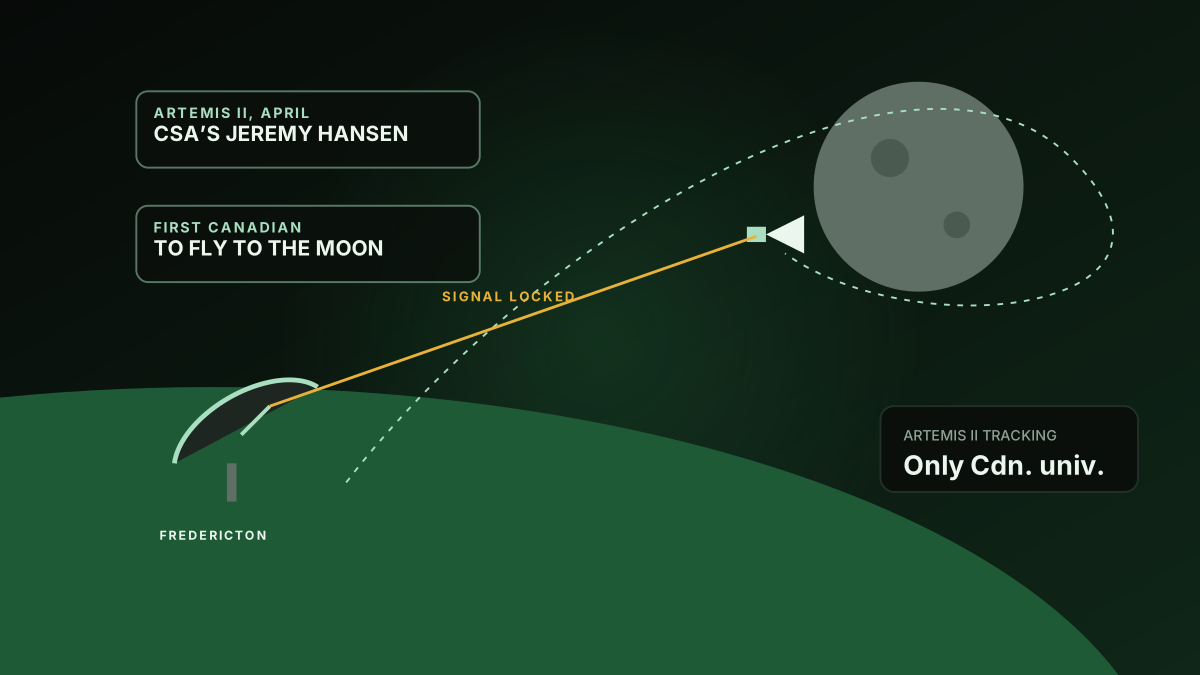
When most people picture space exploration, they picture Florida launch pads, Houston mission control, or a rover on Mars — not Fredericton. But when the first Canadian in history flew around the Moon this spring, one of the ground stations following his spacecraft was in Fredericton.
That detail sits inside a profile of UNB's growing NASA footprint published this week by the university's newsroom — a footprint that now reaches from the surface of Mars to lunar orbit.
The only Canadian university tracking Artemis II
UNB did something on that mission no other Canadian university was asked to do.
Artemis II flew April 1 to 10, 2026: the first crewed flight to the Moon since 1972. Aboard the Orion spacecraft Integrity were NASA's Reid Wiseman, Victor Glover and Christina Koch — and Canadian Space Agency astronaut Col. Jeremy Hansen, the first Canadian, and the first non-American, to fly a lunar mission. On April 6 the crew rounded the far side of the Moon and reached 406,771 km from Earth, the farthest humans have ever travelled, breaking a record held by Apollo 13 since 1970.
Listening for that spacecraft, from Fredericton, were Dr. Brent Petersen of the Department of Electrical and Computer Engineering and Dr. Richard Langley of the Department of Geodesy and Geomatics Engineering. Working through the UNB Earth Station alongside student researchers, they received and tracked Integrity's radio signals as it travelled around the Moon.
UNB was the only Canadian university selected to help track the mission, joining an international network supporting spacecraft communications. For a department celebrating a century of electrical engineering this year, it is a fitting anniversary present: when the first Canadian in history flew to the Moon, the Canadian university tracking his ride was in Fredericton — and undergraduates were in the room.
Also on the Mars rover's science team
The Moon is only half of it. Two UNB researchers are members of the team supporting NASA's Mars Science Laboratory Curiosity rover mission: Dr. Lucy Thompson and Dr. Catherine O'Connell-Cooper. Last year their work contributed to a discovery offering new insight into the planet's history — and into whether Mars may once have supported conditions suitable for life.
It's the kind of finding that feeds the two biggest questions in planetary science: how planets evolve, and whether life exists beyond Earth.
The pipeline behind it
The Earth Station — which receives and processes satellite data — doubles as a training ground where students work hands-on with the same kinds of tools and technologies used by NASA, the Canadian Space Agency, and the European Space Agency, across satellite technology, planetary science, remote sensing, and communications.
"Space exploration has always been a global effort, and universities play a critical role in that work," said Dr. David MaGee, UNB's vice-president research. "What we're seeing at UNB is researchers and students contributing expertise that is making an impact far beyond our campus."
That's the quiet part of UNB's space story, and arguably the most New Brunswick part: the same research-and-student pipeline that feeds the province's tech employers also feeds humanity's space program.
The university says the profile is the first in a series on its space work; the next instalment covers Thompson and O'Connell-Cooper's Mars geology in more depth.
Sources
- Space happens here: Inside UNB's growing role in NASA missions — UNB newsroom feature (Aug. 17, 2026); Curiosity team membership, Artemis II tracking, Earth Station details
- UNB Earth Station — satellite data reception and student training facility
- NASA Mars Science Laboratory Curiosity — mission context for the rover science team
- NASA: Artemis II — launch and splashdown dates (April 1–10, 2026), first crewed lunar flight since 1972
- Canadian Space Agency: The Artemis II mission — Orion Integrity, full crew, Hansen as first Canadian on a lunar mission, 406,771 km distance record
- Canadian Space Agency: Astronaut Jeremy Hansen — biography and mission role
ChronologyUNB· 35 stories since Nov 20, 2024
- Gray Wolf Analytics Brings Scam-Detection Playbook to UNB's RBC Lunch & Learn
- McKenna Institute Pulls District Tech Leads to Chelmsford to Scale Teacher Upskilling
Chronology · show all 35 storiesShow fewer
- Sussex Elementary Opens a Saber STEAM Studio for Robotics and 3D Printing
- UNB Joins $5M National Push to Keep AI Weather Forecasts Grounded in Physics
- UNB's Fifth-Scale ATV Predicts the Ground Under Each Wheel — and Left AI Out of It
- Mastercard's Canada Security VP Keynoted CIC's Fredericton Summit — Then Toured the IoT Lab It Funds
- UNB Names Its First Digital Agriculture Chair — and He Starts With Small Farms
- UNB Sent Middle Schoolers Back to Class With Games, Websites and AI
- Review: UNB's Scott Bateman on the Three AI Myths That Won't Die
- UNB's Machine Learning Health Vault Wins CFI Infrastructure Funding
- UNB Co-Authors Confirm the First Native Sulfur Ever Found on Mars
- UNB Researchers Threat-Model the Protocols That Let AI Agents Act
- UNB Researchers Build a Practical Roadmap for the Post-Quantum Migration
- UNB Poster Weighs the Privacy Cost of Federated-Learning Aggregation
- UNB Researchers Deploy Collaborative AI Agents to Guard Power-Substation Networks
- UNB Researchers Build a Mixture-of-Experts Defence Against Adversarial AI Attacks
- UNB Researchers Make AI Malware Detection Explainable with a 'Dual Prototype' Framework
- UNB Researcher Takes a Geometric Axe to Optimization's Symmetry Problem
- UNB Researcher's 'Trust Passport' Would Stamp Every AI Reply with Its Risk Profile
- National Cyber Agencies and Big Banks Head to Fredericton for UNB's Cybersecurity Summit
- When the First Canadian Flew to the Moon, Fredericton Was Listening (this story)
- UNB Partners with Talent Innovation Canada to Put Grad Talent Inside Industry R&D
- McKenna Connect Puts UNB Mentors Beside 250 Rural Neighbours
- Cybersecurity Pioneer Ali Ghorbani Named to the Order of New Brunswick
- McKenna Institute's TeXplore Turns 17 Days Off School Into Soldering, Robots and AI
- SeaGreen Puts Seaweed Biochar in Ten Queen Street Flower Planters
- UNB Stitches Its Startup Machinery Into One Network
- Creduman Takes Top Spot at UNB’s MTME: NEXT 2026
- Four UNB MTME Startups Launch Next Week at MTME: NEXT
- The UNB Startup Pipeline: How a Fredericton Campus Keeps Minting Companies
- How Fredericton Became a Cybersecurity Town
- A Century of Circuits: UNB's Electrical Engineering Program Turns 100
- First Cheques: UNB's Fraser Fund Backs SpatialOne, Profitual, and AinaTest
- Gray Wolf Analytics: Crypto Forensics from a Fredericton Classroom
- Three Years In, the McKenna Institute Is Quietly Rewiring New Brunswick
Related coverage
News · August 21, 2026
UNB Co-Authors Confirm the First Native Sulfur Ever Found on Mars
News · September 24, 2026
UNB Joins $5M National Push to Keep AI Weather Forecasts Grounded in Physics
News · September 7, 2026
UNB's Fifth-Scale ATV Predicts the Ground Under Each Wheel — and Left AI Out of It