
News3 min read
UNB Co-Authors Confirm the First Native Sulfur Ever Found on Mars


Lucy Thompson and Catherine O'Connell-Cooper ran Curiosity's Canadian APXS instrument on a field of bright stones in Gale crater. The Science cover story: they are elemental sulfur, not sulfate.
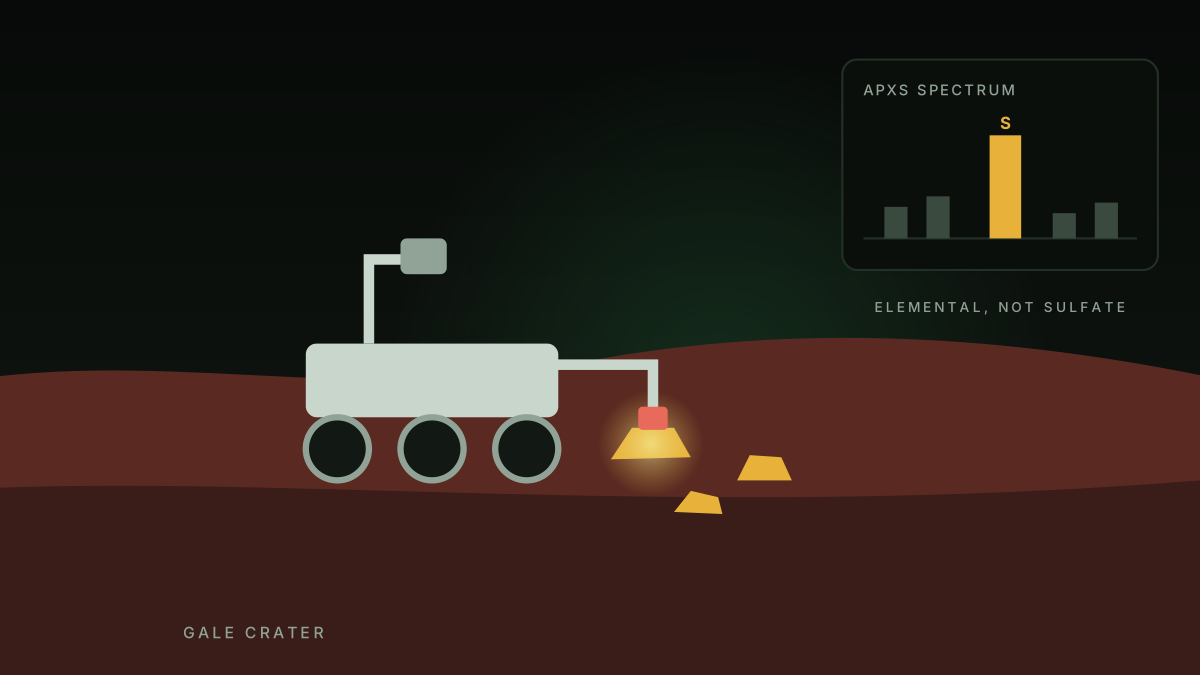
Two University of New Brunswick researchers are on the author list of a Science cover story that settles a first for Mars: the bright stones NASA's Curiosity rover found in Gale crater are native, elemental sulfur — not the sulfate salts the rover has been tasting for more than a decade.
UNB's newsroom posted the campus angle August 21, the day after Washington University in St. Louis flagged the paper as the cover of the August 20 issue. The study is S. J. VanBommel et al., "A native sulfur deposit in Gale crater, Mars". Twenty-three authors sit on it, from NASA, the Canadian Space Agency, the University of Guelph, and WashU among others. UNB's Dr. Lucy Thompson and Dr. Catherine O'Connell-Cooper are the pair who operate the rover's Alpha Particle X-Ray Spectrometer — APXS — from the Planetary and Space Science Centre.
This is the Mars follow-up UNB previewed when it wrote about Artemis II tracking and the Curiosity science team. The earlier piece promised a deeper look at Thompson and O'Connell-Cooper's geology. The sulfur paper is that look.
Sulfate was the default. This was not.
Until now, almost every sulfur detection on Mars had been a compound: sulfates and sulfides, the salts that record evaporated water. Thompson, who was a scientific lead on Curiosity's Gediz Vallis campaign — a canyon cut through the layered slopes of Mount Sharp inside Gale crater — put the surprise in one line:
"All the sulfur that we'd found had pretty much been present as sulfate. So it was really unusual and surprising and exciting to find elemental sulfur."
APXS is a Canadian-built, funded, managed, and operated instrument on the rover's arm. The UNB pair help pick geological targets, work the instrument with the rest of the mission, and read the spectra it sends home. In Gediz Vallis the rover rolled into a field of light-toned stones that did not match the neighbourhood. The spectrometer said they were sulfur in its elemental form.
WashU's Scott VanBommel, a Canadian researcher and former Guelph graduate student, is the paper's lead author and co-led the analysis with Jeff Berger at NASA Johnson Space Center. Their write-up dates the stones to roughly three billion years ago. The Science abstract's working model: magmatic vapor cooled in the near-surface cryosphere, then native sulfur was released by decompression as Gediz Vallis eroded. UNB's campus summary adds that the deposit was later trapped under debris-flow and avalanche material and exposed again by erosion.
The stones are clean enough that the team argues they formed in place. VanBommel told WashU that if they had been hauled in from elsewhere they would be smashed or full of debris. Curiosity, which weighs less than 750 pounds in Martian gravity, crushed chunks just by driving over them.
Why a Fredericton lab is on a Mars cover
PASSC opened in 2001 as Canada's first dedicated planetary-science centre. It has been on Curiosity's APXS team since the rover landed in 2012. That is the same pipeline UNB sketched for its Earth Station work on Artemis II: a small campus that keeps showing up on instruments other countries paid to fly.
Native sulfur on Earth usually means high heat — fumaroles — or microbes. The paper's authors do not see either in this corner of Gale crater. What they do see is a dry, chemically quiet interval long enough to leave fist-sized sulfur stones sitting unoxidized for billions of years. That is a constraint on how late Gale crater stayed wet, written in an element New Brunswick researchers have been measuring from Fredericton for fourteen years.
Sources
- UNB researchers contribute to discovery of native sulfur on Mars — UNB Newsroom (Aug 21, 2026) — Thompson and O'Connell-Cooper roles, APXS, Gediz Vallis, Thompson quote, 23-author team
- A native sulfur deposit in Gale crater, Mars — Science (doi:10.1126/science.adu5501) — VanBommel et al.; in-place deposit; magmatic-vapor / cryosphere model
- Pristine sulfur preserves a snapshot of ancient Mars — WashU EEPS (Aug 20, 2026) — Science cover; ~3 billion years; VanBommel and Berger quotes
- Planetary and Space Science Centre — UNB — PASSC mandate and NASA / CSA instrument work
- When the First Canadian Flew to the Moon, Fredericton Was Listening — NB Tech News — prior UNB NASA / Curiosity coverage
ChronologyUNB· 35 stories since Nov 20, 2024
- Gray Wolf Analytics Brings Scam-Detection Playbook to UNB's RBC Lunch & Learn
- McKenna Institute Pulls District Tech Leads to Chelmsford to Scale Teacher Upskilling
Chronology · show all 35 storiesShow fewer
- Sussex Elementary Opens a Saber STEAM Studio for Robotics and 3D Printing
- UNB Joins $5M National Push to Keep AI Weather Forecasts Grounded in Physics
- UNB's Fifth-Scale ATV Predicts the Ground Under Each Wheel — and Left AI Out of It
- Mastercard's Canada Security VP Keynoted CIC's Fredericton Summit — Then Toured the IoT Lab It Funds
- UNB Names Its First Digital Agriculture Chair — and He Starts With Small Farms
- UNB Sent Middle Schoolers Back to Class With Games, Websites and AI
- Review: UNB's Scott Bateman on the Three AI Myths That Won't Die
- UNB's Machine Learning Health Vault Wins CFI Infrastructure Funding
- UNB Co-Authors Confirm the First Native Sulfur Ever Found on Mars (this story)
- UNB Researchers Threat-Model the Protocols That Let AI Agents Act
- UNB Researchers Build a Practical Roadmap for the Post-Quantum Migration
- UNB Poster Weighs the Privacy Cost of Federated-Learning Aggregation
- UNB Researchers Deploy Collaborative AI Agents to Guard Power-Substation Networks
- UNB Researchers Build a Mixture-of-Experts Defence Against Adversarial AI Attacks
- UNB Researchers Make AI Malware Detection Explainable with a 'Dual Prototype' Framework
- UNB Researcher Takes a Geometric Axe to Optimization's Symmetry Problem
- UNB Researcher's 'Trust Passport' Would Stamp Every AI Reply with Its Risk Profile
- National Cyber Agencies and Big Banks Head to Fredericton for UNB's Cybersecurity Summit
- When the First Canadian Flew to the Moon, Fredericton Was Listening
- UNB Partners with Talent Innovation Canada to Put Grad Talent Inside Industry R&D
- McKenna Connect Puts UNB Mentors Beside 250 Rural Neighbours
- Cybersecurity Pioneer Ali Ghorbani Named to the Order of New Brunswick
- McKenna Institute's TeXplore Turns 17 Days Off School Into Soldering, Robots and AI
- SeaGreen Puts Seaweed Biochar in Ten Queen Street Flower Planters
- UNB Stitches Its Startup Machinery Into One Network
- Creduman Takes Top Spot at UNB’s MTME: NEXT 2026
- Four UNB MTME Startups Launch Next Week at MTME: NEXT
- The UNB Startup Pipeline: How a Fredericton Campus Keeps Minting Companies
- How Fredericton Became a Cybersecurity Town
- A Century of Circuits: UNB's Electrical Engineering Program Turns 100
- First Cheques: UNB's Fraser Fund Backs SpatialOne, Profitual, and AinaTest
- Gray Wolf Analytics: Crypto Forensics from a Fredericton Classroom
- Three Years In, the McKenna Institute Is Quietly Rewiring New Brunswick
Related coverage
News · August 18, 2026
When the First Canadian Flew to the Moon, Fredericton Was Listening
News · September 24, 2026
UNB Joins $5M National Push to Keep AI Weather Forecasts Grounded in Physics
News · September 7, 2026
UNB's Fifth-Scale ATV Predicts the Ground Under Each Wheel — and Left AI Out of It