
News3 min read
UNB's Machine Learning Health Vault Wins CFI Infrastructure Funding


A $97,026 Canada Foundation for Innovation award will help Scott Bateman's team build privacy-preserving synthetic health data — part of $397,026 across three UNB projects announced August 20.
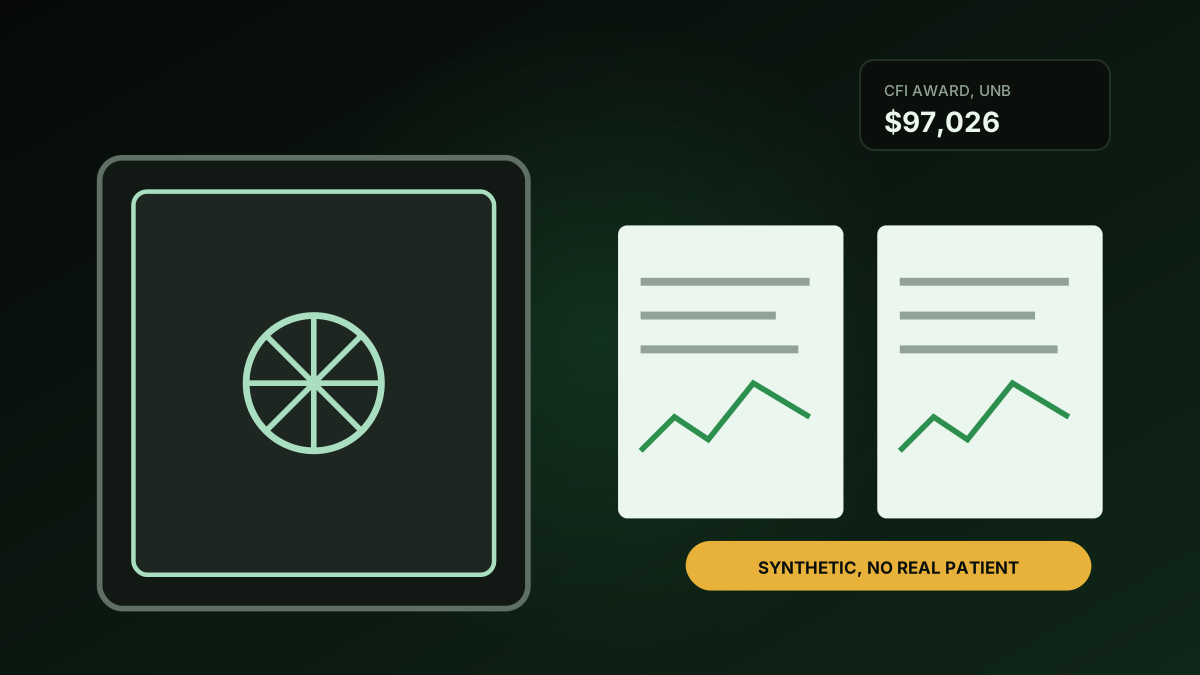
The University of New Brunswick landed infrastructure money from the Canada Foundation for Innovation for three campus projects — and the most tech-facing of them is a Machine Learning Health Vault meant to produce realistic health data that is not anyone's real chart.
UNB's newsroom posted the campus breakdown August 20, the same day CFI announced $118,188,220 for 357 projects at 68 postsecondary institutions nationally. All three UNB awards come through the John R. Evans Leaders Fund, the CFI stream for equipping individual researchers — 334 of the 357 projects, and $97.5 million of the total — rather than the College Fund that covers the rest. UNB's share is $397,026 from CFI, plus institutional and provincial matching on top.
Synthetic health data without the patient
Dr. Scott Bateman (Computer Science; Data Science and AI Research Institute) leads the Health Vault with co-applicants Dr. Stijn De Baerdemacker (Chemistry; same institute) and Dr. Ted McDonald (Political Science; DataNB). CFI's share is $97,026, with another $48,513 from UNB.
The project combines advanced AI with administrative-data research to generate synthetic health data — records built from detailed patterns in real health information without corresponding to any real person's file. The goal, per UNB, is data-informed policy and patient-care decisions made without risking exposure of New Brunswickers' personal health information.
That is the tradeoff administrative-data shops have been chasing for years. It matters here because the province's health data already sits in production systems and patient-facing apps — the same records surfaced through tools like MyHealthNB — and researchers who want to model on them run into privacy limits long before they run into compute limits. A synthetic layer is the standard workaround; the CFI award funds the machinery to build one against New Brunswick's own patterns.
McDonald's involvement is the tell on scope: DataNB is UNB's administrative data research centre, the shop that already works with linked provincial records. Pairing it with the Data Science and AI Research Institute puts the modelling and the data governance in the same project rather than in two solitudes.
Microplastics and aluminum dross, same envelope
The other two awards are engineering and chemistry infrastructure with clear provincial stakes:
- Dr. Zunaira Asif and co-applicant Dr. Ikrema Hassan (Engineering) receive $150,000 (plus $14,616 from UNB) for "From Source to Sink," tracing microplastics across air, water, and sediment with drones, Raman microscopy, and advanced computing — aimed at the standardized datasets that environmental monitoring still lacks for the smallest particles.
- Dr. Barry Blight (Chemistry) and Dr. Kyle Rogers (Chemical Engineering) receive $150,000 from CFI to build a lab that scales their aluminum dross digestion technique, which cuts refinery waste while producing specialty materials and zero-carbon fuel. That project also draws $133,349 from UNB and $150,000 from ResearchNB.
Vice-president research Dr. David MaGee tied the three together in the UNB release: the CFI money supports researchers "in helping us collectively address the growing impact of microplastics, make better healthcare decisions while protecting privacy, and improve the environmental sustainability of manufacturing and energy systems."
For the provincial tech beat, the Health Vault is the piece that ties campus AI capacity to DataNB's administrative-data world — with a dated dollar figure attached.
Sources
- New funding will support UNB research in microplastics, privacy-preserving data science, and aluminum refining — UNB Newsroom (Aug 20, 2026) — project leads and co-applicants, dollar amounts, MaGee quote, ResearchNB / UNB matching, synthetic-data description
- CFI invests $118 million to equip the researchers shaping Canada's future — Canada Foundation for Innovation (Aug 20, 2026) — $118,188,220 across 357 projects at 68 institutions; JELF (334 projects) vs. College Fund split; UNB project titles and amounts
- DataNB — University of New Brunswick — administrative data research centre co-applicant affiliation
- VeroSource and the App Behind MyHealthNB — NB Tech News — provincial health-record context
ChronologyUNB· 35 stories since Nov 20, 2024
- Gray Wolf Analytics Brings Scam-Detection Playbook to UNB's RBC Lunch & Learn
- McKenna Institute Pulls District Tech Leads to Chelmsford to Scale Teacher Upskilling
Chronology · show all 35 storiesShow fewer
- Sussex Elementary Opens a Saber STEAM Studio for Robotics and 3D Printing
- UNB Joins $5M National Push to Keep AI Weather Forecasts Grounded in Physics
- UNB's Fifth-Scale ATV Predicts the Ground Under Each Wheel — and Left AI Out of It
- Mastercard's Canada Security VP Keynoted CIC's Fredericton Summit — Then Toured the IoT Lab It Funds
- UNB Names Its First Digital Agriculture Chair — and He Starts With Small Farms
- UNB Sent Middle Schoolers Back to Class With Games, Websites and AI
- Review: UNB's Scott Bateman on the Three AI Myths That Won't Die
- UNB's Machine Learning Health Vault Wins CFI Infrastructure Funding (this story)
- UNB Co-Authors Confirm the First Native Sulfur Ever Found on Mars
- UNB Researchers Threat-Model the Protocols That Let AI Agents Act
- UNB Researchers Build a Practical Roadmap for the Post-Quantum Migration
- UNB Poster Weighs the Privacy Cost of Federated-Learning Aggregation
- UNB Researchers Deploy Collaborative AI Agents to Guard Power-Substation Networks
- UNB Researchers Build a Mixture-of-Experts Defence Against Adversarial AI Attacks
- UNB Researchers Make AI Malware Detection Explainable with a 'Dual Prototype' Framework
- UNB Researcher Takes a Geometric Axe to Optimization's Symmetry Problem
- UNB Researcher's 'Trust Passport' Would Stamp Every AI Reply with Its Risk Profile
- National Cyber Agencies and Big Banks Head to Fredericton for UNB's Cybersecurity Summit
- When the First Canadian Flew to the Moon, Fredericton Was Listening
- UNB Partners with Talent Innovation Canada to Put Grad Talent Inside Industry R&D
- McKenna Connect Puts UNB Mentors Beside 250 Rural Neighbours
- Cybersecurity Pioneer Ali Ghorbani Named to the Order of New Brunswick
- McKenna Institute's TeXplore Turns 17 Days Off School Into Soldering, Robots and AI
- SeaGreen Puts Seaweed Biochar in Ten Queen Street Flower Planters
- UNB Stitches Its Startup Machinery Into One Network
- Creduman Takes Top Spot at UNB’s MTME: NEXT 2026
- Four UNB MTME Startups Launch Next Week at MTME: NEXT
- The UNB Startup Pipeline: How a Fredericton Campus Keeps Minting Companies
- How Fredericton Became a Cybersecurity Town
- A Century of Circuits: UNB's Electrical Engineering Program Turns 100
- First Cheques: UNB's Fraser Fund Backs SpatialOne, Profitual, and AinaTest
- Gray Wolf Analytics: Crypto Forensics from a Fredericton Classroom
- Three Years In, the McKenna Institute Is Quietly Rewiring New Brunswick
Related coverage
News · August 19, 2026
UNB Poster Weighs the Privacy Cost of Federated-Learning Aggregation
News · September 24, 2026
UNB Joins $5M National Push to Keep AI Weather Forecasts Grounded in Physics
News · August 19, 2026
UNB Researchers Threat-Model the Protocols That Let AI Agents Act