
News4 min read
UNB's Fifth-Scale ATV Predicts the Ground Under Each Wheel — and Left AI Out of It


CBC filmed Sys-MoDEL's MARV, a one-fifth-scale research vehicle with independent steering, torque, and brakes. Kush Bubbar says the control tech could reach production ATVs within five years.
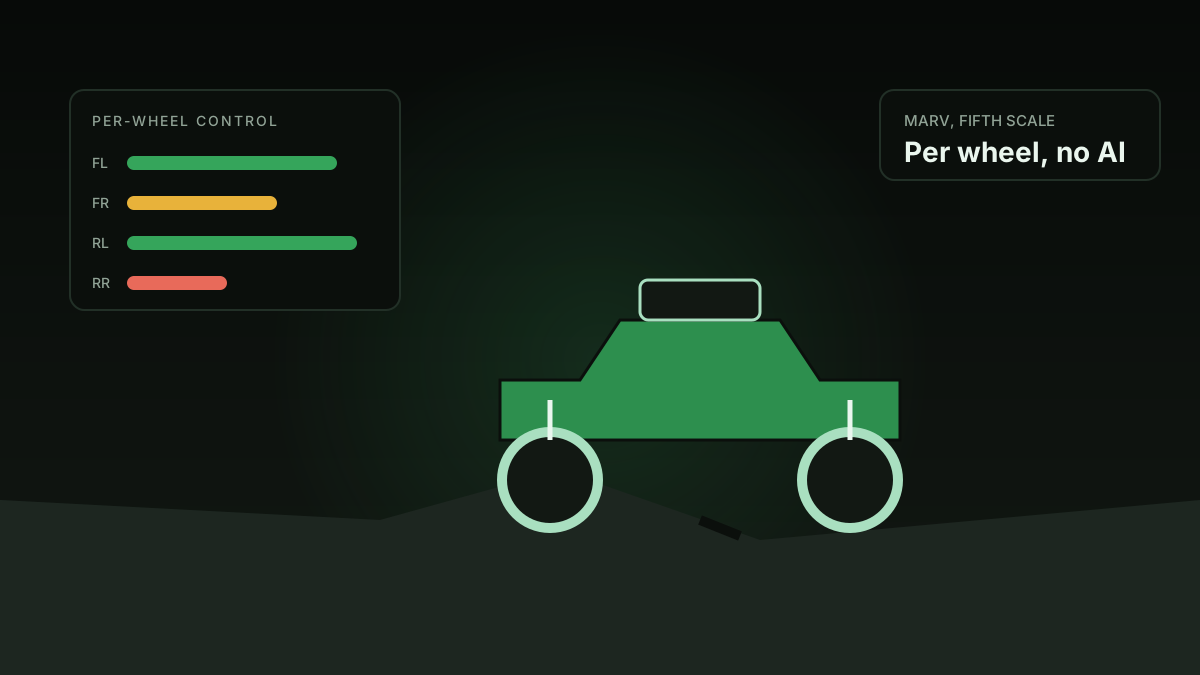
CBC New Brunswick published Monday on a five-year University of New Brunswick project that has been sitting in Sir Edmund Head Hall: MARV, the Multi-Actuated Research Vehicle. Isabelle Leger's piece is the first local-news look at a machine the lab has been publishing about all year — a one-fifth-scale electric platform that can steer, torque, and brake each wheel on its own, then decide in real time whether the next patch of ground is about to roll the vehicle.
It is not a consumer ATV. It is a research mule whose algorithms, the team told CBC, could be licensed into ones that are.
Kush Bubbar, the associate professor who runs the lab, put the New Brunswick case in one sentence: ATVs and off-roading are "an incredibly important part of Canadian life and in particular rural life, especially here in New Brunswick." CBC cited Statistics Canada for the other half of that sentence — about 100 ATV-related deaths a year in Canada, and rollovers in 45 percent of the fatalities, often when a driver does not catch a slope, embankment, or sudden change under the tires.
Four wheels, four opinions
MARV lives in UNB's Sys-MoDEL — the System-Level Model Development Engineering Lab — which Bubbar founded after a decade in Canadian industry. The December 2025 campus feature described two scaled electrics: HARV, a one-tenth-scale active-suspension mule, and MARV, one-fifth scale, with a drive motor and steering actuator at each corner. In May, Benjamin DeBoer, Jeremy Kimball, and Bubbar published the platform in Actuators as an over-actuated X-by-wire testbed — independent drive, steer, brake, and suspension — meant to sit in the gap between simulation and a full-size vehicle you would rather not crash.
CBC's version of that hardware is the safety pitch. Each wheel can answer a different surface at the same time. Sharper turns and crab-walk / turn-in-place manoeuvres fall out of the same independence; the stated job is still rollover prevention. "If the vehicle was a person and could feel the ground and feel the terrain, would that enable the vehicle to make choices in real time and adapt?" Bubbar asked. The driver stays in charge. The vehicle assists.
DeBoer — CBC spells it Deboer; the papers use DeBoer — is the PhD student who moved from Ontario for this. On-road autonomy, he told CBC, is mostly proven on California pavement. Off-road is sand until it is rock. "That makes the control problem significantly more difficult." UNB's earlier piece had him naming the provincial industries that live on that problem: forestry, agriculture, mining, and recreational off-road.
They tried AI. Then they stopped.
The control stack is math. Bubbar told CBC the team tried machine learning early and dropped it when the question became whether a model would ever be allowed to hurt someone. "There's no guarantee that AI is going to make a choice that doesn't harm people and that in itself was a deal breaker for us." He allowed that AI is already common on paved-road systems; off-road, he said, is too unpredictable for that bargain.
That is the opposite of the usual campus-AI press release, and it is the part of the CBC interview that actually changes the story. The lab is not claiming a smarter chatbot in the dash. It is claiming a vehicle that can predict tire–terrain interaction well enough to keep the shiny side up.
A hub, not a showroom
CBC says the project already pulled in Chalmers University of Technology in Gothenburg — and, through Chalmers' work with Volvo, monthly meetings with the Swedish carmaker. Bubbar's line is that there are not many platforms in the world you can run these algorithms on, so other groups want time on this one. A lot of testing is still ahead. His own timeline, given to CBC: the technology could be on assembly-line ATVs within five years.
Ownership is split the way university hardware often is. The physical MARV stays with UNB as a testbed. The apply-to-market intellectual property, CBC reported, sits with DeBoer as lead researcher and would have to be sold or licensed before it shows up in a dealer lot.
The lab itself is larger than one mule. UNB named research engineer Caleob Maher-Watson on both HARV and MARV, and a motor-control partnership with Victory Advanced Technologies. ResearchNB has separately described Sys-MoDEL's off-road work as a collaboration with Fredericton's Potential Motors — the company that started as a student project Bubbar supervised and now sells terrain-perception software. That is a related Fredericton specialty, not this vehicle. MARV is the campus platform. Potential Motors is the commercial stack.
Bubbar also teaches in the J. Herbert Smith Centre. The lab publishes firmware and course repos under a GitHub org that lists Fredericton and sysmodel@unb.ca. None of that is a product launch. The news is simpler: a provincial broadcaster put a one-fifth-scale ATV on camera, and the people who built it said the algorithms are the part that might leave campus.
Sources
- CBC: Meet Marv, a UNB-created vehicle that could make riding an ATV safer — Isabelle Leger, Sept. 7, 2026; MARV hardware, Bubbar and DeBoer interviews, Statistics Canada fatality figures, Chalmers / Volvo meetings, five-year ATV timeline, IP split
- UNB: Navigating tough terrain — Dec. 9, 2025 campus feature; Sys-MoDEL, Sir Edmund Head Hall, HARV / MARV scales, DeBoer and Kimball quotes, Maher-Watson, Victory Advanced Technologies
- DeBoer, Kimball, Bubbar, Actuators 15(5):272 — May 12, 2026 open-access paper on the 1:5 X-by-wire MARV platform
- ResearchNB: Powering Up New Technologies and Student Change-Makers — Sys-MoDEL / Potential Motors collaboration; Bubbar as the student-project supervisor
- Sys-MoDEL — lab site
- Sys-MoDEL on GitHub — Fredericton org, student firmware and architecture repos
ChronologyUNB· 35 stories since Nov 20, 2024
- Gray Wolf Analytics Brings Scam-Detection Playbook to UNB's RBC Lunch & Learn
- McKenna Institute Pulls District Tech Leads to Chelmsford to Scale Teacher Upskilling
Chronology · show all 35 storiesShow fewer
- Sussex Elementary Opens a Saber STEAM Studio for Robotics and 3D Printing
- UNB Joins $5M National Push to Keep AI Weather Forecasts Grounded in Physics
- UNB's Fifth-Scale ATV Predicts the Ground Under Each Wheel — and Left AI Out of It (this story)
- Mastercard's Canada Security VP Keynoted CIC's Fredericton Summit — Then Toured the IoT Lab It Funds
- UNB Names Its First Digital Agriculture Chair — and He Starts With Small Farms
- UNB Sent Middle Schoolers Back to Class With Games, Websites and AI
- Review: UNB's Scott Bateman on the Three AI Myths That Won't Die
- UNB's Machine Learning Health Vault Wins CFI Infrastructure Funding
- UNB Co-Authors Confirm the First Native Sulfur Ever Found on Mars
- UNB Researchers Threat-Model the Protocols That Let AI Agents Act
- UNB Researchers Build a Practical Roadmap for the Post-Quantum Migration
- UNB Poster Weighs the Privacy Cost of Federated-Learning Aggregation
- UNB Researchers Deploy Collaborative AI Agents to Guard Power-Substation Networks
- UNB Researchers Build a Mixture-of-Experts Defence Against Adversarial AI Attacks
- UNB Researchers Make AI Malware Detection Explainable with a 'Dual Prototype' Framework
- UNB Researcher Takes a Geometric Axe to Optimization's Symmetry Problem
- UNB Researcher's 'Trust Passport' Would Stamp Every AI Reply with Its Risk Profile
- National Cyber Agencies and Big Banks Head to Fredericton for UNB's Cybersecurity Summit
- When the First Canadian Flew to the Moon, Fredericton Was Listening
- UNB Partners with Talent Innovation Canada to Put Grad Talent Inside Industry R&D
- McKenna Connect Puts UNB Mentors Beside 250 Rural Neighbours
- Cybersecurity Pioneer Ali Ghorbani Named to the Order of New Brunswick
- McKenna Institute's TeXplore Turns 17 Days Off School Into Soldering, Robots and AI
- SeaGreen Puts Seaweed Biochar in Ten Queen Street Flower Planters
- UNB Stitches Its Startup Machinery Into One Network
- Creduman Takes Top Spot at UNB’s MTME: NEXT 2026
- Four UNB MTME Startups Launch Next Week at MTME: NEXT
- The UNB Startup Pipeline: How a Fredericton Campus Keeps Minting Companies
- How Fredericton Became a Cybersecurity Town
- A Century of Circuits: UNB's Electrical Engineering Program Turns 100
- First Cheques: UNB's Fraser Fund Backs SpatialOne, Profitual, and AinaTest
- Gray Wolf Analytics: Crypto Forensics from a Fredericton Classroom
- Three Years In, the McKenna Institute Is Quietly Rewiring New Brunswick
Related coverage
News · September 24, 2026
UNB Joins $5M National Push to Keep AI Weather Forecasts Grounded in Physics
News · September 2, 2026
UNB Names Its First Digital Agriculture Chair — and He Starts With Small Farms
News · August 21, 2026
UNB's Machine Learning Health Vault Wins CFI Infrastructure Funding