
News5 min read
N.B. Lawyer Admits Filing AI Briefs With Fake Citations


Denis Sawyer faces a Sept. 3 Law Society discipline hearing after admitting he used generative AI incompetently and filed a Provincial Court brief in which 10 of 12 citations were fictitious.
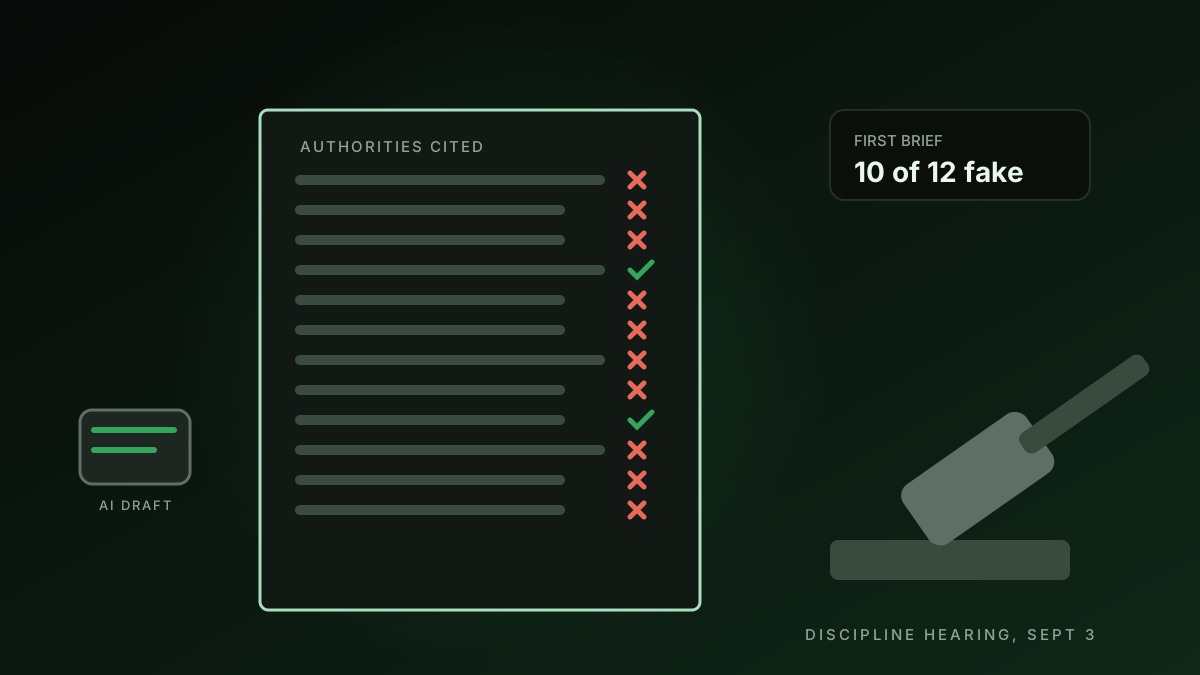
A New Brunswick criminal defence lawyer has admitted to the Law Society that he filed Provincial Court briefs built with generative AI — including a first brief where 10 of 12 citations were fictitious — and will face a discipline hearing in Fredericton on September 3.
The case, reported by CBC News on Aug. 4 and by the Telegraph-Journal (Matthew Daigle) on Aug. 10, is not another viral prompt gaffe. It is a formal professional-conduct file with public charging documents, an admission on the record, and a practice restriction already in force. The Discipline Committee has not yet made a finding or imposed a sanction.
What the Law Society filed
On July 22, 2026, registrar of complaints Joleen Dable issued a Form 22 Notice of Complaint against Denis Sawyer. Two charges go to the Discipline Committee:
Fictitious citations. On or around April 29, 2025, Sawyer signed and filed a brief with the New Brunswick Provincial Court. Ten of twelve citations were fictitious. After he was told, he filed a second brief that removed almost all of the fakes except two, one of which still carried an attributed quote. At the hearing, at opposing counsel’s request, he disavowed both briefs and asked the court to consider only oral submissions. The Society alleges breaches of Code rules on integrity, competence, quality of service, and advocacy.
Incompetent generative AI use. Sawyer used generative AI to prepare the briefs and did not properly review them before filing — contrary to the same Code rules plus Appendix B – Guidelines on Ethics and New Technology.
Law Society counsel for the hearing are Joël Michaud, K.C., and Destiny Grant of Pink Larkin in Fredericton. The complaint does not name the underlying Provincial Court matter.
Sawyer’s admission — and an earlier AI ban
In a reply dated July 17, 2026, at Shediac — posted publicly with the hearing materials — Sawyer wrote:
“With respect to the contents of paragraphs 2.1 and 2.2 of the Notice of Complaint, I, Denis Sawyer, admit the contents of the said paragraphs and accept full responsibility for my oversight.”
A Notice of Hearing dated August 4 sets the Discipline Committee panel for September 3, 2026, at 9:30 a.m. at the Law Society offices, 68 Avonlea Court, Fredericton.
The AI problem was already constrained months earlier. On April 16, 2026, the Complaints Committee — with Sawyer’s consent — imposed a practice restriction: he shall not use generative artificial intelligence in his practice of law until the Discipline Committee finally disposes of the complaint. The notice identifies him as Denis Sawyer of Miramichi.
Sawyer practises with Murphy’s Law, a Miramichi-based criminal firm that also serves clients elsewhere; the firm confirmed to CBC that he remains employed there, and the Telegraph-Journal describes him as based in Dieppe and handling cases across the province. He is allowed to keep practising while the complaint is outstanding, subject to the AI restriction.
Sawyer did not respond to Brunswick News, the Telegraph-Journal reported, and Tim Murphy, head of Murphy’s Law, declined to comment, saying he was not at liberty to speak for Sawyer.
First of its kind here — not the last in Canada
Dable told CBC the Society had not previously handled a complaint about improper AI use. “The use of AI is not prohibited,” she said by email. “However, lawyers remain responsible for complying with their professional obligations … regardless of whether AI is used in the provision of legal services.” Council has established a task force to develop guidance for members on responsible AI use; that work is ongoing.
New Brunswick is not an outlier. University of Ottawa legal-ethics professor Amy Salyzyn told CBC there has been an “accelerating trend” of Canadian lawyers facing complaints over their AI use, with the first cases appearing in 2023: “We need to make sure that we try and, you know, stem this accelerating tide, because it doesn’t show any signs of going away on its own.” Because the common law runs on precedent, she said, fabricated cases in filed documents cut at the integrity of the justice system — “you don’t really have rule by law. You have rule by … machine fabrications.”
Global News put numbers to the pattern, citing Courtyready tallies of Canadian court and tribunal decisions involving AI-fabricated legal materials rising from 7 in 2024 to 87 in 2025, with 74 already documented in the first half of 2026. UNB law professor Norman Siebrasse drew the line for Global: “Using AI is not unethical in itself. What is unethical is using AI incompetently.”
Why it matters on a tech desk
This is the courtroom version of a failure mode New Brunswick has already seen in lighter form: an MLA reading an apparent chatbot rewrite prompt into Hansard. The legislature clip was embarrassing. Fake citations in a filed brief are structural — common-law courts reuse precedent, so invented authorities are not just a personal mistake.
The useful provincial read is narrow. Generative tools are inside ordinary professional work here. The Law Society’s first AI discipline file says the enforcement question is competence and verification, not whether the software exists. On September 3, a panel decides whether the admitted conduct deserves sanction — and if so, what.
Primary documents
Every filing quoted above is a public notice posted by the Law Society of New Brunswick, indexed on its discipline history list (updated Aug. 4, 2026). Readers can check this story against the originals:
- Form 22 — Notice of Complaint (PDF) — July 22, 2026. The two charges: fictitious citations (para. 2.1) and incompetent generative-AI use (para. 2.2); the April 29, 2025 brief and the 10-of-12 count; Code rules 2.1-1, 3.1-2, 3.2-1 and 5.1-1 plus Appendix B; Law Society counsel. Signed by registrar of complaints Joleen Dable.
- Reply to the Notice of Complaint (PDF) — July 17, 2026, Shediac. Sawyer’s one-paragraph admission of paragraphs 2.1 and 2.2, quoted in full above.
- Form 23 — Notice of Hearing (PDF) — Aug. 4, 2026. Sets the Discipline Committee hearing for Sept. 3, 2026, 9:30 a.m., 68 Avonlea Court, Fredericton.
- Notice to the Profession — restricted practice (PDF) — April 16, 2026. The Complaints Committee’s consent condition barring Sawyer from using generative AI in his practice until the complaint is finally disposed of.
News coverage
- Complaint about lawyer's alleged improper AI use a first for N.B., law society says — CBC News (Savannah Awde) — Aug. 4, 2026; Dable and Salyzyn quotes; Murphy’s Law employment; first-in-province framing
- Lawyer admits to AI use in legal briefs that cited fake articles — Telegraph-Journal / Times & Transcript (Matthew Daigle) — Aug. 10, 2026; Dieppe base, firm and Sawyer comment requests (subscriber-only)
- Complaint against New Brunswick lawyer’s use of AI part of growing trend: experts — Global News (Rachel Morgan, Reeti Rohilla) — Aug. 4, 2026; Siebrasse quote; Courtyready national counts
Related coverage
News · August 26, 2026
Public Money Backed a Fredericton Crime AI. U.S. Courts Then Walked Away
News · October 9, 2026
Fredericton Firm Pitches Miramichi a 375-Megawatt Data Centre Campus
News · October 2, 2026
McKenna Institute Pulls District Tech Leads to Chelmsford to Scale Teacher Upskilling