
News8 min read
Public Money Backed a Fredericton Crime AI. U.S. Courts Then Walked Away


Global Intelligence took more than $1.4 million in Canadian public support to build CyberCheck. Canadian police never used it. U.S. prosecutors later withdrew it from murder files after CBC and WIRED documented reports that could not be checked and testimony that did not hold.
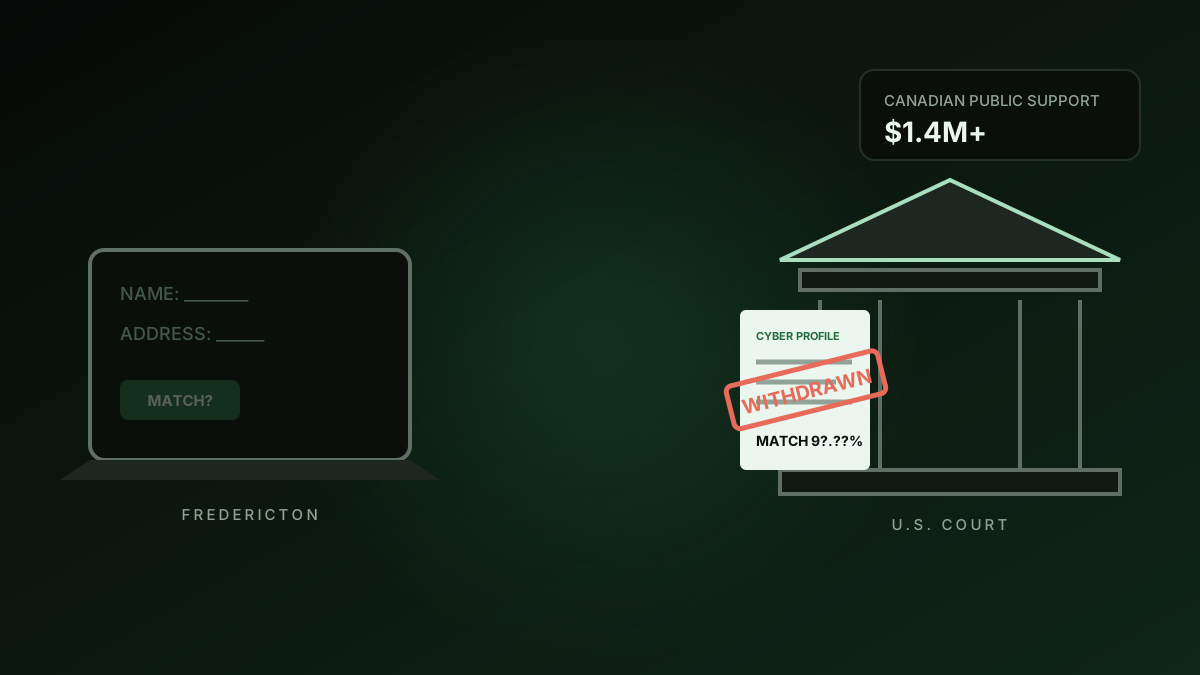
A Fredericton company sold U.S. police an “AI witness”: feed it a name or a crime-scene address, and CyberCheck would say — often to two decimal places — whether a suspect’s “cyber profile” had been there. People went to prison for murder after that output reached a jury. Canadian agencies helped pay to build it. Canadian law enforcement never bought it.
This is a synthesis of reporting already in the public record — CBC News and The Expert Witness, WIRED, NBC News, and the Akron Beacon Journal. We have not independently obtained the U.S. police emails those outlets published. The company’s site is still selling the same pitch.
The product New Brunswick funded
Adam Mosher founded Global Intelligence Inc. in 2017 after about seven years as security director at Bulletproof Solutions in Fredericton. Nothing in the reporting connects his former employer to CyberCheck, which did not exist until after he left.
The claim, still on cybercheck.ai as of August 26, 2026, is that machine learning scrapes the surface, deep, and dark web — “location modelling, digital footprints, anomaly recognition and mobile signals” — and produces “defensible cyber evidence.” The site advertises an 80 percent confidence threshold. In U.S. court, WIRED and Business Insider report, Mosher described more than 700 algorithms, a million lines of code, a fully automated pipeline, and accuracy above 90 percent, including the ability to say a phone pinged a nearby Wi-Fi network without the phone itself.
CBC reports Canadian law enforcement never took the tool up. Mosher offered it to Alberta prosecutors in 2020 in a case involving his wife’s brother; they declined. He later told U.S. courts he had been an expert witness in that prosecution. CBC and WIRED report the defendant pleaded guilty and Mosher never testified. In a second Canadian matter he cited on the stand, CBC says there was not even an arrest.
The company sold into the United States instead. One 2022 stretch of testimony, as WIRED recounts it, claimed 345 agencies and about 24,000 searches since 2017. A later court citation quoted by NBC put usage at nearly 8,000 cases across 40 states.
Who paid
CBC tallied ten payments totalling more than $1.4 million from Public Services and Procurement Canada, the New Brunswick Office of the Comptroller, the New Brunswick Innovation Foundation, the Atlantic Canada Opportunities Agency, Opportunities NB, and the National Research Council. The Halifax Examiner, from federal grant records in May 2024, published a narrower slice: about $115,000 in ONB tax subsidies in 2017, plus $380,629 in NRC and ACOA grants from 2018 to 2024.
ONB also put Mosher on a stage. CBC published a photo of him with then-deputy premier Stephen Horsman, ONB CEO Stephen Lund, and other ONB staff at a promotional event.
The Akron file that would not stay the same
The case that cracked the product open is in Ohio. In August 2020, a drive-by in Akron killed 20-month-old Tyree Halsell. Sprint location data and a Google geofence warrant did not place suspect Phillip Mendoza at the scene. In August 2022, CyberCheck delivered a three-page report that did.
Defence lawyer Don Malarcik found a problem. The police employee who queried the system had entered August 20, not the shooting date of August 2. CyberCheck still placed Mendoza on the 1200 block of Fifth Avenue with 93.13 percent accuracy — on the wrong day. A later report, WIRED found, was identical in MAC addresses, time of day, duration, and accuracy score, except it now used the correct date. The company stands by both: “It is not uncommon to have the same cyber profile with the same device at a location on a different date.”
Malarcik asked for a Daubert hearing — the U.S. reliability test for expert evidence. Two days before it, Summit County prosecutors dropped CyberCheck from Mendoza’s file. Mendoza later pleaded guilty. Under prosecutor Elliot Kolkovich, the Beacon Journal reported, the office then dropped the tool from more than half a dozen murder cases and said it would wait on independent replication — without access to software Mosher calls proprietary.
In two other Akron trials — Salah Mahdi and Adarus Black — defence lawyers did not challenge CyberCheck and juries convicted. Those convictions were upheld on appeal. That is not a finding that the software works. It is a finding that nobody forced the black box open.
What cannot be checked
Mosher has testified that CyberCheck uses only open-source data — the kind that does not need a warrant — and does not keep the raw material. In a January 2024 Texas Daubert hearing, WIRED quotes him saying the system could not preserve “all the artifacts and all the data that we crawl” because “it’s zettabytes of data.” Reports keep what the algorithms deem relevant. Contradictory hits are supposedly used to compute the accuracy score, then discarded.
Rob T. Lee, chief AI officer at the SANS Institute — the same shop Mosher has cited for his own training — reviewed reports and testimony for CBC and WIRED. To know when a device pinged a specific wireless network, he told WIRED, an analyst would need to intercept the signal or read device or network logs. Those are not public web pages. “Those equations don’t exist,” he told CBC. “It’s astrology, and you can’t do astrology in a courtroom.”
Digital-forensics experts who saw code in a related case, Malarcik told WIRED, found a couple of hundred lines that searched public websites — “the equivalent of what you would do on a Google search” — not the million-line machine-learning stack described on the stand.
Mosher testified into October 2023 that CyberCheck had never been peer-reviewed. On October 30 he told an Ohio judge the University of Saskatchewan had reviewed it. The judge ordered the study produced. What Mosher filed, NBC reports, was a 47-page document dated 2019 that reads as software instructions — no reviewer, no findings. The university later told CBC that no peer review of CyberCheck was ever performed. It had held a research contract with Global Intelligence tied to the National Research Council — the same federal funder in the grant record. A contract is not a peer review.
WIRED’s public-records emails, consistent with CBC’s FOI sweep, show no documented example of CyberCheck solving a crime, and several agencies telling others to stay away.
- Ohio’s Bureau of Criminal Investigation signed a $30,000 trial contract in 2023, submitted more than a dozen cases, and told WIRED many results never arrived and some leads “haven’t panned out.” It did not renew.
- Aurora, Colorado detective Nicholas Lesnansky: a “router” CyberCheck tied to a homicide sat at a house whose resident of 20 years said that router name had never been there. In a second case, Global Intelligence staff were “adamant” they had identified a killer; detectives were pointing at someone else.
- Mississippi analyst Heather Collins, on a missing-juvenile file: “They gave us information on possible ‘suspects’ and it wound up being completely false. … They wasted our time.”
- A Dallas FBI violent-crimes detective, quoted by CBC: “I would not use them under any circumstances.”
The closest thing to a success is thin. A South Elgin, Illinois sergeant told WIRED a report placed a missing child and her mother in Oregon — a location later suggested by other work. He still could not get a warrant. The report came with no supporting evidence.
What the company said
Global Intelligence and Mosher largely declined detailed questions from WIRED, NBC, and CBC. An unnamed employee told WIRED that Mosher’s Canadian “expert witness” claims were a “lost-in-translation issue as opposed to some sort of impropriety,” and that other prosecutors had reviewed the matter. WIRED asked for those prosecutors’ names and did not get them. The same employee said agencies “backstop” CyberCheck with their own analysts. The company did not explain how a Wi-Fi ping years after the fact is supposed to appear in open-source data.
The Summit County sheriff’s office told the Beacon Journal and Business Insider it was investigating whether Mosher lied under oath — specifically about the peer review the University of Saskatchewan says never happened. We have not seen a public charging decision. Mosher has not been charged in connection with that inquiry.
Meanwhile the marketing site is unchanged. “You’re not just solving crimes,” it still says; “you’re bringing hope and closure to victims and their families.”
Why it matters here
New Brunswick has a real cybersecurity cluster — Lastwall, Beauceron, Sonrai, TrojAI — companies that ship products customers can test. Lastwall’s CMMC Level 2 is what that pitch looks like when a customer can audit the work. CyberCheck is what it looks like when economic-development agencies write cheques for a black box, the domestic market says no, and the export market is under-resourced U.S. police departments.
The provincial questions are procurement ones: who at ONB, NBIF, ACOA, and NRC signed off, on what technical diligence, and whether anyone has asked for the money back. The next time CyberCheck is named as part of New Brunswick’s cyber success, the court history belongs next to the press photo.
Sources
- Cybercheck was hyped as a revolution in criminal detection — CBC News — David Waters; public-money tally (ten payments, more than $1.4 million); Canadian non-adoption; Alberta / expert-witness claims; SANS “astrology” quote; U.S. FOI sweep; ONB stage photo
- The Expert Witness — transcripts and listen links — CBC Radio — nine-episode Uncover series hosted by Sam Mullins, released 2026; Malarcik interviews, Mosher interviews, University of Saskatchewan response
- This AI Tool Helped Convict People of Murder. Then Someone Took a Closer Look — WIRED — Todd Feathers, Oct. 15, 2024; Mendoza wrong-day reports; no data retention; Ohio BCI / Yakima / Aurora / Mississippi emails; Lee and Coulthart; company “lost-in-translation” reply
- An AI tool used in thousands of criminal cases is facing legal challenges — NBC News — usage figures; New York exclusion; proprietary-code refusals; Saskatchewan peer-review reversal
- CyberCheck was a lauded crime-solving software, then attorneys questioned its credibility — Akron Beacon Journal — Kolkovich withdrawals; independent-replication pause; sheriff’s-office inquiry
- AI Crime Tool Founder Investigated for Providing False Info to Court — Business Insider — Black-trial testimony details; Summit County sheriff inquiry
- This Fredericton man is using untested ‘artificial intelligence’ to help convict people across the United States — Halifax Examiner — Tim Bousquet, May 7, 2024; ONB subsidy and NRC/ACOA grant line items
- CyberCheck — company site — current marketing claims, 80% threshold, “defensible cyber evidence,” checked Aug. 26, 2026
Related coverage
News · September 6, 2026
Mastercard's Canada Security VP Keynoted CIC's Fredericton Summit — Then Toured the IoT Lab It Funds
News · August 19, 2026
UNB Researchers Threat-Model the Protocols That Let AI Agents Act
News · August 19, 2026
UNB Poster Weighs the Privacy Cost of Federated-Learning Aggregation