
Analysis3 min read
N.B. Business Leaders' Barometer: Tired, Short-Staffed and Still Planning to Grow
Drafted with AI (Muse Wonder) and edited by NB Tech News staff. How we use AI


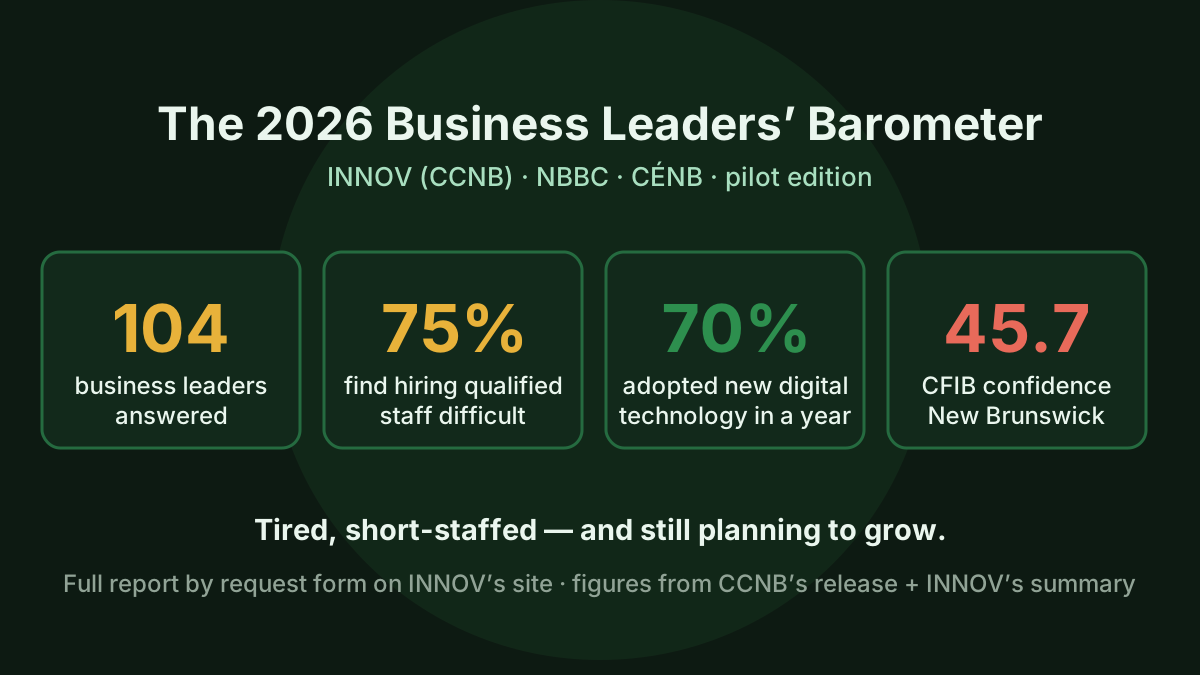
INNOV's first Business Leaders' Barometer heard from 104 New Brunswick leaders: 75% find hiring qualified staff difficult, 70% adopted new digital technology in a year, and nearly one in two reports frequent overload.
New Brunswick business leaders are tired, short-staffed and still planning to grow. That is the picture from the first Business Leaders' Barometer, an applied-research survey by INNOV, the innovation and applied-research centres of the Collège communautaire du Nouveau-Brunswick (CCNB), released Oct. 21.
The exploratory portrait is based on 104 responses from business leaders and organizational managers across the province. INNOV ran it with the New Brunswick Business Council (NBBC) and the Conseil économique du Nouveau-Brunswick (CÉNB). Data collection closed Aug. 21 — the day before new U.S. tariffs took effect, CCNB notes — so the results are a reference point taken just before that escalation.
Hiring is the hard part
Three quarters of respondents, 75%, said recruiting qualified staff is difficult. Almost as many, 72%, said they invest in training and developing the employees they already have.
The launch release in March framed the workforce question as one of the survey's main threads, alongside investment intentions, growth plans and strategic priorities. The questionnaire was designed to take about 10 minutes.
Growth plans, slowdown fears
Asked about what comes next, 64% of respondents said they fear an economic slowdown. At the same time, 45% expect their revenues to rise and only 10% plan to scale back their activities.
Technology adoption sits on the growth side of the ledger: 70% of respondents said they had adopted new digital technologies in the 12 months before answering.
The survey also asked how leaders are doing
The Barometer measured morale and well-being alongside business intentions. "For the first time, we measured not only what leaders foresee, but also what they are experiencing," Mohammed Bellamine, an INNOV researcher who leads the Barometer, said in the release (translated from French). "Nearly one respondent in two reports frequent overload, and nearly three in four say they are interested in, or open to, support programs for their resilience. The interest is there. It remains to be seen whether such support exists, whether it is known, and whether it is accessible to leaders. It is a conversation that concerns our partners and the whole ecosystem."
CCNB is careful about what those answers mean: they are self-reported feelings, the release says, not a clinical diagnosis of burnout.
A second read from CFIB
The Canadian Federation of Independent Business (CFIB) publishes its own monthly Business Barometer. Its October 2026 long-term confidence index for New Brunswick sits at 45.7, as a three-month moving average — below the 50-point line where owners expecting weaker performance outnumber those expecting stronger. The national long-term index held at 50.0 in October.
The two surveys ask different questions of different samples. The CFIB index is a national member survey; the Barometer is a voluntary provincial sample, and INNOV states plainly that its results describe its 104 respondents' perceptions and intentions in 2026 without claiming to represent every business in the province.
The full report is by request
INNOV's results page summarizes the pilot edition, but the full report itself is not a direct download: readers fill in a short form on the results page and the PDF is sent by email, in French or English. Every figure in this story comes from CCNB's release and INNOV's summary page, not from the full report.
The Barometer was launched in Dieppe on Mar. 26 as a twice-a-year measure of leaders' morale, built to track intentions — investment, growth, workforce — rather than only record what has already happened. Participants received an executive summary of the results before the public release.
Sources
- CCNB — Entre inquiétudes et ambitions : le regard de 104 dirigeants et responsables d'organisations du Nouveau-Brunswick (Oct. 21, 2026, French): the release with the hiring, outlook, technology and well-being findings and the Bellamine quote
- INNOV — 2026 Report: New Brunswick Business Leaders' Barometer: the pilot edition's framing, the three partners, the voluntary-sample caveat and the form for the full PDF report
- CCNB — Lancement du baromètre semestriel du moral des chefs d'entreprise du Nouveau-Brunswick (Mar. 26, 2026, French): the launch, the partner organizations and the survey's design
- CFIB — Monthly Business Barometer, October 2026: New Brunswick long-term confidence at 45.7 (three-month moving average) and the national index at 50.0
Related coverage
Analysis · October 15, 2026
DataNB's ICT Workforce Study: N.B. Keeps Its Tech Grads for a Year, Then Loses Many
News · October 20, 2026
Caraquet Lab's New Robot Cell Prints, Scans and Mills Moulds
Analysis · August 11, 2025
'Peak Startup' in Atlantic Canada? What the Question Means for New Brunswick