
Analysis4 min read
DataNB's ICT Workforce Study: N.B. Keeps Its Tech Grads for a Year, Then Loses Many


Four new UNB reports track tech job postings, graduates and immigrants. About 70% of university ICT grads are still in New Brunswick a year out, but only 41% after ten years, and the pay gap with other provinces grows over time.
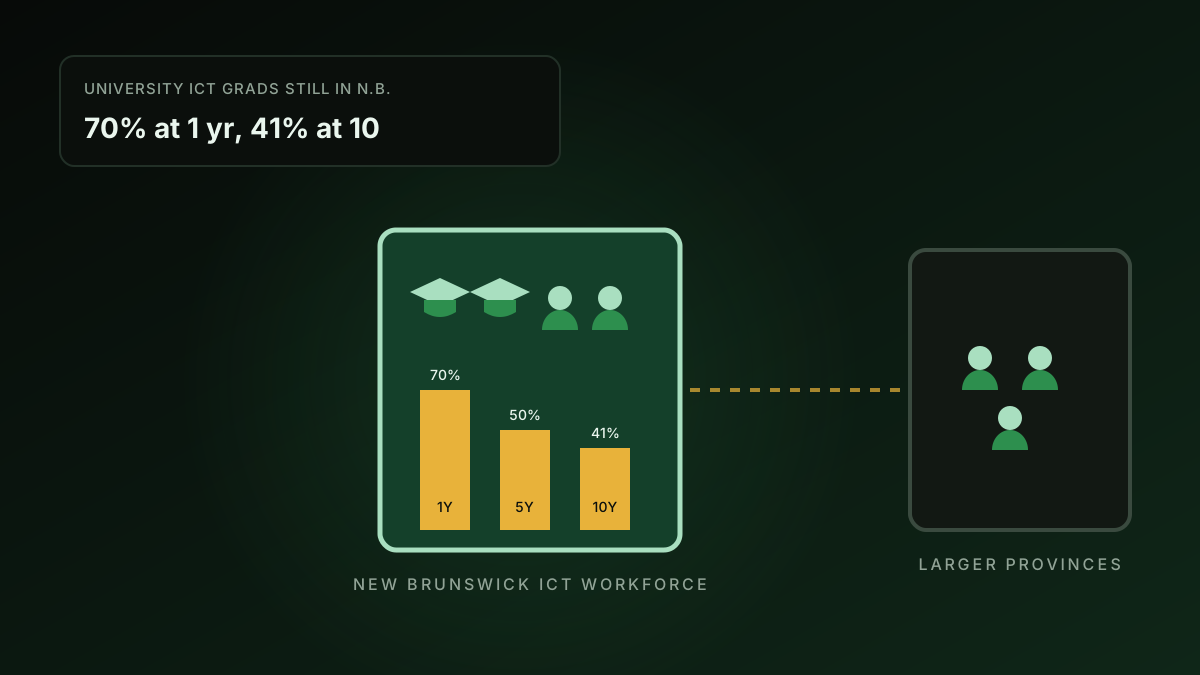
New Brunswick's tech workforce is growing and holds new arrivals for a while, but keeping them for the long run is harder. That is the conclusion of a research program from DataNB, the University of New Brunswick's administrative-data research centre, which UNB published on Oct. 14.
The program has a summary report and four studies, all dated July 2026 and funded by the Atlantic Canada Opportunities Agency. DataNB director Ted McDonald is the principal investigator on all four, and UNB economist Herb Emery, the Vaughan Chair in Regional Economics, co-leads the demand study. The supply and retention reports use linked administrative data, including tax records and Medicare registrations. The demand report uses job-posting data.
Graduates: the one-year number looks good
The retention report finds that N.B. universities have produced about 180 to 200 ICT graduates a year since 2015. Colleges jumped to about 200 a year in 2018 and have stayed there.
| Still in N.B. after | 1 year | 5 years | 10 years |
|---|---|---|---|
| University ICT grads | ~70% | ~50% | 41% |
| College ICT grads | 88% | over 80% | — |
For university graduates, coming from outside the province was the strongest predictor of leaving. Among college graduates, those from another province had nearly 35 times the odds of leaving that N.B.-born grads had. International students now make up nearly half of college ICT graduates, up from under 10%, the report says. They were more likely to stay than N.B.-born college grads, though the authors caution the counts are small and recent.
Immigrants: the nominee program holds best
The Provincial Nominee Program brings in nearly two-thirds of ICT-skilled permanent residents landing in New Brunswick. That group has grown steadily since 2021, with notably more French-speaking and bilingual arrivals. About 68.7% are still in the province a year after landing. Compared with nominees, those who landed through the temporary resident to permanent resident pathway, a one-time federal program that closed in 2021, had a 124% higher risk of leaving. Those from the Canadian Experience Class had a 33% higher risk.
The temporary foreign worker report finds ICT-skilled workers were only about 2.3% of temporary foreign workers arriving each year from 2005 to 2023. When they became permanent residents, 78% stayed at least a year. That falls to 47.4% after five years, about the same as all ICT-skilled permanent residents (47.5%). Since the Atlantic Immigration Program launched in 2017, it has handled 34.5% of their transitions to permanent residency, while the nominee program's share fell from 84% to 41.4%.
The pay gap opens later
The labour supply report helps explain who leaves. A year after graduating or landing, ICT workers earn about the same in New Brunswick as elsewhere in Canada. Five years on, a gap appears (all figures in 2021 dollars):
- university ICT graduates: $81,873 working in N.B. versus $92,303 outside
- ICT-skilled permanent residents: $83,410 in N.B. versus $105,837 outside
Regression models put the five-year premium for working outside the province at about 12% to 13%. The authors note that New Brunswick's cost of living is estimated at 8% below the national average, so part of that gap may reflect higher costs elsewhere. Among university ICT grads working outside the province a year out, the top destinations were Ontario (40%), Nova Scotia (18.3%) and Quebec (16.7%).
The same report finds the workforce changing. Immigrants went from 10.2% of N.B.'s ICT workers in 2016 to 23.7% in 2021. Employment among ICT workers stayed between 91% and 96% from 2010 to 2022.
Fewer postings, higher bars
The demand report looks at job postings in natural and applied sciences, the occupation group that includes most ICT jobs. From 2019 to 2023, total job postings in the province rose 22%, while science and tech postings fell 10%. Their share of all postings fell from 5.6% to 4.1%.
- By city: Fredericton's postings fell 34%. Saint John's rose 15%. The three big cities' combined share fell from about 80% to 70%.
- Education: about 60% of postings listed an education requirement, up from 49%. The share asking for an undergraduate degree rose from 22% to 28%.
- Pay: advertised wages for college-level roles rose from $26.26 to $33.23 an hour, a 9.5% real increase. Professional applied-science jobs paid the most, at $48.77 an hour in 2023.
The authors warn that posting data misses internal hires and can double-count. They call the trends "indicative," not exact counts.
What the reports don't answer
The studies measure where people end up, not why they move. The demand data ends in 2023, before the current AI hiring cycle. The authors call for more research on what keeps skilled workers in the province. They don't recommend specific policies.
Sources
- UNB Newsroom / DataNB — Exploring New Brunswick's ICT workforce: Demand, supply and retention (Oct. 14, 2026): the research program and its overall findings
- DataNB — Retention of ICT graduates and immigrants in New Brunswick (McDonald, Miah, Morehouse, 2026): graduate counts, 1/5/10-year retention, PNP share, landing-stream risks
- DataNB — Labour supply, employment and earnings in New Brunswick's ICT sector (2026): employment rate, immigrant share, destinations, five-year income gaps, cost-of-living caveat
- DataNB — Transition to permanent residency and retention of ICT-skilled temporary foreign workers (2026): temporary-worker share, transition rates, AIP vs PNP, retention
- DataNB — Profiling the demand for jobs in the ICT sector in New Brunswick (Emery, McDonald, 2026): postings 2019–2023, city shifts, education requirements, wages
ChronologyUNB· 42 stories since Nov 20, 2024
- Hack Atlantic: 43 Student Projects in One Weekend at UNB
- Vidova Plugin Lets Claude Edit Video on a Real Timeline
Chronology · show all 42 storiesShow fewer
- Senator Spotlights UNB's DAIR and Picketa as Proof of New Brunswick's 'Innovation Sandbox'
- UNB Researcher Is Designing a Radio Instrument to Map Space Weather at the Moon
- C-Therm's Path From a Team of Two in 2007 to Customers Worldwide
- UNB Inventors Were Granted 10 Patents in 2025–26, Tying a Decade High
- DataNB's ICT Workforce Study: N.B. Keeps Its Tech Grads for a Year, Then Loses Many (this story)
- Gray Wolf Analytics Brings Scam-Detection Playbook to UNB's RBC Lunch & Learn
- McKenna Institute Pulls District Tech Leads to Chelmsford to Scale Teacher Upskilling
- Sussex Elementary Opens a Saber STEAM Studio for Robotics and 3D Printing
- UNB Joins $5M National Push to Keep AI Weather Forecasts Grounded in Physics
- UNB's Fifth-Scale ATV Predicts the Ground Under Each Wheel — and Left AI Out of It
- Mastercard's Canada Security VP Keynoted CIC's Fredericton Summit — Then Toured the IoT Lab It Funds
- UNB Names Its First Digital Agriculture Chair — and He Starts With Small Farms
- UNB Sent Middle Schoolers Back to Class With Games, Websites and AI
- Review: UNB's Scott Bateman on the Three AI Myths That Won't Die
- UNB's Machine Learning Health Vault Wins CFI Infrastructure Funding
- UNB Co-Authors Confirm the First Native Sulfur Ever Found on Mars
- UNB Researchers Threat-Model the Protocols That Let AI Agents Act
- UNB Researchers Build a Practical Roadmap for the Post-Quantum Migration
- UNB Poster Weighs the Privacy Cost of Federated-Learning Aggregation
- UNB Researchers Deploy Collaborative AI Agents to Guard Power-Substation Networks
- UNB Researchers Build a Mixture-of-Experts Defence Against Adversarial AI Attacks
- UNB Researchers Make AI Malware Detection Explainable with a 'Dual Prototype' Framework
- UNB Researcher Takes a Geometric Axe to Optimization's Symmetry Problem
- UNB Researcher's 'Trust Passport' Would Stamp Every AI Reply with Its Risk Profile
- National Cyber Agencies and Big Banks Head to Fredericton for UNB's Cybersecurity Summit
- When the First Canadian Flew to the Moon, Fredericton Was Listening
- UNB Partners with Talent Innovation Canada to Put Grad Talent Inside Industry R&D
- McKenna Connect Puts UNB Mentors Beside 250 Rural Neighbours
- Cybersecurity Pioneer Ali Ghorbani Named to the Order of New Brunswick
- McKenna Institute's TeXplore Turns 17 Days Off School Into Soldering, Robots and AI
- SeaGreen Puts Seaweed Biochar in Ten Queen Street Flower Planters
- UNB Stitches Its Startup Machinery Into One Network
- Creduman Takes Top Spot at UNB’s MTME: NEXT 2026
- Four UNB MTME Startups Launch Next Week at MTME: NEXT
- The UNB Startup Pipeline: How a Fredericton Campus Keeps Minting Companies
- How Fredericton Became a Cybersecurity Town
- A Century of Circuits: UNB's Electrical Engineering Program Turns 100
- First Cheques: UNB's Fraser Fund Backs SpatialOne, Profitual, and AinaTest
- Gray Wolf Analytics: Crypto Forensics from a Fredericton Classroom
- Three Years In, the McKenna Institute Is Quietly Rewiring New Brunswick
Related coverage
News · October 2, 2026
McKenna Institute Pulls District Tech Leads to Chelmsford to Scale Teacher Upskilling
News · September 24, 2026
Sussex Elementary Opens a Saber STEAM Studio for Robotics and 3D Printing
News · August 30, 2026
UNB Sent Middle Schoolers Back to Class With Games, Websites and AI