
News3 min read
UNB Researcher Is Designing a Radio Instrument to Map Space Weather at the Moon


Giacomo Radaelli, a geodesy and geomatics engineering PhD candidate in Fredericton, is developing an orbiting radio instrument concept to observe the Moon's thin, electrically charged ionosphere and help future lunar missions plan for space weather.
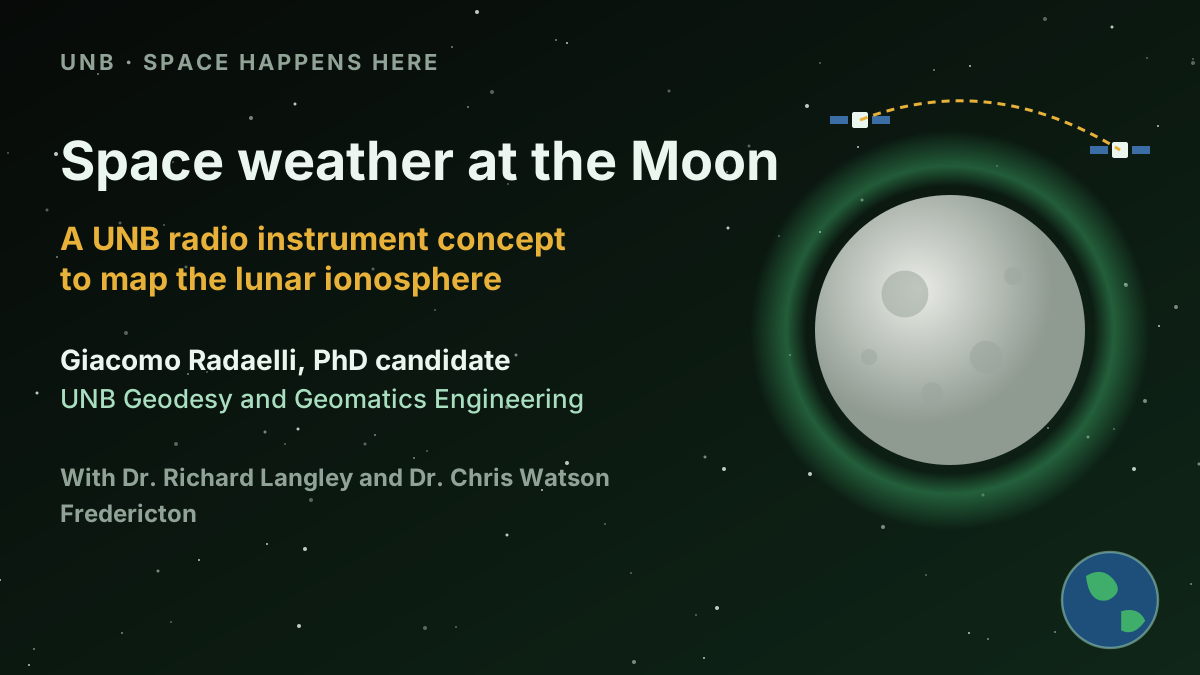
A University of New Brunswick researcher is working on a tool that could give future Moon missions something they have never had: a reliable space weather picture of the Moon itself.
Giacomo Radaelli, a PhD candidate in geodesy and geomatics engineering at UNB in Fredericton, is developing the concept of a radio instrument that would orbit the Moon and map its ionosphere, according to a UNB Newsroom profile published Oct. 14.
A thin, charged layer around the Moon
The lunar ionosphere is a volatile, ghostly-thin layer of charged particles, formed mostly by dust lifted above the surface and ionized while it hangs there. Space weather in that layer can damage equipment and disrupt communications and instruments, and past missions had problems with lunar dust in suits, airlocks and instruments.
"We have a very poor understanding, poor characterization, and poor observation of the lunar ionosphere," Radaelli told UNB.
His proposed instrument would observe and characterize lunar plasma from orbit, mapping it with greater accuracy and reliability than current techniques. The data could feed new space weather models and help mission teams plan around it. "We want to know what happens and how it happens so that we can plan and adjust accordingly," he said.
The work builds on a concept first proposed by his co-supervisor, Dr. Chris Watson, a research scientist in UNB's Department of Physics. Watson's 2023 paper in Radio Science, Radio Instrument Package for Lunar Ionospheric Observation: A Concept Study, describes RIPLIO, a "crosslink" radio occultation mission in which spacecraft in lunar orbit send radio signals to each other through the ionosphere and measure how the signals change. Co-authors include UNB physicist P. T. Jayachandran and Radaelli's supervisor, Dr. Richard Langley. In 2025, Radaelli was lead author on a follow-up paper simulating those crosslink observations under different solar conditions.
From Milan and Toulouse to Fredericton
Radaelli grew up in Italy and earned a bachelor's degree in physics engineering at Politecnico di Milano, then a master's in aerospace systems for navigation and telecommunications at ENAC in Toulouse. As a master's student, he attended a talk by Langley, a physicist and expert in global navigation satellite systems (GNSS). Approaching Langley afterward led to an internship at UNB and then his doctorate.
"I was extremely happy to invite Giacomo to join the team of GNSS and ionosphere researchers at UNB," Langley said. "He has helped to expand our liaisons with ENAC and other research organizations in Europe including, of course, ESA."
In early 2026, Radaelli was selected for the European Space Agency Academy's Space Weather Training Course in Belgium. A Mitacs-funded exchange then took him to the University of Graz in Austria as a visiting researcher with atmospheric physicist Dr. Ulrich Foelsche, an expert in radio occultation. He also attended a radio occultation conference in Austria organized by Foelsche and the COSPAR Scientific Assembly in Florence in August, and he is now discussing applications of the instrument beyond the Moon, toward Mars.
"It's extremely gratifying to see that even at an early stage, Giacomo's research is getting noticed on the global stage," Langley said, adding that with new Moon and Mars missions planned, he hopes more UNB students get involved in space research.
The profile is part of UNB's Space Happens Here series. For more UNB research, see UNB's ten patents in 2025–26.
Sources
- Space happens here: The doctoral student developing a space weather observation system to study a mysterious layer of the Moon — UNB Newsroom (Oct. 14, 2026): Radaelli's program, instrument concept, quotes, education, ESA Academy course, Graz/Mitacs exchange, COSPAR, Mars applications; Watson as co-supervisor; Langley quotes
- Watson et al., Radio Instrument Package for Lunar Ionospheric Observation: A Concept Study, Radio Science (2023): RIPLIO crosslink radio occultation concept; UNB Physics and Geodesy and Geomatics co-authors
- Radaelli et al., Simulation of Crosslink Radio Occultation Observations of the Lunar Ionosphere (URSI AP-RASC 2025): follow-up simulations under solar wind and magnetosphere conditions
- Richard Langley — UNB profile: professor, Geodesy and Geomatics Engineering
- Chris Watson — UNB profile: research scientist, Physics
- Giacomo Radaelli — LinkedIn: PhD student at UNB researching the lunar ionosphere
ChronologyUNB· 42 stories since Nov 20, 2024
- Hack Atlantic: 43 Student Projects in One Weekend at UNB
- Vidova Plugin Lets Claude Edit Video on a Real Timeline
Chronology · show all 42 storiesShow fewer
- Senator Spotlights UNB's DAIR and Picketa as Proof of New Brunswick's 'Innovation Sandbox'
- UNB Researcher Is Designing a Radio Instrument to Map Space Weather at the Moon (this story)
- C-Therm's Path From a Team of Two in 2007 to Customers Worldwide
- UNB Inventors Were Granted 10 Patents in 2025–26, Tying a Decade High
- DataNB's ICT Workforce Study: N.B. Keeps Its Tech Grads for a Year, Then Loses Many
- Gray Wolf Analytics Brings Scam-Detection Playbook to UNB's RBC Lunch & Learn
- McKenna Institute Pulls District Tech Leads to Chelmsford to Scale Teacher Upskilling
- Sussex Elementary Opens a Saber STEAM Studio for Robotics and 3D Printing
- UNB Joins $5M National Push to Keep AI Weather Forecasts Grounded in Physics
- UNB's Fifth-Scale ATV Predicts the Ground Under Each Wheel — and Left AI Out of It
- Mastercard's Canada Security VP Keynoted CIC's Fredericton Summit — Then Toured the IoT Lab It Funds
- UNB Names Its First Digital Agriculture Chair — and He Starts With Small Farms
- UNB Sent Middle Schoolers Back to Class With Games, Websites and AI
- Review: UNB's Scott Bateman on the Three AI Myths That Won't Die
- UNB's Machine Learning Health Vault Wins CFI Infrastructure Funding
- UNB Co-Authors Confirm the First Native Sulfur Ever Found on Mars
- UNB Researchers Threat-Model the Protocols That Let AI Agents Act
- UNB Researchers Build a Practical Roadmap for the Post-Quantum Migration
- UNB Poster Weighs the Privacy Cost of Federated-Learning Aggregation
- UNB Researchers Deploy Collaborative AI Agents to Guard Power-Substation Networks
- UNB Researchers Build a Mixture-of-Experts Defence Against Adversarial AI Attacks
- UNB Researchers Make AI Malware Detection Explainable with a 'Dual Prototype' Framework
- UNB Researcher Takes a Geometric Axe to Optimization's Symmetry Problem
- UNB Researcher's 'Trust Passport' Would Stamp Every AI Reply with Its Risk Profile
- National Cyber Agencies and Big Banks Head to Fredericton for UNB's Cybersecurity Summit
- When the First Canadian Flew to the Moon, Fredericton Was Listening
- UNB Partners with Talent Innovation Canada to Put Grad Talent Inside Industry R&D
- McKenna Connect Puts UNB Mentors Beside 250 Rural Neighbours
- Cybersecurity Pioneer Ali Ghorbani Named to the Order of New Brunswick
- McKenna Institute's TeXplore Turns 17 Days Off School Into Soldering, Robots and AI
- SeaGreen Puts Seaweed Biochar in Ten Queen Street Flower Planters
- UNB Stitches Its Startup Machinery Into One Network
- Creduman Takes Top Spot at UNB’s MTME: NEXT 2026
- Four UNB MTME Startups Launch Next Week at MTME: NEXT
- The UNB Startup Pipeline: How a Fredericton Campus Keeps Minting Companies
- How Fredericton Became a Cybersecurity Town
- A Century of Circuits: UNB's Electrical Engineering Program Turns 100
- First Cheques: UNB's Fraser Fund Backs SpatialOne, Profitual, and AinaTest
- Gray Wolf Analytics: Crypto Forensics from a Fredericton Classroom
- Three Years In, the McKenna Institute Is Quietly Rewiring New Brunswick
Related coverage
News · August 18, 2026
When the First Canadian Flew to the Moon, Fredericton Was Listening
News · October 17, 2026
Senator Spotlights UNB's DAIR and Picketa as Proof of New Brunswick's 'Innovation Sandbox'
News · October 16, 2026
UNB Inventors Were Granted 10 Patents in 2025–26, Tying a Decade High