
News5 min read
N.B. Will Block Social Media on School Networks and Put Phones Away


A rewritten Policy 311 bans personal devices all day for K–8 this September, phases high school in next February, and restricts social apps on the school network — with Beauceron's David Shipley backing the line.
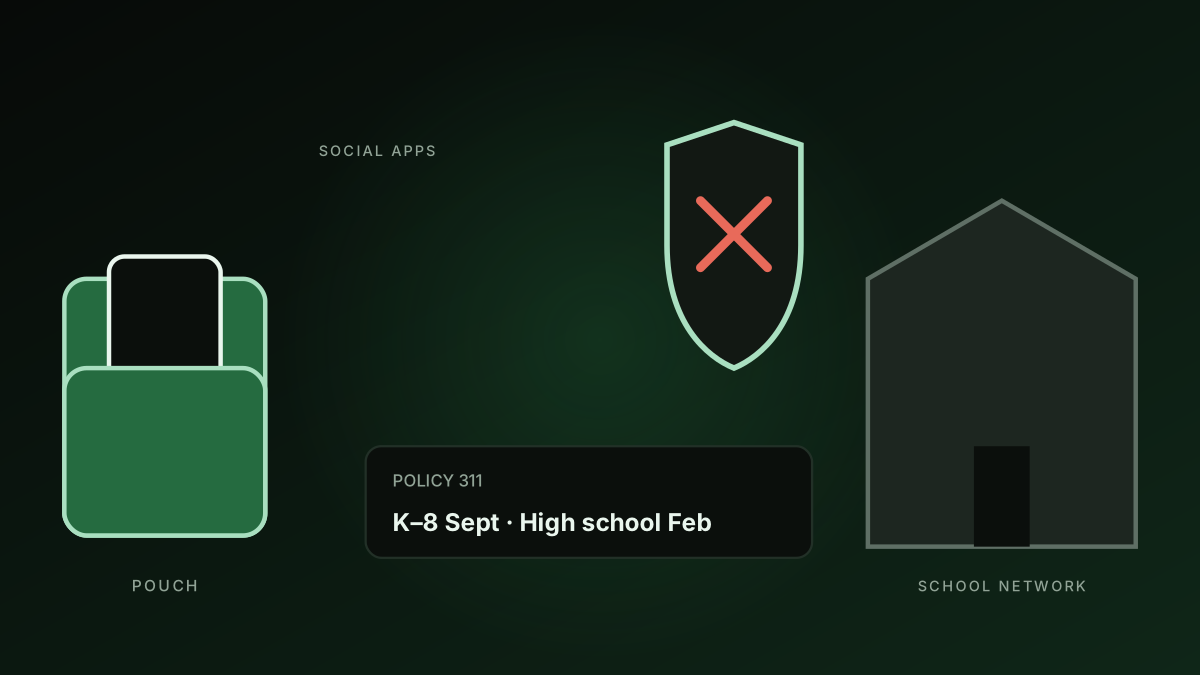
The Holt government said Friday in Oromocto that New Brunswick schools will restrict social media on school networks this September and take personal phones out of the school day — kindergarten through Grade 8 starting next week, high school at the second semester.
That is not a slogan. It is a rewrite of Policy 311 (Responsible Use of Digital Technology), dated 1 September 2026, plus a brand-new Policy 902 for licensed child-care. Education Minister Claire Johnson and Justice Minister Robert McKee framed it as child-development policy. The document itself is a network and device standard.
What actually changes
Policy 311 has been on the books since 1996. The last rewrite, September 2024, added a cellphone section that left use during class to the teacher. The new text replaces that discretion with a schedule.
Kindergarten to Grade 8, effective September 1: no cellphones or other personal mobile devices during the school day, including recess and lunch. Anything brought in goes on silent and out of sight, or wherever the school designates. School-issued devices used for learning are exempt.
Grades 9 to 12: the 2024 teacher-discretion rule stays until February 1, 2027. After that date, high-school students get the same all-day ban — except they may still use laptops and tablets for schoolwork under the Bring Your Own Device program. The press release and the policy agree on that split.
The policy's definition of a personal mobile device is broader than a phone. It names smartwatches, tablets, laptops, wireless earbuds, and portable gaming devices. Changing rooms stay off-limits for anything that can record. Exceptions have to be written into a health plan or Personalized Learning Plan — diabetes apps, accessibility, documented accommodations. Confiscation for a device left out is not a search; opening it would need Policy 712.
Policy 902, also effective September 1, covers licensed early-learning centres. Infants under two get no screen time. Older children get at most 30 minutes a day, educational, educator-guided, never at meals, and none in programs that run three hours or less. Children may not use personal devices at all while they are there. The text cites the Canadian Paediatric Society.
The network rule
The piece that is actually tech policy sits in section 6.7.2: "Social media platforms, as determined by the Department in collaboration with the School Districts, will be restricted on the school network."
The government did not publish the list. Johnson's line in the release is that blocking those sites on school networks and school devices is meant to cut "harmful content and targeted advertising while at school." Students still use school technology; classroom screen time now has to be educational and tied to curriculum outcomes. Software for K–8 is supposed to run on school-issued devices on the school network only.
That is a filter decision, not a product launch. The province already maintains an approved-software list through the IT Strategy and Business Solutions Branch, and the BYOD appendix already talks about a firewall on the student wireless. The new sentence makes social platforms a named category on that list.
Beauceron Security CEO David Shipley is the industry voice in the release. "Screen time limits in early learning protect brains at the age they're most vulnerable. And blocking social media on school networks draws a simple line: products on trial for harming children don't belong in our schools," he said. Shipley's Fredericton firm sells human-risk measurement, not classroom filters; he is on the record here as a parent-facing security voice, not as a vendor of the block.
The release also points at two federal bills still before Parliament — the Safe Social Media Act and a privacy-and-consumer-data bill — as alignment, not as authority for the school rule.
What this is not
It is not a ban on technology in class. Johnson's own statement says the system is still supposed to teach digital literacy, critical thinking, online ethics, and digital wellness. High-school BYOD stays. The McKenna Institute's TeXplore days and the rest of the province's classroom-tech stack are a different file.
It is also not brand new at the school door. Oromocto High — the town where Friday's announcement was staged — had already told families this week that phones go off at the first bell, stay off through class and transitions, and stay off the school Wi-Fi, with lunch as the remaining window. Saint John High tried a classroom ban years ago. The provincial rewrite is what turns those local experiments into a dated, province-wide network and device standard.
The next public proofs are operational: which platforms land on the restricted list, how evenly districts apply confiscation, and whether the February 2027 high-school switch holds once Grade 10–12 students who grew up under teacher discretion hit the all-day rule.
Sources
- Government introduces measures to reduce classroom distractions — GNB (Aug 28, 2026) — Oromocto dateline; Johnson, McKee, Baldwin, and Shipley quotes; K–8 / Grade 9–12 schedule; school-network restriction; federal bills
- Policy 311 — Responsible Use of Digital Technology (effective Sept 1, 2026) — device definitions; 6.5 phone rules and Feb 1, 2027 high-school date; 6.7.2 social-media restriction on the school network; medical exceptions; confiscation vs. search
- Policy 902 — Screen Time and Personal Mobile Device Use in Licensed Early Learning and Child Care Facilities — infant ban; 30-minute cap; no screens in programs of three hours or less; CPS citation
- EECD policies index — current Policy 311 title and Policy 902 listing
- High school hopes for greater social connection, fewer distractions with new cellphone policy — CBC (Aug 27, 2026) — Oromocto High pilot; lunch exception; Wi-Fi ban; 2024 Policy 311 as teacher-discretion baseline
- Stricter cellphone policy coming to N.B. schools — CBC (2024) — September 2024 Policy 311 cellphone section
- Beauceron Security — company site for Shipley's firm
- Beauceron Security and the Unfashionable Truth — NB Tech News — prior coverage of the Fredericton human-risk company
- McKenna Institute's TeXplore — NB Tech News — separate classroom-tech programming still running
Related coverage
News · September 2, 2026
The 12-Year Education Plans Mandate AI Literacy — and Name No Software
News · October 2, 2026
McKenna Institute Pulls District Tech Leads to Chelmsford to Scale Teacher Upskilling
News · September 24, 2026
Sussex Elementary Opens a Saber STEAM Studio for Robotics and 3D Printing