
Companies3 min read
Breathe BioMedical Adds Halifax's IWK as Second Canadian Site for Breast Cancer Breath Study


The Moncton company's multi-centre study now collects breath samples at IWK Health as well as Vitalité. Samples come back to Moncton for analysis, and CBC reports a target of about 800 participants.
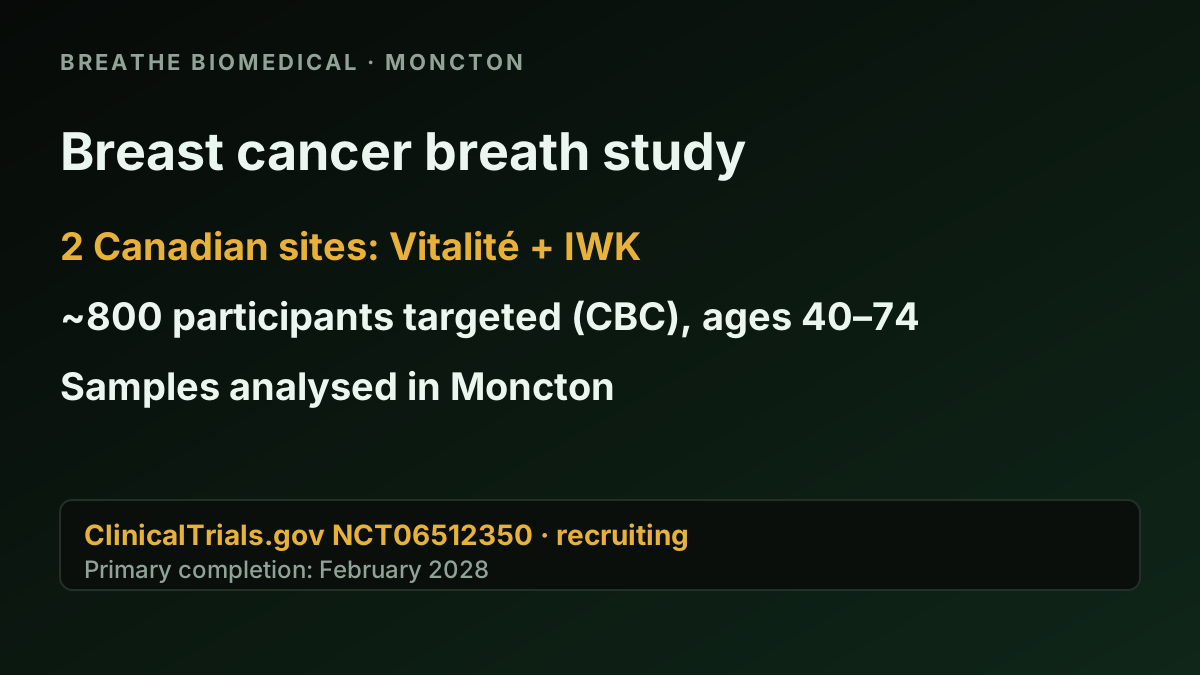
Breathe BioMedical has added a second Canadian hospital to its breast cancer breath study. The Moncton company announced on Oct. 7 that the Breast Health Research Unit at IWK Health in Halifax has joined. The study is an observational data-collection study, and it is testing whether a breath test can help detect breast cancer in women with dense breast tissue, alongside mammography.
In August, Vitalité Health Network in Moncton became the first Canadian site. The ClinicalTrials.gov record lists five sites so far: Vitalité's Dr. Georges-L.-Dumont hospital in Moncton plus four in the United States (Mayo Clinic, George Washington University, Duke University and Weinstein Imaging Associates). IWK is not on the registry yet; once added, it would be the sixth.
Who leads it in Halifax
The IWK arm is co-led by Dr. Gregory Knapp, a surgical oncologist and co-director of the IWK's Breast Health Research Unit, and Dr. Zina Kellow, a breast radiologist. Both are assistant professors at Dalhousie University.
"We don't yet know if this technology works, but we need to ask the questions," Knapp said in the IWK's announcement. Kellow said in the company release that mammography "remains the standard in Nova Scotia for breast cancer screening in the average risk population."
The IWK says it will invite women aged 40 to 74 with no history of breast cancer who are having a standard-of-care breast biopsy or MRI at its University Avenue site.
How the test works
Exhaled breath carries volatile organic compounds, by-products of metabolism. Breathe's sampler collects breath onto standard sorbent tubes. The tubes go to the company's central lab, where its spectrometer reads compounds down to parts per trillion. Machine-learning models then look for patterns linked to breast cancer.
CEO Bill Dawes told CBC that the current study will use the IWK and Vitalité sites, that samples are sent to Moncton for testing, and that the company hopes to enrol about 800 participants, half with breast cancer and half as controls. (The registry, which covers every site, lists an estimated enrolment of 5,175.) CBC reports that Breathe plans to add more sites before the end of the decade, to build a more diverse machine-learning model.
The numbers so far
The company points to a proof-of-concept study in Saint John. Its preliminary analysis found 88.2 per cent accuracy, with 92.9 per cent sensitivity and 80 per cent specificity, in telling apart the breath of women with early-stage breast cancer from women without it, regardless of breast density. Those are the company's figures. CBC reports the Saint John study had around 111 patients, people with and without the disease. The broader study is meant to train the model on a more diverse population. ClinicalTrials.gov lists its primary completion date as February 2028.
Dense tissue is the problem Breathe is aiming at. Both cancer and dense tissue show up white on a mammogram, which makes tumours harder to see.
Sources
- Breathe BioMedical expands multi-center clinical study in breast cancer to Nova Scotia — Breathe BioMedical (Oct. 7, 2026): IWK as second Canadian site; Knapp, Kellow and Dawes quotes; 88.2 / 92.9 / 80.0 per cent proof-of-concept figures; how the technology works
- IWK Breast Health researchers looking into promising method for detecting breast cancer — IWK Health (Oct. 7, 2026): eligibility (ages 40–74, biopsy or MRI at the University Ave. site); Knapp quote
- As easy as breathing — CBC News, Alex Guye (Oct. 8, 2026): Dawes on about 800 participants and the IWK and Vitalité sites; samples tested in Moncton; plans for more sites; about 111 patients in the Saint John study
- NCT06512350 — ClinicalTrials.gov: sponsor, collaborators, five listed sites, recruiting status, estimated enrolment, February 2028 estimated primary completion
- Breathe BioMedical brings its breast cancer breath test home to Moncton — NB Tech News (Aug. 4, 2026)
Related coverage
Companies · August 4, 2026
Breathe BioMedical Brings Its Breast Cancer Breath Test Home to Moncton
Companies · October 15, 2026
Province Offers APEX Industries Up to $2M for a Defence-Focused Moncton Expansion
Companies · July 22, 2026
Gogii Games Turns 20 Without Leaving Main Street Moncton