
Companies5 min read
Breathe BioMedical Brings Its Breast Cancer Breath Test Home to Moncton


Vitalité Health Network is the first Canadian site — and the fifth overall — in the Moncton company's multi-centre study of a machine-learning breath test for women with dense breast tissue.
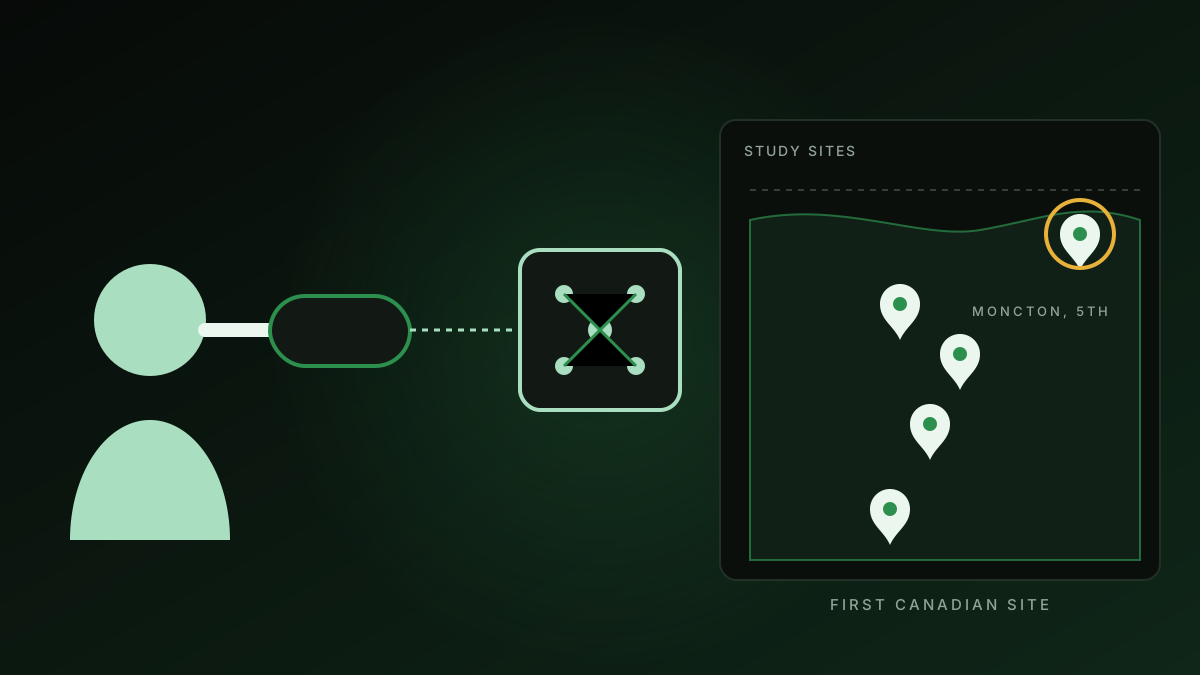
A Moncton company that has been running its clinical trials in Washington, Jacksonville, Durham and Pittsburgh now has a study site in its own city. Breathe BioMedical announced on July 22 that Vitalité Health Network has joined its multi-centre study as the first Canadian site, extending the research beyond the United States for the first time.
The study is testing whether the chemistry of exhaled breath can flag breast cancer early in women with dense breast tissue — a group for whom mammography is least reliable. Dr. Jocelyne Hébert is leading the work locally in Moncton and will oversee breath collection at Vitalité facilities.
"This partnership illustrates our commitment to research and innovation to better serve our population," Hébert said. "This technology offers a new perspective in breast cancer detection by strengthening our ability to potentially detect the disease earlier and more accurately. We are proud to contribute to this scientific advancement here in New Brunswick."
The patients being recruited are ones already in the diagnostic pipeline. Hébert told CBC that women with suspicious lesions found during breast imaging are invited to take part before their biopsy — and that the procedure asks very little of them. "You basically breathe in a machine," she said. "It's not more complicated than blowing up a balloon."
Reading metabolism in parts per trillion
The signal Breathe BioMedical is chasing is a class of chemicals called volatile organic compounds. VOCs are byproducts of metabolism that travel through the bloodstream and leave the body during gas exchange in the lungs, which makes exhaled breath a non-invasive readout of what is happening inside.
"Humans, in their breath, have what we call VOCs, so volatile organic compounds," Hébert said. "Depending on what's going on in your body … you will express different VOCs and we're trying to identify a specific pattern of VOCs expressed by patients who have breast cancer."
The pipeline is deliberately low-tech at the patient end and heavy at the back end. A breath sampler collects alveolar breath onto standard sorbent tubes, which travel to a central lab. There the sample runs through the company's cavity ring-down spectrometer — sensitive down to parts per trillion — producing a spectrographic dataset. Machine-learning models are then applied to that spectral data to pick out patterns associated with the disease.
The company's proof-of-concept study, run in Saint John, reported 88.2 per cent accuracy — 92.9 per cent sensitivity, 80.0 per cent specificity — in separating the breath signatures of women with early-stage breast cancer from those without, irrespective of breast density. The current multi-centre study exists to test that result against a much wider population, and to establish sensitivity, specificity and false-negative and false-positive rates properly.
Why dense breast tissue is the target
The clinical logic for picking this subgroup first is straightforward. Roughly half of women eligible for screening have dense breast tissue, and that group is four to five times more likely to develop breast cancer. Mammography remains the gold standard — but reading one is hardest in exactly this population, because tumours and dense tissue both show up white on the image. The test is least reliable for the women who most need it.
That matters because catching the disease early is close to everything. Survival runs better than 98 per cent when breast cancer is found early, the company notes, and under 30 per cent once it is advanced. Hébert framed the ambition in terms of the surveillance burden some patients carry today — a mammogram plus an MRI, every year. "[Some] patients undergo a mammogram and an MRI every year and hopefully this breath test can replace the yearly MRI just to check if they have breast cancer."
Kimberly Carson, chief executive of Breast Cancer Canada, called the study "a phenomenal step forward."
An Atlantic company running a North American trial
Founded in 2015 and headquartered in Moncton with a US subsidiary in Cambridge, Massachusetts, Breathe BioMedical is led by president and chief executive Bill Dawes. The study is registered as NCT06512350, an observational case-control protocol with an estimated 5,175 participants aged 40 to 74, running to December 2027, with Mayo Clinic, George Washington University, Duke University and Weinstein Imaging Associates as collaborators. Sites came online in sequence: George Washington University's breast centre in February 2025, Mayo Clinic in Jacksonville in December 2025, and Weinstein Imaging in Pittsburgh in May 2026.
Vitalité is the fifth site, and Dawes described the New Brunswick addition as building on the company's existing US clinical network. For the research itself, the value is population diversity — a new Canadian patient group makes the machine-learning models more robust, which is the stated reason for spreading collection across demographics and geographies in the first place.
"As we expand our clinical study with new partners, we are accelerating the collection of reliable data to advance our technology," Dawes said. "We look forward to working with Dr. Hébert and her team to help develop better non-invasive disease detection options for women."
Board chair Jean Nadeau, writing on LinkedIn, put the provincial angle plainly: partnering with a health network of Vitalité's size "underscores the strength of Atlantic Canada's health-tech ecosystem and its ability to drive national impact."
The appropriate expectation-setting comes from Hébert, who notes the Moncton site is still gathering samples and the study remains at a very early stage. A diagnostic is a longer road than the workflow and record-keeping tools other New Brunswick health-tech companies are already selling — MedReddie's procurement platform and VeroSource's provincial health record work among them. But it is also the kind of thing that, if it works, gets used everywhere.
Sources
- Breathe BioMedical Expands Multi-Center Clinical Study in Breast Cancer to Canada — company release, July 22, 2026: Vitalité as first Canadian site, Hébert and Dawes quotes, 88.2% proof-of-concept accuracy, sampler and spectrometer pipeline, dense-tissue and survival statistics
- Moncton researchers testing breath samples to detect breast cancer earlier — CBC News, July 30, 2026: Hébert interview, VOC explanation, patient recruitment before biopsy, early-stage caveat, Breast Cancer Canada comment
- Identifying Patterns in the Breath of Individuals With Breast Cancer (NCT06512350) — trial registry: design, 5,175 estimated enrolment, ages 40–74, December 2027 completion, collaborators and US site list
- Breathe BioMedical — company site: technology overview, dense-tissue focus, leadership
- Breathe BioMedical Expands Multi-Center Clinical Study in Breast Cancer to Pittsburgh — company release, May 5, 2026: Weinstein Imaging site addition
- Mayo Clinic Jacksonville comes online as third site — company release, December 16, 2025: site sequencing
- Bill Dawes on LinkedIn, July 22, 2026 — fifth site, US clinical network context
- Jean Nadeau on LinkedIn, July 22, 2026 — board chair comment on Atlantic Canada health-tech
Related coverage
Companies · July 22, 2026
Gogii Games Turns 20 Without Leaving Main Street Moncton
Companies · June 9, 2025
Fiddlehead Technology and the Science of Fewer Wasted Truckloads
Companies · February 12, 2024
VidCruiter: Moncton's Quiet Giant of Hiring Software