
News3 min read
Edmundston’s EV responders rethink the roadside—and the tow yard
Reported and fact-checked by NB Tech News staff; drafted with AI assistance. How we use AI


An emergency plug keeps a car from driving away; new gloves and a concrete-block enclosure change a towing operator’s work. None is a battery shut-off.
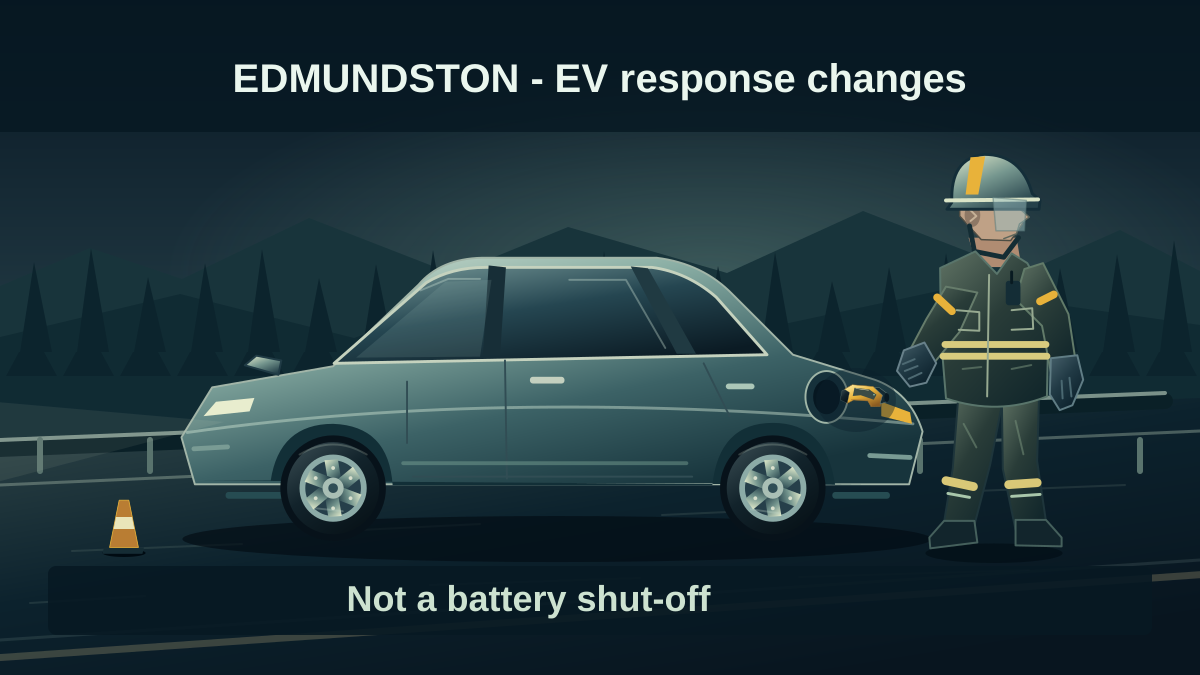
In Edmundston, adapting to electric-vehicle crashes now means more than bringing a tow truck. Firefighters have an emergency plug intended to prevent an EV moving under its own power, while a local towing operator has bought insulating gloves and is building a concrete-block enclosure for damaged vehicles.
Those are the changes described in CIMT’s November 6 report, based on interviews with fire department director Jacques Doiron and Remorquage Edmundston Towing owner Dusty Bossé. They address different parts of the job: controlling vehicle movement at an incident, protecting workers and separating vehicles in storage.
The distinction is important. A plug that stops a car from driving away does not make its high-voltage battery electrically isolated.
A charging signal, not a power switch
Doiron said Edmundston’s fire department now has an emergency plug donated by the Association des concessionnaires d’Edmundston. As he explained to CIMT, the device makes the vehicle think it is charging, preventing it from advancing while leaving access to the doors, windows and trunk.
The underlying idea uses a vehicle’s charging-related safety logic to inhibit propulsion. It is not the same operation as disconnecting its high-voltage system.
That limit is explicit in the technical FAQ from Total Safety Solutions, a manufacturer of emergency EV plugs. Its device does not switch off high voltage or main power, and electrical functions such as windows, seats and lights remain available. The FAQ also says the plug does not necessarily apply the parking brake or shift a vehicle into Park: manufacturers can implement the movement-prevention requirement differently.
CIMT does not identify Edmundston’s make or model. The manufacturer’s documentation explains the distinction between immobilization and isolation; it does not establish which product the department owns or what additional features it has.
The changes continue at the tow yard
Bossé told CIMT he had travelled to Drummondville for EV-recovery training at the annual congress of the Association des Professionnels du Dépannage du Québec. Since that training, he had equipped his business with insulating gloves and was changing its storage arrangements.
“We are building an enclosure with concrete blocks,” Bossé said, translated from French, describing a space intended to separate the vehicles from others if a fire occurs.
The enclosure was under construction, according to his account—not a completed installation. Neither its dimensions nor any demonstrated protection level was provided. His account describes a change in workplace practice, not evidence that the business has eliminated electrical or fire risks.
The training itself is independently documented. The APDQ’s 2026 congress page lists the October 15–17 event in Drummondville and an EV course on October 15. Its course description covers high-voltage hazards, intervention procedures and practical demonstrations.
Different tools for different risks
Doiron also told CIMT his firefighters had received training. The report does not quantify local EV incidents, injuries or the effect of these changes.
What it documents is narrower and more tangible: a fire department equipped to inhibit a vehicle’s movement, and a towing business changing its protective equipment and storage layout. The report gives no acquisition date, cost or incident-use count for the plug.
In Edmundston, the adjustment is happening both at the roadside and after a vehicle leaves it. Keeping an EV still is one task. Managing the electrical and storage risks is another.
Sources
- CIMT, November 6, 2026: interviews with Jacques Doiron and Dusty Bossé, the donated plug, gloves and enclosure under construction.
- Ville d’Edmundston: fire department and Jacques Doiron’s official role.
- Total Safety Solutions: emergency-plug operation and limits; not confirmation of Edmundston’s device model.
- APDQ: 2026 congress dates and EV-training listing.
- APDQ: EV-recovery course description.
Related coverage
News · September 10, 2026
WorkSafeNB: AI Is Writing Safety Policies That Cite the Wrong Province
News · November 18, 2026
High School Students Across New Brunswick Walk Out Over the Phone Ban
News · November 17, 2026
UNB's DataNB Says a Military Health Platform Is Feasible — If Trust Is Built
Comments
Loading comments…