
News8 min read
High School Students Across New Brunswick Walk Out Over the Phone Ban
Reported and fact-checked by NB Tech News staff; drafted with AI assistance. How we use AI


Hundreds of students walked out at 2:30 p.m. in the province's three largest cities, the biggest crowds at Leo Hayes and Moncton High. The demand: rescind the Policy 311 changes before the all-day phone ban reaches grades 9–12 on Feb. 1, 2027. The district's answer: the policy is not changing.
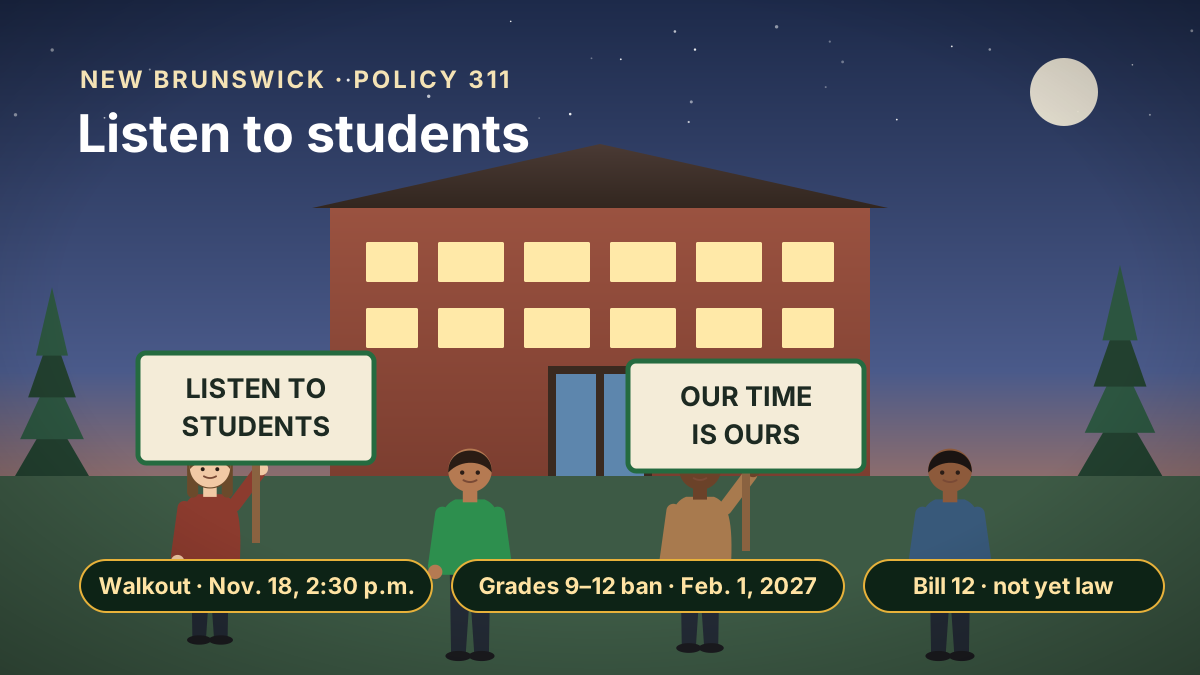
At 2:30 p.m. today, high school students across New Brunswick walked out of class over the province's school cellphone ban. The protest was organized by a single Instagram account, @unbanphonesnbhighschools, which calls itself a student union, posts everything in English and French, and had 982 followers this morning. Its linked protest-locations sheet listed 73 schools — every anglophone and francophone district in the province — each with a designated meeting spot.
The timing is deliberate. The students are not yet living under the rule they are protesting. They are trying to stop it before it reaches them.
What happened Wednesday afternoon
Updated Wednesday evening with reporting from CBC and Your Greater Moncton.
The walkout's centre of gravity was the three largest cities. CBC, which has not verified how many of the 73 listed schools saw walkouts elsewhere in the province, reported hundreds of students taking part in each metro:
- Leo Hayes High School drew Fredericton's largest crowd — several hundred students.
- Moncton High School drew more than 200, chanting "Unban phones" and carrying signs reading "Free phones" and "Breaks are OURS."
- Saint John saw about 100 students each at Simonds High School and Harbour View High School, where students walked to a nearby park with their signs.
- Fredericton High School was the exception: about 30 students, marching through the mall parking lot across the street — a turnout CBC described as underwhelming, at one of the schools whose listed meeting spot was the Legislative Assembly itself.
The students CBC interviewed made the campaign's posted argument in person. A Grade 12 student at Harbour View said he accepts phones being put away during class, but breaks and lunch are students' free time. A Grade 10 student at Leo Hayes said he had supported the policy until now precisely because it left non-class time alone. A 14-year-old at Moncton High raised the safety case the campaign leads with: students should be able to reach a parent or an emergency contact.
No one was disciplined for taking part. A superintendent's letter sent home to parents in advance said the event was neither sanctioned nor supervised by the district, but that students would not face discipline solely for participating, and that the district respects students' right to peaceful assembly.
The official response, so far, is that nothing changes. Education Minister Claire Johnson was not made available for an interview at the legislature on Wednesday. Anglophone West superintendent David McTimoney, whose district covers Fredericton, told CBC it was good to see students speaking their minds respectfully — and then closed the door: "it's not going to change the policy."
The concerns are also on the record inside the system. At Tuesday's Anglophone East District Education Council meeting, Superintendent Randolph MacLEAN told council that high school principals had raised practical questions about the coming ban — photography courses that use phones, newcomer students who rely on them as translators, and families who bought a phone instead of a computer. DEC member Erin Lantz argued the district should be teaching responsible use instead, noting the province is also introducing AI instruction in schools.
What they are actually protesting
The province rewrote Policy 311 (Responsible Use of Digital Technology) effective September 1, as we reported in August. Students from kindergarten to Grade 8 have been under an all-day ban on personal mobile devices ever since — no phones in class, at recess or at lunch, devices silent and out of sight. Social media platforms are also restricted on school networks and school devices.
High school students got a phase-in. Until now, the older rule has applied to them: phones away during class, at the teacher's discretion. On February 1, 2027, the start of the second semester, grades 9–12 get the same all-day rule as the younger grades, breaks and lunch included. Laptops and tablets stay allowed for schoolwork under the Bring Your Own Device program.
That February date is the target. The account's November 10 post, which set today's date after an earlier November 12 walkout was postponed, states the demand plainly: "We demand that the government rescind the changes to 311 policy for students in grades 9-12. We will not be silenced." A pinned post from October 10 adds a second demand: remove the integration of AI into New Brunswick's school curriculum — a live file in its own right, given the province's AI literacy plans for classrooms.
The four reasons, in their words
A "Why?" post published November 17 gives the campaign's four reasons:
- "Students were not asked for their opinions on the policy 311 update"
- "Non-instructional time is OUR TIME"
- "Many students fear their safety without a phone"
- "Banning phones is not a substitute for teaching responsible internet usage"
The argument, in other words, is not that phones belong in class. It is that lunch and breaks are not class, that students were not consulted, and that a ban is a weaker tool than teaching. The campaign has been building since the policy was announced: a pinned post from August 28, the day the rewrite was unveiled, promotes a petition to "Unban Phones in N.B. High schools."
Organized like a campaign
The operation is more disciplined than a hashtag. A rules post from November 16 instructs participants: no violence, respect everyone, follow the law, stay peaceful, keep the protest organized — and if you are asked to leave a business or property, leave immediately. The caption explains why: the organizers want the walkout "tame and organised so that the government will listen to us, instead of using us as an example on why phones should be banned."
A support post asks students to make respectful signs, livestream, and send photos and video to the campaign for posting. Some of the 73 meeting spots are pointed: Fredericton High, Leo Hayes and École Sainte-Anne list the Legislative Assembly or Premier Susan Holt's constituency office; Harrison Trimble, Bernice MacNaughton and École Mathieu-Martin list Education Minister Claire Johnson's constituency office; Saint John High and St. Malachy's meet at King's Square. Others are schoolyards, arenas and parks.
The organizers are also policing their own flank. On November 17 they warned Moncton High students that a separate TikTok account promoting its own plans "is not involved with the school walkout," said they had never had contact with whoever runs it, and asked students to follow instructions only from their account (or a Fredericton High counterpart). CBC covered the walkout live at 2:30 p.m. and published its full report the same evening.
The other track: Bill 12
The policy is already in force as a policy. What is still moving is the statute. Bill 12, An Act Respecting Young Persons, Digital Markets and Technology Use, would put the Policy 311 and Policy 902 rules into law alongside its better-known rules against manipulative purchase design aimed at under-16s. The bill was introduced November 3 and passed second reading November 6; the legislature's bill record, checked today, still shows second reading as its latest stage. It is not law.
Canadian Lawyer's November 12 account of the bill quotes André Côté of the Dais at Toronto Metropolitan University calling the package "a first for Canada, putting under law cellphone restrictions and limits on non-educational videos." Justice Minister Robert McKee, the bill's sponsor, has framed the legislation as protecting young people from the negative impacts of being online; Education Minister Claire Johnson framed the August policy as a way to reduce classroom distractions and rebuild social connection.
The students' counter-argument is now a date on a calendar. Wednesday answered the two open questions. Turnout was real but concentrated: hundreds in each of the three largest cities, led by Leo Hayes and Moncton High, and still unverified across most of the 73 listed schools. And the answer from the system, delivered the same day, was no — the policy stands, the minister did not take questions at the legislature, and February 1 remains the date to watch. Bill 12's committee stage is the one venue left where the rule could still be amended before it hardens into law.
Sources
- @unbanphonesnbhighschools — Instagram profile — "Student Union" account; 37 posts, 982 followers when checked November 18, 2026; bilingual bio; link to protest locations
- Walkout date announcement — Instagram (Nov. 10, 2026) — new date after the November 12 postponement; "We demand that the government rescind the changes to 311 policy for students in grades 9-12"
- "Why?" — Instagram (Nov. 17, 2026) — the campaign's four reasons; French version at @unbanphonesnbhighschools
- Walkout rules — Instagram (Nov. 16, 2026) — peaceful-protest rules and the "tame and organised" rationale
- How to support the walkout — Instagram (Nov. 17, 2026) — signs, livestreams, photo submissions, designated locations
- Protest locations sheet — via unbanphonesnb.carrd.co — 73 schools listed by district, with meeting spots including the Legislative Assembly and the constituency offices of the premier and the education minister
- Students across New Brunswick walking out in protest against cellphone policy — CBC — CBC segment scheduled for 2:30 p.m., November 18, 2026
- High school students across N.B. walk out over cellphone ban — CBC News (Nov. 18, 2026) — turnout by school in Saint John, Moncton and Fredericton; student interviews; McTimoney: "it's not going to change the policy"; Minister Johnson not made available for an interview
- Students, Anglo East DEC members express concerns about school cell phone legislation — Your Greater Moncton (Nov. 18, 2026) — Tuesday's Anglophone East DEC meeting: principals' concerns relayed by Superintendent MacLEAN; DEC debate on teaching responsible use; superintendent's no-discipline letter to parents
- Government introduces measures to reduce classroom distractions — GNB (Aug. 28, 2026) — Policy 311 rewrite, K–8 all-day ban, February 2027 phase-in for grades 9–12, school-network social media restriction
- N.B. Will Block Social Media on School Networks and Put Phones Away — NB Tech News — prior coverage of Policy 311 and Policy 902 in detail
- N.B.'s Bill 12 Would Make Platforms Answer for Purchase Traps Aimed at Kids — NB Tech News — prior coverage of Bill 12's consumer-protection provisions
- Bill 12 status — Legislative Assembly of New Brunswick — first reading November 3, second reading passed November 6; status checked November 18, 2026
- New Brunswick tables landmark Young Consumers in Digital Markets Act — Canadian Lawyer (Nov. 12, 2026) — first-of-its-kind framing; Côté and McKee quotes; February 2027 in-force date for grades 9–12 limits
ChronologyStudents· 4 stories since Oct 18, 2026
- High School Students Across New Brunswick Walk Out Over the Phone Ban (this story)
- Two UNB Students Win Atlantic Quantum Hackathon With a Satellite Collision Tool
Chronology · show all 4 storiesShow fewer
Related coverage
News · August 28, 2026
N.B. Will Block Social Media on School Networks and Put Phones Away
News · September 2, 2026
The 12-Year Education Plans Mandate AI Literacy — and Name No Software
Analysis · October 15, 2026
AI-Formatted Citations in N.B.'s 12-Year Education Plan Point to the Wrong Papers
Comments
Loading comments…