
Analysis5 min read
AI-Formatted Citations in N.B.'s 12-Year Education Plan Point to the Wrong Papers


Copilot formatted the anglophone plan's references, and two pointed to papers by other authors. A quiet Oct. 13 revision fixed them but pasted a full bibliography entry into the body text. The plan's target: reading scores that were lowest among the provinces on PISA 2022.
New Brunswick's anglophone education plan, Strong Basics, Bright Futures, runs to 2038. Its AI chapter makes a promise: students "will learn about AI, how it works and where it fails, and learn with AI, using it transparently and responsibly."
The plan's own reference list shows the problem that promise describes. So does the way the error was handled.
What happened
CBC News reporter Paula Dayan-Perez reported Thursday that professors found references in the plan that don't seem to exist. Vincent Geiger, of Australian Catholic University, told CBC his article doesn't appear to exist, and he had never heard of the journal. William Jeynes, of California State University, Long Beach, found his name on a paper written by someone else.
The Department of Education told CBC that staff wrote the plan, and that Microsoft 365 Copilot was used to format the bibliography. That, the department said, is how two incorrect references got in. "The human review of the document missed those incorrect references and corrections are being made," communications director Shawn Berry wrote.
UNB's Matt McGuire told CBC there is a term for AI stitching real pieces into something new: "Frankencitations."
We checked the two versions
The Internet Archive has the September edition of the PDF, dated "2026.09." The copy on gnb.ca now is stamped "2026.10." Its PDF metadata says it was made Oct. 13, two days before CBC's story ran. Put side by side:
- Geiger, September: "The role of numeracy in Australian primary school education," International Journal of Educational Research. Its DOI resolves to a different 2015 paper in that journal, about a constructivist curriculum for social work students.
- Geiger, October: "A rich interpretation of numeracy for the 21st century," ZDM, 2015, with Goos and Forgasz. That paper is real.
- Jeynes, September: "Parental involvement and academic achievement: A meta-analysis," Educational Psychology Review. Its DOI resolves to a 2001 meta-analysis by Fan and Chen.
- Jeynes, October: his real 2012 Urban Education meta-analysis.
McGill's Nabil Beitinjaneh told CBC he found orphaned citations, meaning works cited in the text but missing from the reference list. The September PDF has at least one we could confirm: "Hill et al., 2020" appears in the body and nowhere in the references.
The quiet revision
The October version adds Hill and Tyson (2009) to the references. It also pastes the entire bibliography entry, journal, volume, pages and DOI, into the middle of a sentence on collaboration:
"…(Jeynes, 2012; Hill, N. E., & Tyson, D. F. (2009). Parental involvement in middle school: A meta-analytic assessment of the strategies that promote achievement. Developmental Psychology, 45(3), 740–763. https://doi.org/10.1037/a0015362. This priority area emphasizes partnerships…"
We don't know who or what made that edit. The revised PDF carries no correction notice. The only visible sign of the change is the edition stamp.
The September edition's inside title page called it Strong Basics, Strong Futures. The cover said Bright Futures. The October edition says Bright Futures in both places.
The results the plan is meant to fix
- Reading: in PISA 2022, New Brunswick's 15-year-olds averaged 469 in reading. That was the lowest of the ten provinces, and below the OECD average of 476. CMEC's report says New Brunswick had the highest share of students below the baseline level in reading, at 28 per cent. Alberta had the lowest, at 15. The margin of error overlaps Newfoundland and Labrador's 478, so the gap between the two is not statistically clear.
- Not every test agrees. On the Grade 8 PCAP 2023 reading assessment, 73 per cent of New Brunswick students reached the expected level, tied with Newfoundland and Labrador. Nova Scotia was lower, at 71. So the province is last on the international test and second-last on the national one.
- School days: New Brunswick students are scheduled for 180 days a year; teachers work 195 (CMEC transfer guide, 2023–24). Ontario's legal minimum is 194. CBC counted 180 back in 2016, when the department was still saying 185. It is one of the shortest school years in the country. We couldn't find a current national table to say it is the shortest.
The plan is meant to turn those results around by 2038. The reference list is the one part of it anyone can check line by line, and that is where the checking failed.
Accountability
The plan's own consultation summary lists "digital literacy and critical thinking about information sources" as essential skills. Action B.3 sets out to "reframe assessments to evaluate student learning processes and critical thinking." The department applied neither standard to its own document. Using an AI tool to format references is common. Publishing them without checking that each one leads to the paper cited is the failure.
The error is limited in scope. The department says the research behind the plan is real, and Jeynes told CBC the plan describes his research accurately in the body. The rest of the plan, on literacy, numeracy, staffing and lunches, doesn't depend on two DOIs. (We covered what the plans actually commit on AI in September.)
Geiger raised a cost that goes beyond New Brunswick. A policy citation pointing at the wrong paper won't show up in the tools researchers use to track policy impact. He said it matters little to an established researcher but a lot to junior ones, whose policy citations go uncounted.
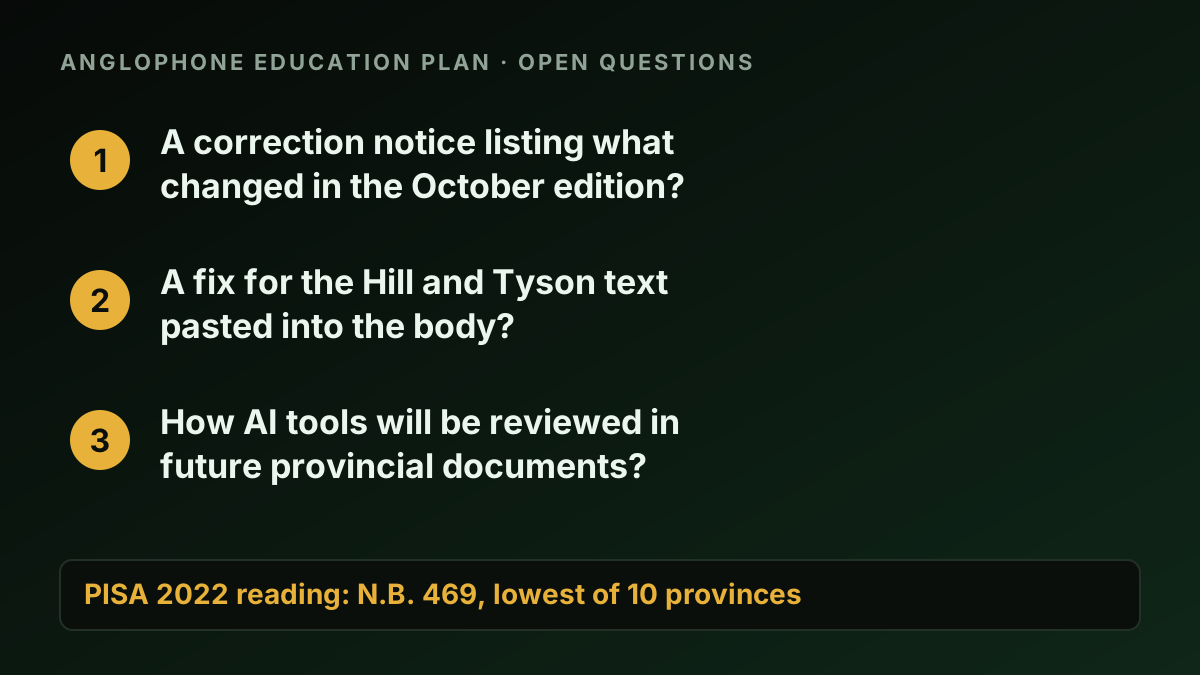
Three questions remain open. Will the department publish a correction notice listing what changed between the September and October editions? Will the pasted Hill and Tyson text be fixed? And how will AI tools be reviewed in future provincial documents? The plan asks schools to teach exactly that kind of review.
Sources
- CBC News: 'Pretty shoddy': Prof says N.B. education plan attributes to him an article that doesn't seem to exist (Oct. 15, 2026): professors' comments, the department's statement on Copilot, quotes
- Strong Basics, Bright Futures, current gnb.ca PDF (2026.10, created Oct. 13): AI chapter wording, corrected references, pasted Hill & Tyson entry
- September 2026 edition, Internet Archive snapshot of Oct. 1: original Geiger and Jeynes entries, "Hill et al., 2020", "Strong Futures" title page
- Measuring Up: Canadian Results of PISA 2022, CMEC: provincial reading means, share below Level 2
- Statistics Canada table 37-10-0239-01, PCAP reading by level: Grade 8 reading, Level 2 or above
- CMEC Student Transfer Guide, New Brunswick 2023–24: 180 student days, 195 teacher days
- Ontario school year calendars: 194-day minimum
- CBC News (2016): N.B. school year short-changes students 5 days
- Crossref records: 10.1016/j.ijer.2015.03.002, 10.1023/A:1009048817385, 10.1007/s11858-015-0708-1, 10.1177/0042085912445643
Related coverage
News · September 2, 2026
The 12-Year Education Plans Mandate AI Literacy — and Name No Software
News · August 28, 2026
N.B. Will Block Social Media on School Networks and Put Phones Away
Analysis · August 22, 2026
Review: UNB's Scott Bateman on the Three AI Myths That Won't Die