
News4 min read
Two UNB Students Win Atlantic Quantum Hackathon With a Satellite Collision Tool
Reported and fact-checked by NB Tech News staff; drafted with AI assistance. How we use AI


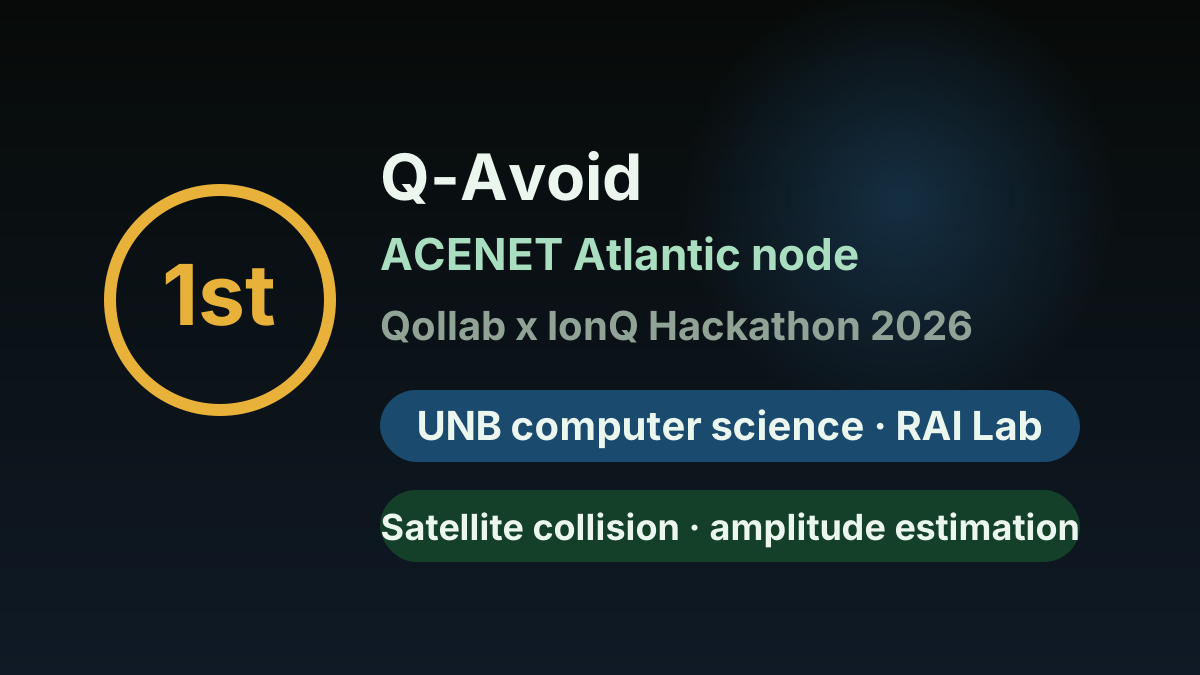
Tushita Govindaraj and Muhammad Umair Akram Butt took first at ACENET's node of the Qollab x IonQ Hackathon 2026. Their Q-Avoid project used quantum amplitude estimation on 365 ESA conjunction warnings and raised correct maneuver calls from 88% to 98% for the same evaluation budget.
Over Canada's Thanksgiving weekend, two University of New Brunswick computer science students in Fredericton put a quantum algorithm on a problem that keeps satellite operators awake: how likely are two spacecraft to collide.
Tushita Govindaraj, a final-year Bachelor of Computer Science Honours student, and Muhammad Umair Akram Butt, a Master of Computer Science student, entered as team RAI-Lab. Their project, Q-Avoid, took first place at the ACENET (Atlantic Canada) node of the Qollab x IonQ Hackathon 2026, a global quantum computing challenge.
"The first real proof came when the circuit's probability of measuring the "hit" qubit printed 3.007282e-04, and the classical reference integral printed exactly the same number, 3.007282e-04," Govindaraj said on the ACENET winners page. "Seven digits, identical. Up to then I'd been hoping the encoding was right; after that I knew it was. With the clock running down, I let myself enjoy it for about ten seconds and then went straight on to the benchmarks."
Q-Avoid: collision risk with fewer evaluations
Q-Avoid uses quantum amplitude estimation to estimate the probability that two satellites collide. The team framed the work around Atlantic Canada, where RADARSAT satellites watch the coast for sea ice, oil spills and ship traffic, and tested the method against classical Monte Carlo on 365 real European Space Agency conjunction warnings.
For the same number of model evaluations, the share of correct maneuver decisions rose from 88% to 98%. Theory gives Monte Carlo error a slope of −½ against cost and amplitude estimation a slope of −1. On the ESA data, the fitted slopes came out at −0.49 and −0.99. The notebook notes that the deepest circuit needs about 8,600 two-qubit gates, which requires fault-tolerant hardware. Qollab's write-up says the method can use up to 486 times fewer model evaluations than Monte Carlo for one-in-a-million collision risks.
Almost two hours before the deadline, the team's Qiskit runs and their fast simulation disagreed. The sampler was being reseeded on every call, so 20 runs that should have been independent were the same run 20 times. Next on their list is a hardware noise model, to find how much of the amplification survives on real devices. Team RAI-Lab also entered ChemScope, PhaseCheck and Roost.
Atlantic node of a global build
The online build window ran from 7 p.m. ET on October 9 to 7 p.m. ET on October 11. Projects had to use Qiskit, publish under an MIT license on Qollab, and fit themes labelled Quantum Impact, Quantum Playground and Quantum Unlocked.
At ACENET's node, 45 teams signed up — 27 of them solo — with 34 on the student track and 11 on the professional track. Fifteen of those teams entered 26 projects — the highest project count in North America and the second highest in the world, ACENET said. Globally, Qollab reported 211 teams and 327 projects across 22 local nodes.
ACENET is a research computing consortium of 15 universities and community colleges in Atlantic Canada. Muhammad Muzammil, its Digital Research Consultant for quantum computing, led the node with Michele Fash, Director of Business Development. ACENET thanked three Atlantic Canada judges: Dr. Stijn De Baerdemacker (University of New Brunswick), Dr. Edith Leal-Sanchez (Dalhousie University) and Dr. James LeBlanc (Memorial University). Qollab's node write-up says De Baerdemacker and Leal-Sánchez scored the projects on novelty, technical execution, impact and documentation.
Second place went to Agent Escape Room, a solo build by Salsabil Ben Halima of the Université de Moncton. Third place went to Can you hear entanglement, by Amir Ayati, Ehsan Ghasempouri and Vivek Das of UNB's QuNB group.
Under the published hackathon rules, a local node that enters 10 or more projects awards first place $500 cash and $5,000 in IonQ compute credits, with smaller cash and compute prizes for second and third. ACENET's 26 projects put the node over that threshold. Global winners were announced October 29; Q-Avoid's Atlantic win is the local result.
RAI Lab students
Both winners study computer science in UNB's Faculty of Computer Science and work with Mahtab Sarvmaili in the Responsible AI Research Lab. The faculty said the pair "brought home the gold" at the Atlantic node.
Butt was one of four Atlantic students ACENET placed in Calcul Québec's 2026 summer program in quantum computing, which gave participants access to MonarQ, a 24-qubit superconducting quantum computer. Qollab's node write-up notes he went on from that program to take first at the ACENET hackathon node.
Q-Avoid and the other ACENET entries are open source on Qollab. ACENET later hosted an on-campus showcase where UNB teams presented their projects.
Sources
- ACENET winners page, Qollab x IonQ Hackathon 2026: node signup and entry counts; build window; Q-Avoid description, ESA benchmark results, slopes, circuit depth, reseeding bug, team quote from Tushita Govindaraj; second and third place; node leads Muhammad Muzammil and Michele Fash; De Baerdemacker and Leal-Sánchez scored projects; Calcul Québec / MonarQ note on Muhammad Umair Akram Butt
- Q-Avoid on Qollab: project page for the winning entry
- Qollab x IonQ Hackathon 2026 rules and terms: build dates, Qiskit and MIT requirements, themes, local prize table for nodes with 10 or more projects
- Qollab Hackathon 2026 global results: 211 teams, 327 projects, 22 local nodes; global announcement timing
- ACENET Canada: Atlantic research computing consortium
- ACENET Canada on LinkedIn: 15 teams entered 26 projects; highest project count in North America and second worldwide; first/second/third place; three named judges (Dr. Stijn De Baerdemacker, Dr. Edith Leal-Sanchez, Dr. James LeBlanc)
- UNB Faculty of Computer Science — Fredericton on LinkedIn: first place at ACENET node; Tushita Govindaraj (BCS Honours) and Umair Akram (MCS); students of Mahtab Sarvmaili / RAI Lab
- Responsible AI Research Lab: UNB Faculty of Computer Science lab
- Calcul Québec 2026 summer program recipients: Muhammad Umair Akram Butt listed among summer quantum program participants
- IonQ: hackathon hardware and compute partner
ChronologyUNB· 51 stories since Nov 20, 2024
- Two UNB Students Win Atlantic Quantum Hackathon With a Satellite Collision Tool (this story)
- Bad API Wording, Timed: UNB Put 108 Developers on a Clock and Measured the Confusion
Chronology · show all 51 storiesShow fewer
- The Screening AI That Argues Back — and Backs Down
- UNB Saint John Will Launch a Bachelor of Data Science in 2027
- UNB Opens VR Suites to Train Nurses for Newborn Emergencies
- N.B. Indie Builds: iPhone Apps, a Tourism Map and 3D-Printer Dashboards
- N.B. Researchers Put Caregiver Strain Under AI Motion Capture
- The $133M Device Meant to Keep Southeast N.B.'s Voltage From Collapsing
- UNB Joins a Transatlantic Alliance on Deployable Defence Infrastructure
- Hack Atlantic: 43 Student Projects in One Weekend at UNB
- Vidova Plugin Lets Claude Edit Video on a Real Timeline
- Senator Spotlights UNB's DAIR and Picketa as Proof of New Brunswick's 'Innovation Sandbox'
- UNB Researcher Is Designing a Radio Instrument to Map Space Weather at the Moon
- C-Therm's Path From a Team of Two in 2007 to Customers Worldwide
- UNB Inventors Were Granted 10 Patents in 2025–26, Tying a Decade High
- DataNB's ICT Workforce Study: N.B. Keeps Its Tech Grads for a Year, Then Loses Many
- Gray Wolf Analytics Brings Scam-Detection Playbook to UNB's RBC Lunch & Learn
- McKenna Institute Pulls District Tech Leads to Chelmsford to Scale Teacher Upskilling
- Sussex Elementary Opens a Saber STEAM Studio for Robotics and 3D Printing
- UNB Joins $5M National Push to Keep AI Weather Forecasts Grounded in Physics
- UNB's Fifth-Scale ATV Predicts the Ground Under Each Wheel — and Left AI Out of It
- Mastercard's Canada Security VP Keynoted CIC's Fredericton Summit — Then Toured the IoT Lab It Funds
- UNB Names Its First Digital Agriculture Chair — and He Starts With Small Farms
- UNB Sent Middle Schoolers Back to Class With Games, Websites and AI
- Review: UNB's Scott Bateman on the Three AI Myths That Won't Die
- UNB's Machine Learning Health Vault Wins CFI Infrastructure Funding
- UNB Co-Authors Confirm the First Native Sulfur Ever Found on Mars
- UNB Researchers Threat-Model the Protocols That Let AI Agents Act
- UNB Researchers Build a Practical Roadmap for the Post-Quantum Migration
- UNB Poster Weighs the Privacy Cost of Federated-Learning Aggregation
- UNB Researchers Deploy Collaborative AI Agents to Guard Power-Substation Networks
- UNB Researchers Build a Mixture-of-Experts Defence Against Adversarial AI Attacks
- UNB Researchers Make AI Malware Detection Explainable with a 'Dual Prototype' Framework
- UNB Researcher Takes a Geometric Axe to Optimization's Symmetry Problem
- UNB Researcher's 'Trust Passport' Would Stamp Every AI Reply with Its Risk Profile
- National Cyber Agencies and Big Banks Head to Fredericton for UNB's Cybersecurity Summit
- When the First Canadian Flew to the Moon, Fredericton Was Listening
- UNB Partners with Talent Innovation Canada to Put Grad Talent Inside Industry R&D
- McKenna Connect Puts UNB Mentors Beside 250 Rural Neighbours
- Cybersecurity Pioneer Ali Ghorbani Named to the Order of New Brunswick
- McKenna Institute's TeXplore Turns 17 Days Off School Into Soldering, Robots and AI
- SeaGreen Puts Seaweed Biochar in Ten Queen Street Flower Planters
- UNB Stitches Its Startup Machinery Into One Network
- Creduman Takes Top Spot at UNB’s MTME: NEXT 2026
- Four UNB MTME Startups Launch Next Week at MTME: NEXT
- The UNB Startup Pipeline: How a Fredericton Campus Keeps Minting Companies
- How Fredericton Became a Cybersecurity Town
- A Century of Circuits: UNB's Electrical Engineering Program Turns 100
- First Cheques: UNB's Fraser Fund Backs SpatialOne, Profitual, and AinaTest
- Gray Wolf Analytics: Crypto Forensics from a Fredericton Classroom
- Three Years In, the McKenna Institute Is Quietly Rewiring New Brunswick
Related coverage
News · October 18, 2026
Hack Atlantic: 43 Student Projects in One Weekend at UNB
News · August 19, 2026
UNB Researchers Build a Practical Roadmap for the Post-Quantum Migration
Startups · October 18, 2026
Vidova Plugin Lets Claude Edit Video on a Real Timeline