
Analysis9 min read
The $133M Device Meant to Keep Southeast N.B.'s Voltage From Collapsing


Ottawa's $50 million for NB Power's Salisbury Terminal goes toward a 300-megavar STATCOM, a power-electronics voltage stabilizer that regulators agreed the Moncton area needs by the end of 2028. The $219 million Mactaquac loan announced alongside it buys planning, not a rebuild.
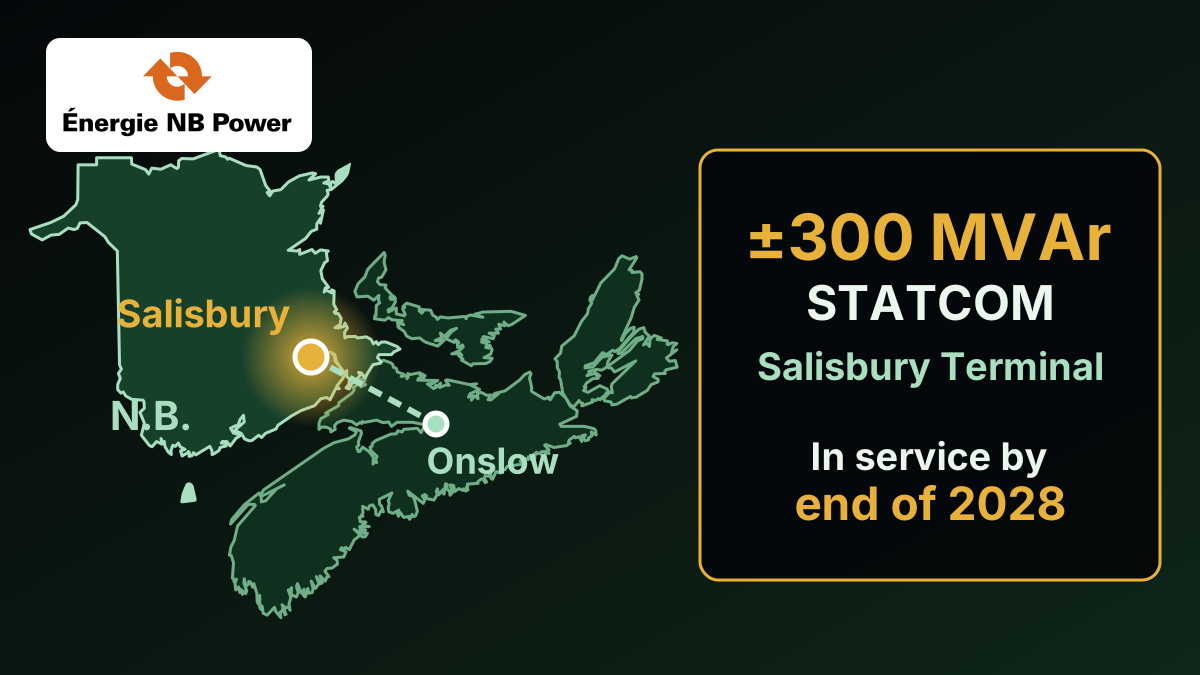
When federal Energy and Natural Resources Minister Tim Hodgson stood at the Mactaquac dam on Oct. 13 and announced almost $270 million for NB Power, most of the attention went to the dam. The smaller piece, $50 million from Natural Resources Canada, pays toward something few New Brunswickers have heard of: a static synchronous compensator, or STATCOM, at the Salisbury Terminal just west of Moncton.
NB Power president and CEO Lori Clark acknowledged as much. She said most customers hadn't heard of the Salisbury project, but called it crucial for the growing southern New Brunswick market, the Telegraph-Journal reported. "It is a least-cost option for New Brunswickers, so that we can ensure that we continue to have safe, secure, reliable electricity," she said.
What a STATCOM does
A STATCOM is a large power-electronics device that "rapidly provides and absorbs reactive power thereby regulating voltage," as NB Power describes it in a March 2026 presentation to Salisbury council. Reactive power is the part of an alternating-current flow that supports voltage across the network rather than doing useful work. When a line or generator trips, the grid needs more of it, fast.
The Salisbury unit is rated at plus or minus 300 megavolt-amperes reactive (MVAr), according to the application NB Power filed with the New Brunswick Energy and Utilities Board. The terminal itself is a high-voltage substation that the federal release calls "key to managing the flow of electricity across New Brunswick's grid."
Why Salisbury
The case for it is laid out in the board's July 25, 2025 decision, which approved the STATCOM together with two Saint John transmission projects.
NB Power is New Brunswick's registered planner under NERC reliability standard TPL-001-5.1, which requires yearly simulations of how the transmission system would ride through equipment failures. NB Power's 2023 assessment, covering 2024 to 2033, found future voltage and thermal violations. Some would have meant load shedding or load loss, meaning controlled or uncontrolled outages, which the standard doesn't permit.
In the east, the board wrote, the problem is a shortage of dynamic reactive resources. The largest ones serving the region are near Saint John and at Belledune. At winter peaks, they are already near their maximum output before anything goes wrong, and they are too far from Moncton to head off what the decision calls "eastern region load collapse."
NB Power's planners found that adding 600 MVAr at Salisbury would keep voltages in range with room for growth. The utility's plan is to install 300 MVAr of fast-acting support there now, as the STATCOM. It would meet the other 300 MVAr later with capacitor banks at eastern terminals, a need it says new generation planned for the region may reduce.
The utility compared three options at 300 MVAr: a STATCOM, a static VAR compensator and synchronous condensers. It said the STATCOM had the lowest projected capital cost and fixed every violation it had found. The expert witnesses agreed that where a grid doesn't need extra inertia, a STATCOM is the current state of the art for dynamic reactive support. The public intervener and Utilities Municipal both supported approval, and the board found the project prudent.
The cost figures
The board put the projected capital cost at $133.4 million ($133,434,842 in NB Power's application). During the hearing, NB Power disclosed supplier quotes of $57 million to $79 million for the STATCOM itself, which the board said makes up more than half of the projected cost.
The federal money is a $50 million contribution from the Smart Renewables and Electrification Pathways Program (SREPs). The federal grants record dates the agreement from March 30, 2026 to March 31, 2029 and says the project will cut emissions "by decreasing the need for emitting generation for voltage." NRCan's list of SREPs projects gives a total project cost of $104.8 million. Neither government release explains how that figure differs from the board's.
Clark told the Telegraph-Journal that ratepayers will cover about $80 million of what she put at a $130 million total.
Who builds it, and when
NB Power's council presentation lists two purchase orders: the STATCOM to Hitachi Energy, and engineering for the terminal's yard extension to Stantec. Hitachi Energy is to complete detailed engineering and then build the STATCOM on site. The plan also lists factory acceptance tests for the transformers and the STATCOM, commissioning, and training for NB Power's operations and maintenance crews.
Vegetation clearing at the terminal finished in November 2025. Grading, foundations and roads are scheduled for this fall, construction runs from spring 2027 to fall 2028, and commissioning is expected by the end of 2028, according to NB Power's project page. The presentation says that without the STATCOM, NB Power could miss reliability standards, and that voltage problems "could lead to widespread service interruptions across parts of Atlantic Canada."
Salisbury is also where Nova Scotia's next big line lands. Nova Scotia Power's Wasoqonatl transmission line will twin the existing 345-kilovolt link with a new line of about 160 km from Onslow, N.S., to Salisbury. Nova Scotia's energy board approved it in November 2025, Valard Construction is the contractor, and it is due in service at the end of 2028, the same date as the STATCOM.
NB Power's 2026 Integrated Resource Plan, released Oct. 5, says the twinning is "primarily to address Nova Scotia needs" but improves reliability and congestion in New Brunswick. NB Power has started preliminary analysis of what else would be needed to raise how much power the tie can carry. The plan also says more wind and solar will mean more synchronous condensers and static VAR compensators to keep the grid stable. It flags the southeast in particular, where the transmission system faces "grid congestion as well as a high concentration of renewable generation."
What the Mactaquac loan does and doesn't buy
The other $219 million is a three-year loan from the Canada Infrastructure Bank for early site development on the Mactaquac Life Achievement Project. It covers engineering and environmental investigations, regulatory reviews, early supply work, and First Nations and community engagement. It does not pay for the rebuild.
The 672-megawatt station supplies 30 per cent of the province's legislated renewable requirement and 20 per cent of the capacity needed at peak. The Telegraph-Journal notes it is the only station in NB Power's fleet that can restart the grid on its own after a provincewide blackout. Premature concrete deterioration has affected critical equipment, including turbines and spillway gates. Provincial Energy Minister René Legacy put the rough estimate for the full project at $8.9 billion to $9 billion.
Clark told CBC News the loan helps "partly offset some of the costs related to the engineering work that's required, the planning work that's required to getting to the final investment decision," and that the utility is still looking for a private-sector partner. The loan's repayment terms weren't announced. In July, NB Power signed a development-phase agreement for the civil work with the Mactaquac Improvement Partnership of Aecon, FlatironDragados and Green Infrastructure Partners. That agreement does not authorize construction, which NB Power expects to begin in mid-2027 if approvals come through.
Kingsclear First Nation Chief Justice Gruben, whose community sits beside the dam, attended the announcement. He told CBC his community wants opportunities in training, employment and procurement. "We want to be involved in that process directly," he said.
The province's smart-grid bench
The Salisbury build is in Hitachi Energy's and Stantec's hands. The same federal program, though, is also paying for grid modernization by a New Brunswick utility.
Saint John Energy, the city's municipal utility, received $9.74 million in SREPs funding in March for Grid Forward Saint John, a project NRCan lists at $19.5 million in total. It replaces aging underground equipment, adds line capacity, brings in a new outage management system, and adds smart water-heater controllers and intelligent switching. "Grid Forward Saint John is about making sure our system is ready for what's next," said president and CEO Ryan Mitchell. SREPs also backed the Burchill wind project in Saint John and Saint John Energy's Net Zero Innovation Unit.
In June the utility opened Plug-In Labs, which gives outside researchers and companies governed access to a digital twin of Saint John's grid running on near-real-time and historical utility data. No identifiable customer information is shared, and users have no access to live systems. Glen Fillmore, Saint John Energy's vice-president of strategic growth and transformation, told the Telegraph-Journal the platform had been about four years in the making and that the utility is the first in Canada to offer such a tool. NBCC says its students will use it for hands-on work.
Saint John Energy's smart grid forecasts load and dispatches batteries, water heaters, heat pumps and other devices to shave peaks. It won the International Smart Grid Action Network's top prize in 2021. Starting in 2019, the utility worked with UNB's Emera & NB Power Research Centre for Smart Grid Technologies on forecasting and control algorithms for it, with the UNB team led by Eduardo Castillo Guerra, UNB reported.
The centre's NB Power Industrial Research Chair, Julian Cardenas Barrera, works on energy forecasting and control of distributed energy resources. In November 2025, UNB and NB Power signed a strategic partnership covering research and the student pipeline. NB Power is UNB's largest co-op employer, with more than 500 four-month work terms in the past eight years.
Fredericton is also home to the Smart Grid Innovation Network (SGIN), which NB Power, Siemens and UNB created in 2016 as a three-lab testing environment for smart-grid products. SGIN later received $815,115 in SREPs funding for smart energy benchmarking. Siemens Canada set up two global smart grid centres in the city, one for consulting and one for software R&D, as part of a partnership with NB Power that began in 2012. In 2022 it opened a Critical Infrastructure Defense Center there for operational-technology cybersecurity. UNB's Canadian Institute for Cybersecurity works on the same problem, using AI agents to watch substation networks.
The NB Power–Siemens work included the Shediac Smart Energy Community, part of the federally funded Smart Grid Atlantic program. It found that cold-climate heat pumps were the simplest way to cut morning and evening peaks. NRCan's project summary says time-of-day rates will come once NB Power's smart-meter rollout is complete. Its latest report to the board counts 374,429 meters upgraded, about 95 per cent, as of June 30. The IRP calls for another 146 MW of demand response on top of the 80 MW the utility runs today.
The grid's next tests are already lined up. NB Power has 10 data-centre projects in its connection queue, Cookville Solar is looking for a buyer for 150 MW near Sackville, and the three Maritime provinces are planning their grid together.
Sources
- Natural Resources Canada news release, Oct. 13, 2026
- Government of New Brunswick news release, Oct. 13, 2026
- Canada Infrastructure Bank: CIB loans $219 million towards Mactaquac Site Development project
- Telegraph-Journal: Feds pump big money into planning of Mactaquac refit
- CBC News: Ottawa announces close to $270M for N.B. energy projects
- New Brunswick Energy and Utilities Board decision, Matter EL-001-2025, July 25, 2025
- New Brunswick Energy and Utilities Board notice, Matter EL-001-2025
- NB Power: STATCOM project presentation to Salisbury council
- NB Power: Static Synchronous Compensator (STATCOM) project page
- Government of Canada grants record: Dynamic Reactive Support, STATCOM implementation at Salisbury Terminal
- Natural Resources Canada: Projects announced to date, Smart Renewables and Electrification Pathways Program
- Nova Scotia Power: Wasoqonatl Transmission Line (NS-NB Reliability Tie)
- NB Power: 2026 Integrated Resource Plan
- NB Power: 2026 Integrated Resource Plan informed by customer priorities, Oct. 5, 2026
- NB Power: NB Power advances planning for the Mactaquac Life Achievement Project, July 30, 2026
- Natural Resources Canada news release, March 27, 2026: Grid Forward Saint John
- Telegraph-Journal: Saint John Energy opens up virtual replica of city's grid for testing
- Plug-In Labs: About
- Saint John Energy: Our Smart Grid
- UNB Newsroom: UNB teams up with Saint John Energy, Feb. 18, 2021
- UNB Newsroom: UNB and NB Power announce strategic partnership, Nov. 26, 2025
- UNB: Emera & NB Power Research Centre for Smart Grid Technologies, faculty members
- NB Power: Siemens partnership
- Siemens: Siemens inaugurates Critical Infrastructure Defense Center in Canada, April 1, 2022
- Natural Resources Canada: Shediac Smart Energy Community Project
- NB Power: AMI quarterly report to the NBEUB, quarter ending June 30, 2026
ChronologyNb Power· 7 stories since Jul 23, 2026
- The $133M Device Meant to Keep Southeast N.B.'s Voltage From Collapsing (this story)
- N.B. Indie Builds: Power Meters, Trading Cards and a Fire Map
Chronology · show all 7 storiesShow fewer
- N.B. Power Has 10 Data-Centre Projects in Its Queue
- Fredericton Firm Pitches Miramichi a 375-Megawatt Data Centre Campus
- Cookville’s 150 MW Solar Plan Still Needs a Buyer for the Electrons
- Miramichi Hits Pause on Zoning That Would Let Data Centres Into Heavy Industry
- Ottawa Funds PEI–NB Cable Prep as Maritime Premiers Sign an Electricity Pact
Related coverage
News · July 23, 2026
Ottawa Funds PEI–NB Cable Prep as Maritime Premiers Sign an Electricity Pact
News · October 20, 2026
N.B. Researchers Put Caregiver Strain Under AI Motion Capture
News · October 19, 2026
UNB Joins a Transatlantic Alliance on Deployable Defence Infrastructure