
News4 min read
N.B. Researchers Put Caregiver Strain Under AI Motion Capture


A new four-year program led by Université de Moncton and UNB kinesiologists will study injuries in long-term care. The same team is already using camera-based AI motion capture to test a powered bed that turns residents.
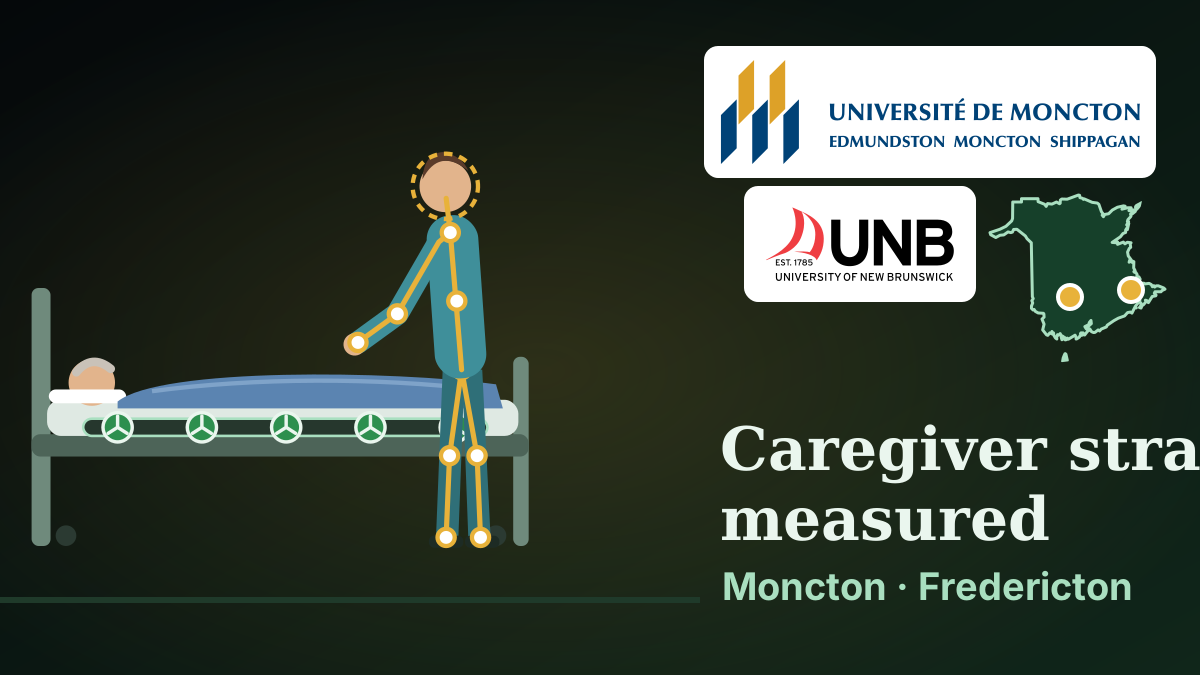
Two New Brunswick kinesiologists who measure how caregivers' bodies move have a new four-year research program. WorkSafeNB announced on Oct. 15 that more than $1.6 million in combined funding from WorkSafeNB, Mitacs, the New Brunswick Continuing Care Safety Association (NBCCSA) and ResearchNB will support a program on the physical demands of caregiving in the province's long-term care homes.
It is led by Michelle Cardoso, associate professor and Research Chair in Healthcare and Ergonomics at the Université de Moncton, and Wayne Albert, full professor of kinesiology at the University of New Brunswick.
Why it matters
Health-care workers have some of the highest rates of work-related musculoskeletal injuries of any occupation in Canada. WorkSafeNB says previous research estimates those injuries cost New Brunswick's long-term care sector about $8 million a year, through lost work time, staffing pressures and added strain on the health system.
The program sets four goals:
- Find patterns and causes of workplace injuries through province-wide epidemiological research.
- Measure the physical demands of caregiving with advanced biomechanical and ergonomic assessments, in the lab and in real care settings.
- Develop and evaluate innovative technologies, ergonomic interventions and training techniques that reduce injury risk.
- Work with health-care organizations across New Brunswick to put the findings into practice.
Rather than one study, it is meant to be a long-term research platform. Planned work includes resident handling, transfers, toileting, injury surveillance, and what helps or hinders the adoption of new equipment and technologies. Through Mitacs, it will train 23 undergraduate, graduate and postdoctoral researchers.
"Our vision extends beyond individual projects," Cardoso said in the release. "We are building a sustainable research program that will continue generating solutions for years to come."
The announcement does not name any specific device or technology. The team's recent work shows the kind of tools it brings.
Motion capture without markers
Cardoso and Albert's team is using Theia3D, an AI-powered markerless motion capture platform made by Theia, to study how caregivers move when they reposition a patient in bed. The software turns video from standard cameras into full-body 3D movement data, with no reflective markers or body sensors. Theia announced the project on Aug. 11.
That matters in a crowded bedside scene. According to Theia's release, the team's earlier marker-based setup needed about 72 markers on the caregiver, 15 on the simulated patient and another 8 to 10 on the bed.
"Without the need for reflective markers, we can collect and process data much more efficiently, reducing both experimental setup and data processing time," Cardoso said in Theia's release. She added that the approach "has the potential to bring motion analysis into real-world clinical settings."
"These measurements provide the evidence we need to evaluate new technologies and determine which approaches can reduce the physical demands placed on caregivers," Albert said.
A bed that does the turning
The device under test is the Vendlet, a powered repositioning system that uses motorized side rails and special sheets to turn and reposition a patient in bed. The team is comparing manual patient handling with and without it across nearly 550 lab trials with simulated patients. Theia's release says the team is the first in North America to evaluate the system, and that its lab houses the only Vendlet available for research on the continent.
The researchers shared preliminary results at the 2026 World Congress of Biomechanics in July. Compared with trained manual techniques, the Vendlet was associated with more neutral caregiver postures, lower joint and spinal forces, less cumulative loading, and lower perceived discomfort and effort during simulated repositioning tasks. The team plans to publish further results.
Theia's release also reports that on June 25, ResearchNB, the Research and Productivity Council and NBCCSA visited the lab. They discussed developing a bracket system to make the Vendlet compatible with North American medical beds, and explored pursuing patent protection for the design.
The sensor trial behind it
The work builds on an earlier lab study registered as NCT06285786, sponsored by UNB and run at the Université de Moncton from September 2023 to April 2024. Twenty-eight nursing students performed four repositioning tasks on a long-term care bed with and without the Vendlet, before and after training in safe patient handling.
The lab measured them with marker-based motion capture, surface electromyography on eight pairs of muscles, galvanic skin response and heart-rate monitors for stress, and pressure mats on the bed and under their feet. One stated goal was to measure how far a markerless system's results differ from the marker-based standard, to judge whether such studies could later be done in real care settings.
Earlier Vendlet work was funded in part through Mitacs Accelerate, with ResearchNB as partner. Albert's Occupational Performance Lab at UNB lists graduate projects on cumulative shoulder and back loads with patient-transfer aids, injury rates among care providers, and the barriers to bringing technology into long-term care.
Sources
- WorkSafeNB news release, Oct. 15, 2026
- Theia news release, Aug. 11, 2026
- ClinicalTrials.gov: NCT06285786
- Mitacs project: patient handling techniques and new technology
- Mitacs project: Phase 2 assessment of a patient turning device
- UNB Occupational Performance Lab: lab members
- Your Greater Moncton, Oct. 19, 2026
ChronologyUNB· 44 stories since Nov 20, 2024
- N.B. Researchers Put Caregiver Strain Under AI Motion Capture (this story)
- UNB Joins a Transatlantic Alliance on Deployable Defence Infrastructure
Chronology · show all 44 storiesShow fewer
- Hack Atlantic: 43 Student Projects in One Weekend at UNB
- Vidova Plugin Lets Claude Edit Video on a Real Timeline
- Senator Spotlights UNB's DAIR and Picketa as Proof of New Brunswick's 'Innovation Sandbox'
- UNB Researcher Is Designing a Radio Instrument to Map Space Weather at the Moon
- C-Therm's Path From a Team of Two in 2007 to Customers Worldwide
- UNB Inventors Were Granted 10 Patents in 2025–26, Tying a Decade High
- DataNB's ICT Workforce Study: N.B. Keeps Its Tech Grads for a Year, Then Loses Many
- Gray Wolf Analytics Brings Scam-Detection Playbook to UNB's RBC Lunch & Learn
- McKenna Institute Pulls District Tech Leads to Chelmsford to Scale Teacher Upskilling
- Sussex Elementary Opens a Saber STEAM Studio for Robotics and 3D Printing
- UNB Joins $5M National Push to Keep AI Weather Forecasts Grounded in Physics
- UNB's Fifth-Scale ATV Predicts the Ground Under Each Wheel — and Left AI Out of It
- Mastercard's Canada Security VP Keynoted CIC's Fredericton Summit — Then Toured the IoT Lab It Funds
- UNB Names Its First Digital Agriculture Chair — and He Starts With Small Farms
- UNB Sent Middle Schoolers Back to Class With Games, Websites and AI
- Review: UNB's Scott Bateman on the Three AI Myths That Won't Die
- UNB's Machine Learning Health Vault Wins CFI Infrastructure Funding
- UNB Co-Authors Confirm the First Native Sulfur Ever Found on Mars
- UNB Researchers Threat-Model the Protocols That Let AI Agents Act
- UNB Researchers Build a Practical Roadmap for the Post-Quantum Migration
- UNB Poster Weighs the Privacy Cost of Federated-Learning Aggregation
- UNB Researchers Deploy Collaborative AI Agents to Guard Power-Substation Networks
- UNB Researchers Build a Mixture-of-Experts Defence Against Adversarial AI Attacks
- UNB Researchers Make AI Malware Detection Explainable with a 'Dual Prototype' Framework
- UNB Researcher Takes a Geometric Axe to Optimization's Symmetry Problem
- UNB Researcher's 'Trust Passport' Would Stamp Every AI Reply with Its Risk Profile
- National Cyber Agencies and Big Banks Head to Fredericton for UNB's Cybersecurity Summit
- When the First Canadian Flew to the Moon, Fredericton Was Listening
- UNB Partners with Talent Innovation Canada to Put Grad Talent Inside Industry R&D
- McKenna Connect Puts UNB Mentors Beside 250 Rural Neighbours
- Cybersecurity Pioneer Ali Ghorbani Named to the Order of New Brunswick
- McKenna Institute's TeXplore Turns 17 Days Off School Into Soldering, Robots and AI
- SeaGreen Puts Seaweed Biochar in Ten Queen Street Flower Planters
- UNB Stitches Its Startup Machinery Into One Network
- Creduman Takes Top Spot at UNB’s MTME: NEXT 2026
- Four UNB MTME Startups Launch Next Week at MTME: NEXT
- The UNB Startup Pipeline: How a Fredericton Campus Keeps Minting Companies
- How Fredericton Became a Cybersecurity Town
- A Century of Circuits: UNB's Electrical Engineering Program Turns 100
- First Cheques: UNB's Fraser Fund Backs SpatialOne, Profitual, and AinaTest
- Gray Wolf Analytics: Crypto Forensics from a Fredericton Classroom
- Three Years In, the McKenna Institute Is Quietly Rewiring New Brunswick
Related coverage
News · October 19, 2026
UNB Joins a Transatlantic Alliance on Deployable Defence Infrastructure
News · October 17, 2026
Senator Spotlights UNB's DAIR and Picketa as Proof of New Brunswick's 'Innovation Sandbox'
News · September 24, 2026
UNB Joins $5M National Push to Keep AI Weather Forecasts Grounded in Physics