
News5 min read
Bad API Wording, Timed: UNB Put 108 Developers on a Clock and Measured the Confusion
Reported and fact-checked by NB Tech News staff; drafted with AI assistance. How we use AI


A UNB team catalogued 14 ways APIs are worded badly, scanned 4,027 real endpoints — 74 per cent of the REST ones unversioned — then timed 108 developers and watched bad wording triple comprehension time and cut correct answers from 84 per cent to 18.
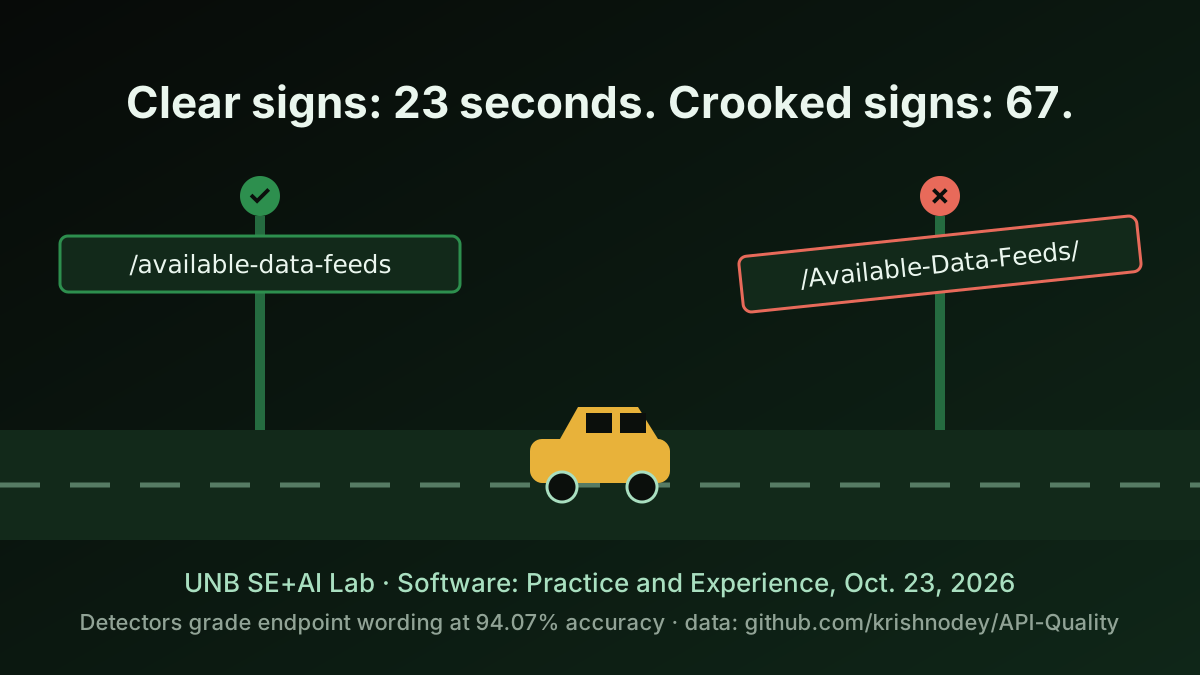
Here is an endpoint in the wild: /Available-Data-Feeds/ — capital letters, a trailing slash, no version. Nothing about it tells a developer what it does, and everything about it has to be guessed before a single line of client code can be written. A team at the University of New Brunswick has now counted how much that guessing costs — in seconds, and in wrong answers.
In a study published October 23 in Software: Practice and Experience, Krishno Dey, Stuart Thiel and Francis Palma of UNB's SE+AI Lab, with Hung Cao of the Analytics Everywhere Lab, did three things: defined a field guide of 14 linguistic design patterns and their evil twins, built software to detect them, and ran both over 4,027 endpoints from 69 real REST and GraphQL APIs. Then they put 108 developers on a clock to find out whether any of it actually matters. It does, measurably.
A field guide to bad wording
The catalogue pairs every good habit with the antipattern that breaks it, and the examples are drawn from real APIs:
- ✗ Amorphous vs. ✓ Tidy.
/Available-Data-Feeds/is amorphous — uppercase, trailing slash. Its tidy twin,/available-data-feeds/{dataSourceId}, is lowercase, structured, and readable at a glance. - ✗ CRUDy vs. ✓ Verbless.
update/players/{id}stuffs a verb into the path, doing the HTTP method's job twice. The verbless/players/idlets the method speak. - ✗ Contextless vs. ✓ Contextualized.
/newspapers/earth/players/{id}throws unrelated nouns into one path;/football/club/players/{id}keeps every node in one world. - ✗ Inconsistent Documentation. In Adobe's Audience Manager API, a POST to
/datasources/bulk-deleteis documented as "Bulk delete multiple data sources" — the method says create, the words say delete. Pipefy's POST/createCardRelation, documented "Creates a card relation," is the counterexample.
Ten of the 14 pairs come from the literature; four — including Parameters Tunneling and Identifier Ambiguity — are this team's own. PokéAPI, of all things, supplies documentation that has nothing to do with its endpoint.
What 4,027 endpoints actually look like
The detectors — syntactic checks on path structure, semantic checks on documentation — scored 94.07 per cent average accuracy against a ground truth set by three professionals. What they found is a split verdict. Most endpoints follow most of the rules: 98 per cent use contextualized resource names, 99 per cent are structured. But the failures cluster exactly where they hurt most:
- 74 per cent of the REST endpoints carry no version at all — the study's most common antipattern. Any change an unversioned endpoint's owner ships can break every client, silently. In GraphQL APIs the figure is 58 per cent.
- The antipatterns are not evenly spread. Pinterest's API shows a significant presence of them — inconsistent documentation, nonstandard and unversioned endpoints, CRUDy paths. Apple Music, Artsy, GitLab and IBM's Anomaly Detection API largely adhere to the patterns. And these 69 were chosen for being well-structured and documented — the wider world is likely worse.
Then they put developers on a clock
The detection half of the paper could be dismissed as automated tidiness. The experiment cannot. The team recruited 108 participants — students and professionals, all with at least basic Web API experience — and gave each of them 28 endpoint tasks presented as OpenAPI documents, half patterned, half antipatterned, in random order. For every task: say what it does. Correctness and time were fused into a single score (TAU, Timed Actual Understandability). Every one of the 14 pairs came out statistically significant after correction for multiple comparisons. The gaps are not subtle:
- Documentation that matches its endpoint: 84 per cent of participants got it right. Documentation that doesn't: 18 per cent.
- Contextless names: a contextualized path took 23 seconds on average; its contextless twin took 67 seconds — nearly triple, for the same operation.
- Unlabelled identifiers: 20.6 seconds with annotation, 49.5 seconds without.
And seniority is no shield. Experience helped on the well-worded tasks but did nothing on the antipattern ones: knowing the rules tells you something is wrong, not what the endpoint does.
The sceptical footnotes, and the bill
The caveats belong in the open. The ground truth behind that 94.07 per cent is 94 endpoints judged by three professionals — a sample, with majority voting where they disagreed. The experiment ran online, on snippets rather than production systems, with durations outside 5 seconds to 4 minutes discarded. And the long tail of undocumented internal APIs — the ones developers actually curse at — is uncounted entirely.
What survives the caveats is the shape of the result: the cost of bad wording is not a matter of taste, it is timed and counted, it falls on every developer who integrates with the API, not the team that wrote it, and the tooling to find it before it ships now exists — the team has published its data and materials on GitHub. The work was funded by the New Brunswick Innovation Foundation (award TRF2023-003) and UNB's Faculty of Computer Science. If a machine can grade your API's wording with 94 per cent accuracy, the argument in the next design review is no longer about preference. It is about who pays the 44 extra seconds, multiplied by every developer, every time.
Sources
- Dey, K., Thiel, S., Cao, H., Palma, F., "Linguistic Patterns and Antipatterns Detection and Their Impact on Understandability and Readability of APIs," Software: Practice and Experience, October 23, 2026: https://doi.org/10.1002/spe.70118 (open access, CC BY-NC-ND) — catalogue definitions and endpoint examples (Section 4), detection results (RQ1), impact experiment and Table A1 statistics (RQ2), threats to validity (Section 8)
- Study data as reported in the paper: 4,027 endpoints from 69 REST and GraphQL APIs; 74% of REST endpoints unversioned; detection accuracy 94.07%, precision 82.77%, recall 87.35%, F1 88.06%; experiment with 108 participants and 28 snippets; Pertinent Documentation correctness 84% vs 18%; Contextualized Resource Names 23.1s vs 66.8s mean comprehension time
- Replication package and study data, SE+AI Lab (UNB): https://github.com/krishnodey/API-Quality
- Funding as stated in the paper: New Brunswick Innovation Foundation, NBIF TRF award TRF2023-003, and the Faculty of Computer Science, University of New Brunswick
ChronologyUNB· 49 stories since Nov 20, 2024
- Bad API Wording, Timed: UNB Put 108 Developers on a Clock and Measured the Confusion (this story)
- The Screening AI That Argues Back — and Backs Down
Chronology · show all 49 storiesShow fewer
- UNB Opens VR Suites to Train Nurses for Newborn Emergencies
- N.B. Indie Builds: iPhone Apps, a Tourism Map and 3D-Printer Dashboards
- N.B. Researchers Put Caregiver Strain Under AI Motion Capture
- The $133M Device Meant to Keep Southeast N.B.'s Voltage From Collapsing
- UNB Joins a Transatlantic Alliance on Deployable Defence Infrastructure
- Hack Atlantic: 43 Student Projects in One Weekend at UNB
- Vidova Plugin Lets Claude Edit Video on a Real Timeline
- Senator Spotlights UNB's DAIR and Picketa as Proof of New Brunswick's 'Innovation Sandbox'
- UNB Researcher Is Designing a Radio Instrument to Map Space Weather at the Moon
- C-Therm's Path From a Team of Two in 2007 to Customers Worldwide
- UNB Inventors Were Granted 10 Patents in 2025–26, Tying a Decade High
- DataNB's ICT Workforce Study: N.B. Keeps Its Tech Grads for a Year, Then Loses Many
- Gray Wolf Analytics Brings Scam-Detection Playbook to UNB's RBC Lunch & Learn
- McKenna Institute Pulls District Tech Leads to Chelmsford to Scale Teacher Upskilling
- Sussex Elementary Opens a Saber STEAM Studio for Robotics and 3D Printing
- UNB Joins $5M National Push to Keep AI Weather Forecasts Grounded in Physics
- UNB's Fifth-Scale ATV Predicts the Ground Under Each Wheel — and Left AI Out of It
- Mastercard's Canada Security VP Keynoted CIC's Fredericton Summit — Then Toured the IoT Lab It Funds
- UNB Names Its First Digital Agriculture Chair — and He Starts With Small Farms
- UNB Sent Middle Schoolers Back to Class With Games, Websites and AI
- Review: UNB's Scott Bateman on the Three AI Myths That Won't Die
- UNB's Machine Learning Health Vault Wins CFI Infrastructure Funding
- UNB Co-Authors Confirm the First Native Sulfur Ever Found on Mars
- UNB Researchers Threat-Model the Protocols That Let AI Agents Act
- UNB Researchers Build a Practical Roadmap for the Post-Quantum Migration
- UNB Poster Weighs the Privacy Cost of Federated-Learning Aggregation
- UNB Researchers Deploy Collaborative AI Agents to Guard Power-Substation Networks
- UNB Researchers Build a Mixture-of-Experts Defence Against Adversarial AI Attacks
- UNB Researchers Make AI Malware Detection Explainable with a 'Dual Prototype' Framework
- UNB Researcher Takes a Geometric Axe to Optimization's Symmetry Problem
- UNB Researcher's 'Trust Passport' Would Stamp Every AI Reply with Its Risk Profile
- National Cyber Agencies and Big Banks Head to Fredericton for UNB's Cybersecurity Summit
- When the First Canadian Flew to the Moon, Fredericton Was Listening
- UNB Partners with Talent Innovation Canada to Put Grad Talent Inside Industry R&D
- McKenna Connect Puts UNB Mentors Beside 250 Rural Neighbours
- Cybersecurity Pioneer Ali Ghorbani Named to the Order of New Brunswick
- McKenna Institute's TeXplore Turns 17 Days Off School Into Soldering, Robots and AI
- SeaGreen Puts Seaweed Biochar in Ten Queen Street Flower Planters
- UNB Stitches Its Startup Machinery Into One Network
- Creduman Takes Top Spot at UNB’s MTME: NEXT 2026
- Four UNB MTME Startups Launch Next Week at MTME: NEXT
- The UNB Startup Pipeline: How a Fredericton Campus Keeps Minting Companies
- How Fredericton Became a Cybersecurity Town
- A Century of Circuits: UNB's Electrical Engineering Program Turns 100
- First Cheques: UNB's Fraser Fund Backs SpatialOne, Profitual, and AinaTest
- Gray Wolf Analytics: Crypto Forensics from a Fredericton Classroom
- Three Years In, the McKenna Institute Is Quietly Rewiring New Brunswick
Related coverage
News · October 27, 2026
The Screening AI That Argues Back — and Backs Down
News · October 20, 2026
N.B. Researchers Put Caregiver Strain Under AI Motion Capture
News · October 19, 2026
UNB Joins a Transatlantic Alliance on Deployable Defence Infrastructure