
News6 min read
The Screening AI That Argues Back — and Backs Down
Reported and fact-checked by NB Tech News staff; drafted with AI assistance. How we use AI


Sixty volunteers walked corridors and sat still while a chest strap logged their heartbeats. The Fredericton-built system reading those heartbeats was designed, above all, to lose an argument with a doctor.
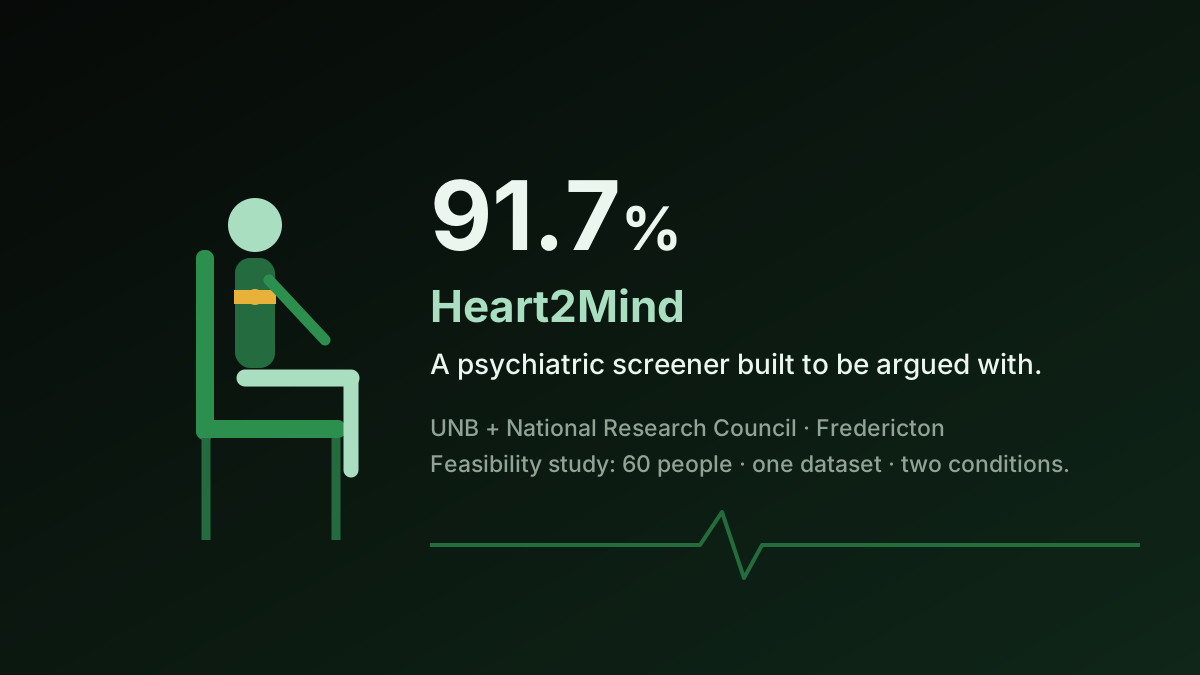
For an hour and a half to two hours, the volunteers did almost nothing. They walked short corridors, then sat and rested, then walked again — 60 people wearing a Polar H10 chest strap while it logged every interval between their heartbeats. Thirty of them live with schizophrenia or bipolar disorder. Thirty do not.
That unglamorous session is the raw material for Heart2Mind, a system built at the University of New Brunswick and the National Research Council in Fredericton. It reads a heartbeat series, predicts whether it belongs to someone in the treatment group — and then, by design, lets a clinician talk it out of its own answer. The paper appeared October 24 in ACM Transactions on Computing for Healthcare; the code is public on GitHub.
Why a heartbeat, and why an argument
The physiology first. The autonomic nervous system — the circuitry that speeds the heart up and settles it down — behaves measurably differently in psychotic disorders, and the giveaway is in the gaps: heart-rate variability, the small irregularities between beats, shrinks and destabilizes. A healthy heart is not a metronome. A struggling one, paradoxically, can tick more evenly while lurching between states.
The argument is the actual invention. Medical AI normally arrives as a verdict: a score, a label, a rationale stapled to it. Heart2Mind's designers — the team calls its field contestable AI — built the opposite posture: every prediction can be cross-examined in a chat window, and the system must defend its reasoning with the underlying numbers or concede. The posture is arriving on a regulatory schedule, too. The paper grounds the design in the GDPR, the EU AI Act, Health Canada's guidance and Canada's own Directive on Automated Decision-Making — frameworks converging on a right to challenge what an algorithm decided about you.
91.7 per cent, with the footnotes attached
The prediction engine is a Multi-Scale Temporal-Frequency Transformer (MSTFT). It reads the beat-to-beat series twice at once — in the time domain, where metrics like RMSSD and pNN50 capture beat-level variability, and in the frequency domain, where the balance of low- and high-frequency power shows which branch of the nervous system is driving — and fuses the two readings.
Fusion is not decoration. Time-only, the model scores 78.7 per cent accuracy; frequency-only, 77.6. Fused, under leave-one-out cross-validation on the 60-person HRV-ACC dataset — train on 59 people, test on the one held out, repeat 60 times — it reaches 91.7 per cent, and 89.1 per cent under five-fold validation with an AUC of 0.961, beating the strongest previous method by 6.1 points.
The footnotes: 60 people is a small room to draw a percentage from, the dataset is the only one of its kind, and every participant was recorded under the same corridor-and-chair protocol. The number says the signal is real and the fusion works. It does not say the system is ready for a clinic, and the paper never claims otherwise.
The machine flags itself first
Before any human gets to argue, Heart2Mind argues with itself. For each prediction it generates two independent explanations — one from where the model's attention fell, one from gradient analysis — and compares them region by region. Where they disagree, the region is marked discrepant; past a threshold, the prediction is held back as suspect. The team's rule of thumb: a prediction carrying more than about five discrepancy regions is one a clinician should look at personally.
Then the human study. Twelve recruited experts — seven from AI, two from biomedical engineering, two from human-computer interaction, one from cognitive psychology — each worked two cases through the contestation interface: one the model had called correctly, and one it had gotten wrong.
The wrong case is the story. The model had looked at a treatment-group recording and called it control. Its two explanations disagreed in seven regions — the most of any misclassified sample in the study — and when the contestable LLM re-read the case, it found what the headline average had hidden: overall variability (SDNN 73.07 ms) looked unremarkable, but Region 7 collapsed to 34.99 ms, a period of severe autonomic rigidity, and Region 1's beat-level variability fell to 16.01 ms. Two of the three language models tested overturned the call to treatment. In the room, 11 of the 12 expert sessions on that case also reached the right answer — eight by the human winning the argument outright, three by human and machine correcting each other.
One session transcript, published in the paper's appendix, shows how direct the exchanges get. A biomedical engineering expert, facing a case where both their own judgment and the base model pointed the wrong way, wrote: "Are you sure that this should be a treatment case? This goes against both the AI and my predictions. Please revise carefully." The system revised, walked through the regional numbers step by step, and held its ground — correctly. Final decision: treatment.
The sessions were not ordeals. Correcting the wrong case took a median of eight and a half minutes and four turns of dialogue; confirming the right one, about seven and a half minutes and three turns — in prose measured at roughly a Grade 15 reading level.
What it does not certify
The failure modes are in the paper too, and they are instructive. The third language model tested refused to overturn the wrong case, ruling the fluctuations "within the realm of normal variability" — a plausible-sounding sentence that happened to be wrong, from the same interface that produced the corrections. One expert session failed the other way: the participant read the irregular pattern as a sensor artifact, and the error stood. And the model that reasoned most accurately, gemma-3, took 36 to 38 seconds per answer — an eternity in a live clinical workflow, against ten seconds for the faster, occasionally wronger alternative.
Scope is the deeper limit. The validation covers exactly two conditions, schizophrenia and bipolar disorder; whether the approach extends to depression or anxiety is, in the authors' words, unexplored. The input is one signal from one sensor, the sample is small and homogeneous, and the paper concedes that current language models "still exhibit inconsistent medical knowledge" — an awkward trait in a component whose whole job is to be argued with. Clinical partnerships for real-world evaluation are in development.
None of that dims the design idea, which is the part most likely to outlive the dataset. A generation of medical AI is being built to be believed. This one — built in Fredericton, on two hours of corridor walking at a time — is built to be cross-examined, and it publishes the transcripts of the times it lost. That is a standard the rest of the field will eventually be held to.
The authors are Hung Nguyen (UNB and NRC), Alireza Rahimi and Veronica Whitford (UNB), Hélène Fournier (NRC, Moncton), Irina Kondratova and René Richard (NRC, Fredericton), and Hung Cao of UNB's Analytics Everywhere Lab, where the work was done.
Sources
- Nguyen, H. et al., "Heart2Mind: Human-Centered Contestable Psychiatric Disorder Prediction System Using Wearable ECG Monitors," ACM Transactions on Computing for Healthcare, October 24, 2026: https://doi.org/10.1145/3788686 — all figures, the HRV-ACC protocol, the human study results and the session transcripts quoted above are from the paper and its appendices
- Heart2Mind implementation, Analytics Everywhere Lab (UNB): https://github.com/Analytics-Everywhere-Lab/heart2mind
- Participant session videos from the human study, linked in the paper: https://www.youtube.com/playlist?list=PLWTlzhO-RmiwdSjadQCfp8hpAF8RducVL
- HRV-ACC dataset (60 participants; Polar H10 recordings; schizophrenia/bipolar and control groups), as described in the paper
ChronologyUNB· 49 stories since Nov 20, 2024
- Bad API Wording, Timed: UNB Put 108 Developers on a Clock and Measured the Confusion
- The Screening AI That Argues Back — and Backs Down (this story)
Chronology · show all 49 storiesShow fewer
- UNB Opens VR Suites to Train Nurses for Newborn Emergencies
- N.B. Indie Builds: iPhone Apps, a Tourism Map and 3D-Printer Dashboards
- N.B. Researchers Put Caregiver Strain Under AI Motion Capture
- The $133M Device Meant to Keep Southeast N.B.'s Voltage From Collapsing
- UNB Joins a Transatlantic Alliance on Deployable Defence Infrastructure
- Hack Atlantic: 43 Student Projects in One Weekend at UNB
- Vidova Plugin Lets Claude Edit Video on a Real Timeline
- Senator Spotlights UNB's DAIR and Picketa as Proof of New Brunswick's 'Innovation Sandbox'
- UNB Researcher Is Designing a Radio Instrument to Map Space Weather at the Moon
- C-Therm's Path From a Team of Two in 2007 to Customers Worldwide
- UNB Inventors Were Granted 10 Patents in 2025–26, Tying a Decade High
- DataNB's ICT Workforce Study: N.B. Keeps Its Tech Grads for a Year, Then Loses Many
- Gray Wolf Analytics Brings Scam-Detection Playbook to UNB's RBC Lunch & Learn
- McKenna Institute Pulls District Tech Leads to Chelmsford to Scale Teacher Upskilling
- Sussex Elementary Opens a Saber STEAM Studio for Robotics and 3D Printing
- UNB Joins $5M National Push to Keep AI Weather Forecasts Grounded in Physics
- UNB's Fifth-Scale ATV Predicts the Ground Under Each Wheel — and Left AI Out of It
- Mastercard's Canada Security VP Keynoted CIC's Fredericton Summit — Then Toured the IoT Lab It Funds
- UNB Names Its First Digital Agriculture Chair — and He Starts With Small Farms
- UNB Sent Middle Schoolers Back to Class With Games, Websites and AI
- Review: UNB's Scott Bateman on the Three AI Myths That Won't Die
- UNB's Machine Learning Health Vault Wins CFI Infrastructure Funding
- UNB Co-Authors Confirm the First Native Sulfur Ever Found on Mars
- UNB Researchers Threat-Model the Protocols That Let AI Agents Act
- UNB Researchers Build a Practical Roadmap for the Post-Quantum Migration
- UNB Poster Weighs the Privacy Cost of Federated-Learning Aggregation
- UNB Researchers Deploy Collaborative AI Agents to Guard Power-Substation Networks
- UNB Researchers Build a Mixture-of-Experts Defence Against Adversarial AI Attacks
- UNB Researchers Make AI Malware Detection Explainable with a 'Dual Prototype' Framework
- UNB Researcher Takes a Geometric Axe to Optimization's Symmetry Problem
- UNB Researcher's 'Trust Passport' Would Stamp Every AI Reply with Its Risk Profile
- National Cyber Agencies and Big Banks Head to Fredericton for UNB's Cybersecurity Summit
- When the First Canadian Flew to the Moon, Fredericton Was Listening
- UNB Partners with Talent Innovation Canada to Put Grad Talent Inside Industry R&D
- McKenna Connect Puts UNB Mentors Beside 250 Rural Neighbours
- Cybersecurity Pioneer Ali Ghorbani Named to the Order of New Brunswick
- McKenna Institute's TeXplore Turns 17 Days Off School Into Soldering, Robots and AI
- SeaGreen Puts Seaweed Biochar in Ten Queen Street Flower Planters
- UNB Stitches Its Startup Machinery Into One Network
- Creduman Takes Top Spot at UNB’s MTME: NEXT 2026
- Four UNB MTME Startups Launch Next Week at MTME: NEXT
- The UNB Startup Pipeline: How a Fredericton Campus Keeps Minting Companies
- How Fredericton Became a Cybersecurity Town
- A Century of Circuits: UNB's Electrical Engineering Program Turns 100
- First Cheques: UNB's Fraser Fund Backs SpatialOne, Profitual, and AinaTest
- Gray Wolf Analytics: Crypto Forensics from a Fredericton Classroom
- Three Years In, the McKenna Institute Is Quietly Rewiring New Brunswick
Related coverage
News · October 20, 2026
N.B. Researchers Put Caregiver Strain Under AI Motion Capture
News · October 17, 2026
Senator Spotlights UNB's DAIR and Picketa as Proof of New Brunswick's 'Innovation Sandbox'
News · September 24, 2026
UNB Joins $5M National Push to Keep AI Weather Forecasts Grounded in Physics