
News10 min read
Lorneville Gets Its Night With VoltaGrid on Nov. 5 — and Two Days to Sign the Petition
Reported and fact-checked by NB Tech News staff; drafted with AI assistance. How we use AI


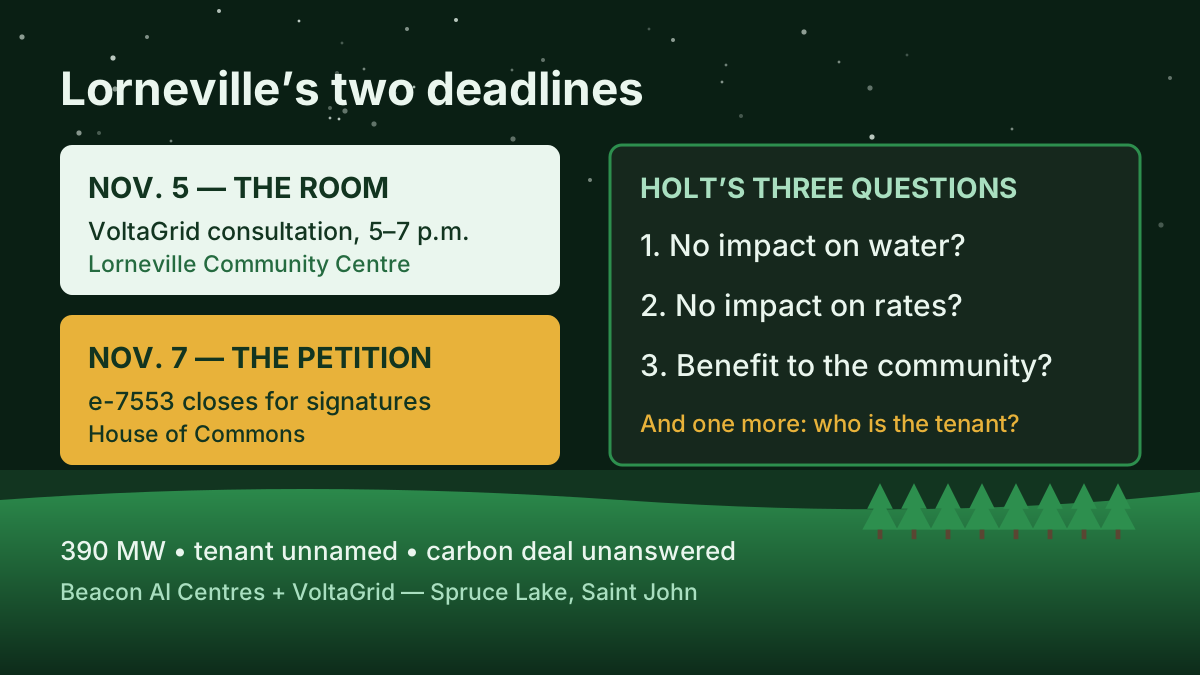
VoltaGrid hosts a community consultation at the Lorneville Community Centre on Thursday, Nov. 5, 5 to 7 p.m., with the tenant for its 390 MW data centre still unnamed and a special carbon deal on the table in emails released under right-to-information. The federal petition against hyperscale data centres closes for signatures two days later, on Nov. 7.
✍️ Sign petition e-7553 — it closes Saturday, Nov. 7
Tell Ottawa to put federal rules around hyperscale data centres.
Be there: VoltaGrid community consultation — Thursday, Nov. 5, 5–7 p.m., Lorneville Community Centre, 1141 Lorneville Rd, Saint John, NB.
Lorneville has two dates circled, 48 hours apart.
On Thursday, Nov. 5, from 5 to 7 p.m., VoltaGrid hosts what it calls a "community consultation" at the Lorneville Community Centre in Saint John — the company's night in the room with the residents who live beside the expanded Spruce Lake Industrial Park, where VoltaGrid and Beacon AI Centres want to build a 390-megawatt AI data centre and a 190-megawatt natural gas plant to help power it.
Two days later, on Saturday, Nov. 7, a House of Commons petition asking Ottawa to put federal rules around hyperscale data centres closes for signatures, according to the organizers promoting it.
The opposition is treating the meeting as a turnout test. "November 5th, Voltagrid will be in town for a 'community consultation' join us at the Lorneville community center. There is strength in numbers. 5PM-7PM," the Resist Data Center New Brunswick account posted on Instagram on Oct. 22. Data Center Dynamics likewise reports the pair are set to host a public session for the data centre on Nov. 5.
What happens Nov. 5
The meeting is the companies' event, not the province's and not the city's. VoltaGrid is the host, the venue is the community centre in the village itself, and the window is two hours on a Thursday evening.
What residents bring into that room is a file they have built largely themselves. The Save Lorneville group has spent months pulling provincial records through right-to-information requests, and on Oct. 26 it published a briefing for the Nov. 5 session built from emails it obtained that way. The briefing, summarized below, is now effectively the opposition's agenda for the evening: a set of questions the companies have not answered in public, asked in a room full of neighbours.
The project itself is well documented, even if its customer is not. Beacon AI Centres is an Alberta company launched by investment firm Nadia Partners. VoltaGrid is a Texas-based power company. Together they propose a data centre on a 120-hectare parcel in the expanded Spruce Lake Industrial Park, in the small coastal village of Lorneville, according to Data Center Dynamics. The city approved a rezoning in July that added 645 hectares to the park. The facility would draw 200 megawatts from the N.B. Power grid and another 190 megawatts from the on-site gas plant — 390 megawatts in all. Its environmental impact assessment, Registration No. 1663, was filed on April 10, 2026, and remains under provincial review. Residents have also filed for judicial review of the rezoning, according to a guide to resisting AI data centre development in Canada published by AI Civil Society Canada.
The emails: a tenant, and a carbon price to 'fix'
The sharpest material Save Lorneville is carrying into Nov. 5 comes from the province's own inbox.
In emails released under right-to-information and published by Save Lorneville on Oct. 26, VoltaGrid chief executive Nathan Ough told the province in May 2026 that the company was "close to finalizing" an agreement with a prospective tenant, and proposed a special carbon-pricing arrangement to help move the transaction forward. CBC's reporting on the same records was headlined "Data-centre partner asked province to 'fix' carbon tax." NB Tech News first linked that story in our coverage of the Oct. 20 rally at the legislature.
Under the proposal Save Lorneville describes, VoltaGrid would pay a fixed $5.1 million a year for 15 years. A quarter of it — about $1.275 million a year — would go directly to Lorneville. The rest would be split between Saint John Energy, city priorities and data-centre decarbonization. The gas plant, meanwhile, would keep emitting roughly 755,000 tonnes of greenhouse gases a year.
Save Lorneville calls it, in effect, a pay-to-pollute scheme: the plant keeps emitting, and part of the carbon payment comes back to the community that has to live beside it.
The other half of the disclosure cuts at the project's central sales pitch. Beacon and VoltaGrid, and the Holt government in promoting hyperscale development, have sold Lorneville as "sovereign" Canadian digital infrastructure. Yet the tenant Ough described in May was unnamed then and is unnamed now. A sovereign facility with an undisclosed commercial tenant raises an obvious question — sovereign for whom?
Questions for Nov. 5
These are the questions Save Lorneville is suggesting residents put to Beacon and VoltaGrid on Nov. 5, paraphrased from its Oct. 26 briefing:
- Who is the "prospective tenant" Nathan Ough mentioned in his May email to the province?
- Did that deal close?
- Which project is Lorneville actually being asked to accept: a sovereign Canadian data centre, or a private hyperscale facility for an undisclosed commercial tenant?
- Is the prospective tenant Canadian or foreign-owned?
- If this is a sovereign Canadian project, what binding commitment exists to Canadian government, public-sector or domestic sovereign use?
- What carbon-pricing arrangement, if any, did VoltaGrid ultimately reach with the province?
- Now that the proposed $1.275-million annual payment to Lorneville did not proceed, what exactly is VoltaGrid offering the community in return for hosting a large gas plant next to it?
Ough himself is part of the local colour the companies bring into the room. He was born in Saint John and grew up there, worked as an analyst at Irving Oil, co-founded the natural-gas logistics company Certarus at 23 and founded VoltaGrid in 2020, according to profile coverage in the Wall Street Journal. VoltaGrid has since signed a partnership with Halliburton to develop distributed power for data centres and agreed to supply Oracle with 2.3 gigawatts of capacity, Data Center Dynamics reports. The company across the table on Nov. 5 is not a startup looking for a first customer; it is a U.S. power company with some of the largest names in the industry already signed.
Nov. 7: the petition closes
Read and sign petition e-7553 before it closes on Nov. 7: Petition e-7553 — Hyperscale AI data centres, House of Commons
The petition was initiated by Jillian Szabo-Hammond of Haneytown, New Brunswick. Its whereas-clauses argue that Ottawa has promoted hyperscale AI data centre development through its national AI strategy without establishing federal protections for the communities, ecosystems and public utilities that bear the costs; that the proposed 390-megawatt Lorneville centre, powered in part by VoltaGrid's gas plant, would become one of New Brunswick's top three industrial greenhouse gas emitters; that its 200 megawatts from N.B. Power, a publicly owned utility, raise questions about energy security, affordability and costs being socialized onto ordinary ratepayers to subsidize a private foreign corporation; and that no federal regulatory framework exists to evaluate the cumulative environmental, energy or social impacts of hyperscale development, while consultations on the federal AI strategy excluded affected municipalities and communities.
It asks the House of Commons to:
- Apply the Impact Assessment Act to hyperscale data centres exceeding 100,000 tonnes of annual carbon dioxide emissions or drawing more than 100 megawatts from a public grid.
- Direct the Minister of Fisheries and Oceans to assess the federal habitat protection obligations triggered by the Lorneville project.
- Require that the federal AI strategy include binding community and environmental protection standards before any further federal support goes to hyperscale data centre development.
Both accounts driving the Nov. 5 turnout — Resist Data Center New Brunswick and No AI Data Centres NB — link the petition in their profiles and give Nov. 7 as the closing date for signatures.
The wider stakes in the room
Nov. 5 does not happen in isolation. On Oct. 20, between 300 and 350 people rallied outside the legislature in Fredericton as the throne speech promised to write data-centre standards into the Electricity Act this session, with projects that miss them not approved. Premier Susan Holt, who stopped to talk with demonstrators, set out her test in three questions: "Can they do it without impact on water? Can they do it without impact on energy rates? Can they do it with a positive benefit on the community?" Our full report is at Protesters Press Holt as N.B. Promises Data-Centre Law.
Behind Lorneville sits a much larger queue. N.B. Power has 10 data-centre projects in its connection queue, seeking about 900 megawatts between them, and the utility says it has no supply agreements with any of them and that a place in the queue is not a commitment to build.
And Lorneville may not be Saint John's only file. As our Miramichi coverage reported, Cross River Infrastructure Partners wrote to Opportunities New Brunswick Minister Luke Randall on April 28 about a "new large-scale data centre campus" in Saint John, structured around an initial request for 50 megawatts of network-firm power, with room to expand. Save Lorneville's Chris Watson has argued that any additional development has to be assessed together with the projects already proposed — cumulative effects, not one file at a time against an empty background.
The province, for its part, has previously signalled that its decision on the Spruce Lake proposal will likely wait until its data-centre policy framework is finalized. That framework went out for public consultation in September, and the promised Electricity Act amendments have not yet been tabled.
What to watch next
Three things will tell whether Nov. 5 changed anything: whether VoltaGrid names its tenant, or explains why it cannot; whether the company confirms what carbon arrangement, if any, replaced the fixed-price proposal in Ough's May email; and whether anyone from the province attends to say how the meeting feeds into the environmental review and the standards bill still to come. Two days later, the signature count on e-7553 when it closes on Nov. 7 will give the opposition a number to carry into that legislative debate.
Sources
- Resist Data Center New Brunswick — Instagram, Oct. 22, 2026: "November 5th, Voltagrid will be in town for a 'community consultation' join us at the Lorneville community center. There is strength in numbers. 5PM-7PM"; account bio links petition e-7553 and gives Nov. 7 as its closing date
- Save Lorneville — Instagram briefing, Oct. 26, 2026, built from right-to-information emails: Ough's May 2026 "close to finalizing" tenant language, the proposed 15-year fixed carbon price of $5.1 million a year with 25 per cent to Lorneville, roughly 755,000 tonnes of annual greenhouse gas emissions, and the group's suggested questions for Nov. 5
- CBC News — Data-centre partner asked province to 'fix' carbon tax: the right-to-information records on VoltaGrid's carbon-pricing request to the province
- Data Center Dynamics — Beacon AI Center and VoltaGrid may build data center in Saint John, Canada: 120-hectare parcel in the Spruce Lake Industrial Park, July rezoning adding 645 hectares, the Nov. 5 public session, Nadia Partners' launch of Beacon, and VoltaGrid's Halliburton partnership and 2.3 GW Oracle supply agreement
- House of Commons — Petition e-7553: initiated by Jillian Szabo-Hammond of Haneytown, N.B.; the 390 MW Lorneville centre, top-three industrial emitter and 200 MW N.B. Power draw in the whereas-clauses, and the petition's three asks
- Government of New Brunswick — EIA registrations: Registration No. 1663 for the Beacon/VoltaGrid project at Spruce Lake, 390 MW with a 190 MW on-site gas plant and 200 MW from the grid
- AI Civil Society Canada — Resisting AI Data Centre Development in Canada: the rezoning's unanimous council passage despite overwhelmingly negative public comments, and residents' application for judicial review
- NB Tech News — Protesters Press Holt as N.B. Promises Data-Centre Law (Oct. 21, 2026): the Oct. 20 rally of about 300 to 350, the throne speech's Electricity Act promise, and Holt's water, rates and community-benefit test
- NB Tech News — N.B. Power Has 10 Data-Centre Projects in Its Queue (Oct. 18, 2026): 10 projects, about 900 MW, no supply agreements, and a queue place as no commitment to build
- NB Tech News — Fredericton's FTL Pitches a 375 MW Data Centre for Miramichi: Cross River Infrastructure Partners' April 28 email to Minister Luke Randall, its initial 50 MW request, and Chris Watson on assessing cumulative effects together
- NB Tech News — Province Opens Data-Centre Policy Consultation: the draft framework, the September consultation window, and the province's signal that the Spruce Lake decision waits for the finalized framework
ChronologyData Centres· 7 stories since Jul 26, 2026
- Lorneville Gets Its Night With VoltaGrid on Nov. 5 — and Two Days to Sign the Petition (this story)
- Grand Falls Wants a Freeze on New Data Centres
Chronology · show all 7 storiesShow fewer
- Protesters Press Holt as N.B. Promises Data-Centre Law
- N.B. Power Has 10 Data-Centre Projects in Its Queue
- Fredericton Firm Pitches Miramichi a 375-Megawatt Data Centre Campus
- Province Asks for Comment on How Data Centres Get Built Here
- Miramichi Hits Pause on Zoning That Would Let Data Centres Into Heavy Industry
Related coverage
News · October 21, 2026
Protesters Press Holt as N.B. Promises Data-Centre Law
News · October 18, 2026
N.B. Power Has 10 Data-Centre Projects in Its Queue
News · October 9, 2026
Fredericton Firm Pitches Miramichi a 375-Megawatt Data Centre Campus