
Analysis8 min read
From 600 Patients a Day to 50: Anatomy of New Brunswick's Virtual Care Fumble


The province dropped a homegrown virtual care service for a debt-laden call-centre giant. Three weeks in, patients are stuck on hold, prescriptions are in limbo, and the health minister is taking the blame.
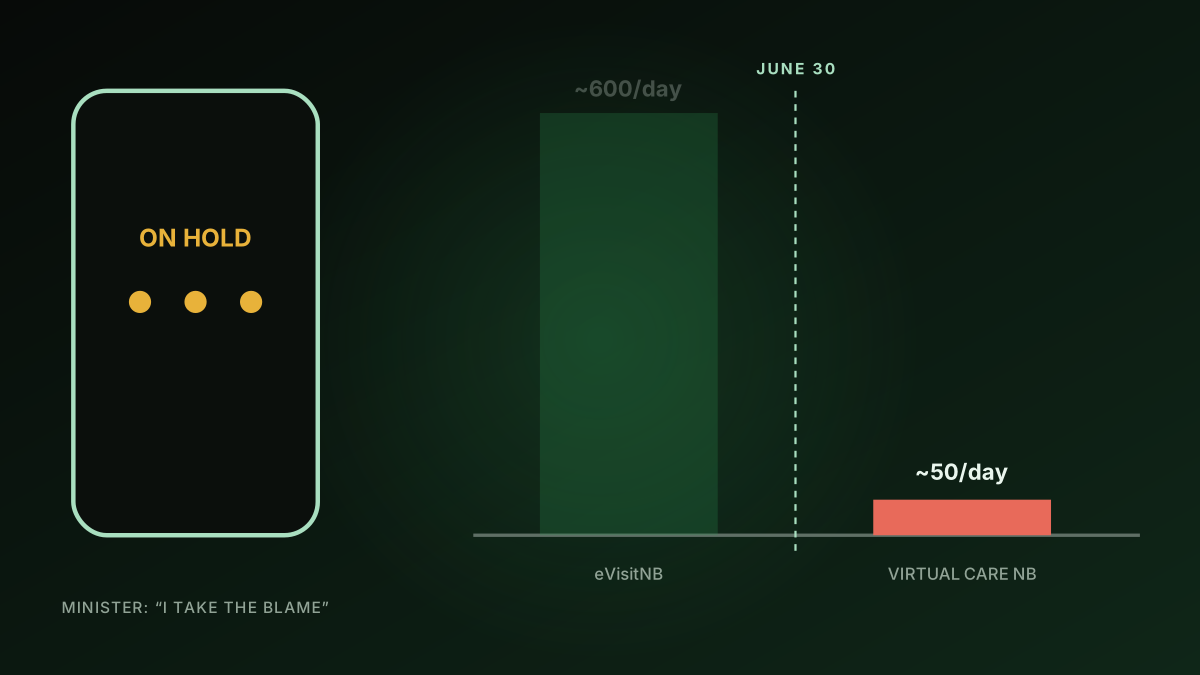
On July 15, New Brunswick Health Minister Dr. John Dornan called a rare midsummer news conference to say something ministers almost never say out loud: "I take the blame for claiming it would be seamless."
The "it" is the province's switch, on June 30, from eVisitNB — a Woodstock-built virtual care service that had handled New Brunswickers' online doctor visits since the pandemic — to Virtual Care NB, a new service run by a subsidiary of Foundever Group, the Luxembourg-headquartered call-centre giant that also operates Tele-Care 811. Three weeks in, the reported results include hours-long 811 hold times, two-week waits for antibiotics, video appointments where no provider showed up, and a prescription-renewal backlog that has patients lining up at pharmacy counters instead. Interim Progressive Conservative Leader Glen Savoie's verdict: "This thing has been a boondoggle, it's a mess."
This is, at bottom, a technology procurement story — and the numbers tell it starkly. The old platform saw about 600 patients a day, upward of 1,000 in cold and flu season, according to its CEO. In mid-July, Dornan said the new one was averaging about 50 consultations a day.
A homegrown platform, dropped
eVisitNB was launched in January 2020 by Woodstock physician Dr. Hanif Chatur, running on Toronto-based Maple's telehealth software. Since January 2022 it had operated under a provincial contract that let any New Brunswicker with a Medicare card see a nurse practitioner online for free — a lifeline in a province where roughly 200,000 people have no family doctor.
On February 6, 2026, the River Valley Sun broke the news that the Holt government would not renew eVisitNB's contract. The province first pointed to official-languages concerns — the Commissioner of Official Languages had issued two 2024 reports after francophone patients couldn't get service in French, a problem Maple attributed to a since-fixed glitch. But when Deputy Health Minister Eric Beaulieu faced MLAs, the rationale shifted: after reviewing 500,000 eVisitNB visits and running a fall 2025 request for proposals that drew 11 candidates, the department judged Foundever's bid "stronger," chiefly on integration with provincial systems such as electronic health records, NB Health Link and Tele-Care 811.
The winner was Foundever Assistance Services Corp., the London, Ont.-based subsidiary (formerly Assistance Services Group) of Foundever Group. PC health critic Bill Hogan, whose Woodstock-Hartland riding is home to eVisitNB, called on the government to halt negotiations, warning that patient data was moving from "a New Brunswick company with 100 per cent Canadian data storage" to a multinational. The government countered that the contract requires all patient information to be stored in Canada.
The warnings were on the record
Before the contract was even signed, there was a public, written warning about the winning bidder's finances. On December 18, 2025, S&P Global downgraded Foundever Group two notches, from B- to CCC, and advised in a research note that the company — roughly $3.6 billion in 2024 revenue, third-largest player in global outsourced customer service — was likely to default on its debts within a year.
The Holt government signed anyway, on March 25, 2026: a two-year deal budgeted at $12.9 million per year against 250,000 services, with options to renew — about $30 million including HST, by the Telegraph-Journal's accounting. For comparison, the legislature's estimates committee heard that eVisitNB had been paid roughly $11 million for 233,532 visits in the 2025-26 fiscal year as of mid-March. The province is budgeting more money for a comparable volume of care.
Then Foundever missed its own start line. The takeover was supposed to happen April 1; the province quietly extended eVisitNB by 90 days because, in Dornan's words, the new provider was "not ready to take over the service." The handover finally happened June 30 — at the height of summer vacation season for doctors and hospital staff.
Launch month: hold music and empty waiting rooms
Where eVisitNB dropped patients into a virtual waiting room, Virtual Care NB requires triage first: an online symptom checker built around clicking pain points on a body diagram, or a call to Tele-Care 811, before a scheduled appointment between 8 a.m. and 8 p.m.
The reported patient experience in July: one Moncton woman told CTV she spent four hours cycling through the symptom checker and an empty video call before giving up — "I give up. I'm just going to call my family doctor and see if I can get anywhere." Another patient told CBC her husband, whom an 811 nurse agreed likely needed antibiotics, was quoted a two-week wait for a virtual appointment; he opted for home remedies over an emergency-room visit. A Woodstock business owner described three separate phone calls, a series of glitches and five days of waiting for a routine refill of medication she had taken for years. Others reported 90-minute-plus 811 hold times and appointment links that never arrived.
Nurse practitioners had warned about the new appointment model before launch, and the New Brunswick Pharmacists' Association said the province held no meaningful discussions with pharmacists before go-live — an assessment Dornan agreed with. Capacity lagged too: Foundever hired 27 nurse practitioners in the two weeks before launch and was up to 52 by mid-July, against the 165 eVisitNB had. In its first two weeks, Virtual Care NB helped between 15 and 90 patients a day; in the same two weeks of July 2025, eVisitNB served 8,316 patients — an average of 594 a day.
"We didn't have data" — except the data existed
At his news conference, Dornan offered an explanation for the prescription-renewal crunch: "We didn't have data from the prior provider as to what volume was prescription renewals." Given 200,000 New Brunswickers without primary care, he allowed, "we might have been able to anticipate that to some extent."
eVisitNB's CEO called the claim "a bit shocking." Chatur told CBC News he emailed the Department of Health in September 2025 with year-to-date figures showing about 63 per cent of consultations involved a prescription renewal. "We're a data-driven company because we're digital," he said. "We know when our consults start, we know when they end, we know what they're for." The River Valley Sun, meanwhile, published a Department of Health report that itself analyzed eVisitNB's monthly data — including 160,905 new prescriptions written between July 2023 and July 2024 — and monthly reports showing eVisitNB's nurse practitioners wrote 20,835 prescriptions in June 2026, the service's final month.
Pressed on the contradiction, the department revised its position: it lacked "detailed, reliable data specific to prescription renewals," Dornan said in a statement, citing unspecified "data issues" with what eVisitNB provided. The fixes announced on July 15 — a direct online prescription-renewal option and a dedicated renewals choice on the 811 phone menu — are, in effect, features the province is retrofitting three weeks after launch, for the single most common thing patients used the old service for.
Paying twice
The epilogue is that New Brunswickers who can afford it are now buying back the service their taxes already fund. Maple has emailed former eVisitNB users inviting them to continue on its platform at their own cost. One Fredericton senior told CBC he signed up the day after Dornan's news conference — $97.50 a month for himself and his wife — and had a prescription renewed "within a few minutes." His takeaway from the minister's advice to plan renewals days ahead: wait times must be "exorbitant."
Foundever's corporate story kept moving, too. In early July its last two founders, CEO Laurent Uberti and COO Olivier Camino, left the company as part of a restructuring that cut roughly $900 million US in debt and brought a $225-million equity injection from the Mulliez family, its majority owner. Opposition leaders in Fredericton called for a backup plan for Virtual Care NB. Dornan declined: "I'm not worried... We're not entertaining other options at this point."
New Brunswick has real, homegrown digital-health capability — this province produced the company behind MyHealthNB and a procurement-tech startup selling into European health systems. What it did not manage, on the evidence of the past five months, is a procurement that kept a working service working: the province swapped a local provider moving ~600 patients a day for a financially distressed multinational moving 50, at a higher annual budget, past a written default warning, without consulting pharmacists, while its own department sat on the usage data that predicted exactly the crunch that followed. The minister has taken the blame. The patients are taking the wait.
Sources
- Minister admits 'seamless' transition on virtual care has been rocky — Telegraph-Journal: July 15 news conference, "I take the blame," 52 vs. 165 nurse practitioners, up to 90 patients/day, Foundever executive exits
- N.B. government says prescription problems being addressed with new virtual care provider — CTV: $26M/two-year contract framing, Savoie "boondoggle" quote, pharmacists' association concerns, promised 811 and online renewal fixes
- eVisitNB CEO disputes minister's claim about prescription renewal data — CBC: Chatur's September 2025 data emails, 63% renewal figure, department's "detailed, reliable data" statement, 50 consultations/day, Maple's at-cost offer and the $97.50/month Fredericton couple
- Health Minister says lack of prescription data partly to blame for Virtual Care NB's rocky start, despite reports proving otherwise — River Valley Sun: department report prescription figures, 15–90 patients/day vs. 8,316 patients in two weeks of July 2025, S&P CCC rating, Foundever founder departures
- New Brunswick vows improvements to virtual care after criticism of new provider — Global News: July 15 commitments and minister's response to criticism
- Virtual care contract signed with new vendor — GNB release, April 2, 2026: $12.9M annual budget, 250,000 services, RFP criteria, two-year term
- BREAKING NEWS: eVisitNB contract not renewed by province — River Valley Sun, February 6, 2026: non-renewal scoop, official-languages background, Assistance Services Group / Foundever ownership
- New virtual care provider had 'stronger' bid to enhance service, MLAs told — CBC: deputy minister's Public Accounts testimony, 2022 sole-source origin, integration rationale
- Serious questions raised over financial health of eVisitNB replacement — Telegraph-Journal: S&P Global downgrade to CCC, default warning, 11 bidders
- Release the virtual care contracts: PC health critic to Liberals — Telegraph-Journal: March 25 signing, ~$30M including HST, eVisitNB's ~$11M for 233,532 visits comparison
- Patients report delays, confusion after N.B. replaces provider for virtual care service — CBC: launch-week patient accounts, 811 hold times, two-week antibiotics wait
- 'I give up': Patient raises concerns about new N.B. virtual care service — CTV: four-hour symptom-checker ordeal and empty video appointment
- How does virtual care fit into New Brunswick's health system? — CBC: symptom checker and 811 triage design, scheduled-appointment model, expert criticism
- Opposition urges backup plan for Virtual Care NB provider — Telegraph-Journal: Uberti and Camino departures, opposition reaction
- Foundever, world No. 3 in call centers, facing financial trouble? S&P Global warns of possible default in 2026 — En-Contact: S&P report details, Foundever corporate background
- Questions remain about location of virtual care company set to sign with Holt government — NB Media Co-op: data-residency concerns and Hogan's objections
Related coverage
News · July 15, 2026
MedReddie Partners with Health Proc Europe to Reach 5,000 Hospitals
News · September 14, 2026
AVSS Makes the First Cut of Canada's Defence Drone Marketplace
News · September 2, 2026
The 12-Year Education Plans Mandate AI Literacy — and Name No Software