
Analysis5 min read
First in Canada, and still building
Reported and fact-checked by NB Tech News staff; drafted with AI assistance. How we use AI


UNB built Canada's first computer science faculty, spun out close to a billion dollars in exits and grew the cybersecurity cluster the province now runs on — and the build is still going.
On Wednesday night, UNB's Faculty of Computer Science posted a page from its past: its 1981/82 master's program, captioned "a little walk down memory lane." The walk deserves to be longer. The program in that brochure was already thirteen years old, built by a school collecting Canadian firsts. The decades since produced Q1 Labs, Radian6 and the cybersecurity cluster the province now runs on.
The firsts
Computing at UNB starts in 1959, when an electrical engineering instructor, W. Dana Wasson, persuaded the university and NB Power to co-finance a Royal-McBee LGP-30, the university's first programmable computer. Wasson became the first director of the Computing Centre in 1964, and the next three decades are largely his.
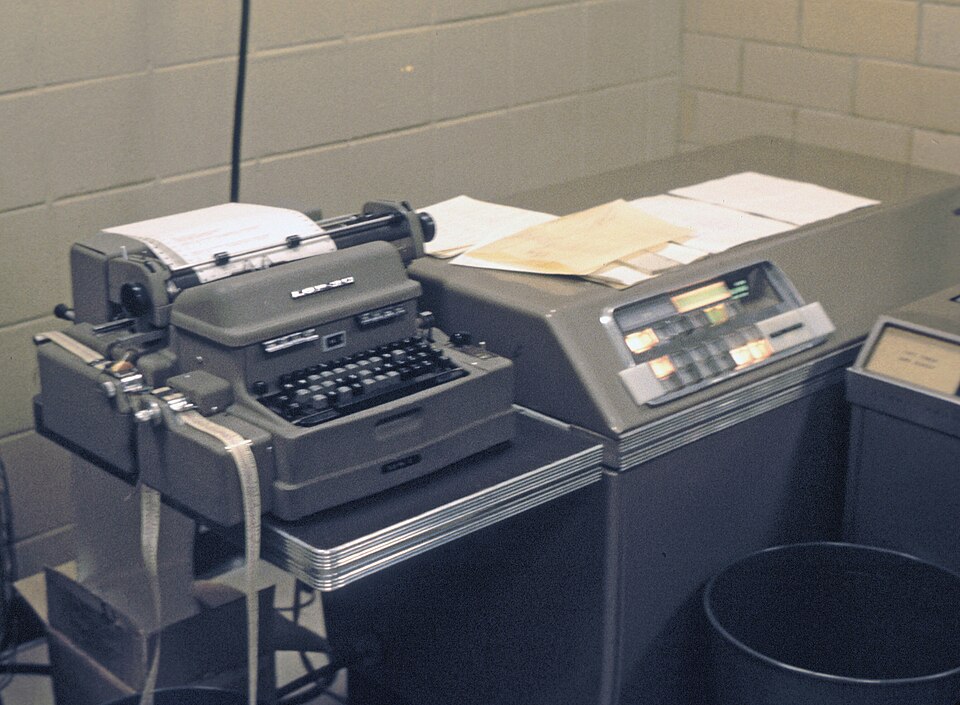
An LGP-30 at Manhattan College in 1965; UNB's arrived in 1959. Photo: Bob Fleischer, CC BY 2.0, via Wikimedia Commons.

In 1968, UNB established a Department of Computer Science — which its own institutional history calls the first in Canada — and installed an IBM 360/50G billed as the most powerful computer in the country east of Montreal. The formal dates run against that billing: the University of Toronto's department dates to 1964 — grown from a computing centre running since 1947, though a graduate department at first — and Waterloo's to 1967. If UNB's first rests on a narrower definition, UNB has never spelled it out; the faculty first below is the one nobody contests. In 1970, UNB's machines were linked to Université de Moncton, Mount Allison and UNB Saint John in Canada's first regional computer network, at 2,400 baud, and its first courses were taught that summer. The department became a school in 1973, conferred its first bachelor's degree in 1974, added a PhD in 1987, and on May 1, 1990 became the Faculty of Computer Science — the first standalone faculty of its kind in Canada — with Wasson as founding dean.
Wasson also imported the co-op model from Waterloo, starting the first co-op program east of Ontario in the early 1980s. It now ties the faculty to industry: more than 100 employer partners, over 400 work-term placements a year, more than 60 per cent of its students in co-op, and better than 80 per cent of them with a job offer by graduation.
The billion-dollar year
The proof arrived in 2011. UNB had spun out a network-security company from its own IT operation — Chris Newton, Sandy Bird and Dwight Spencer building, professors Ali Ghorbani and Jane Fritz as knowledge assets, Gerry Pond as mentor and backer. Q1 Labs' QRadar platform became the centrepiece of IBM's security division; Newton's second Fredericton company, Radian6, worked in social-media monitoring. Radian6 went to Salesforce in a $326-million deal, and Q1 Labs went to IBM for a reported roughly $600 million — close to a billion dollars of exits rooted in one small faculty.
The engineering stayed. Q1's headquarters moved to the Boston area, but its R&D stayed in Fredericton, and alumni seeded much of the security scene that followed. Pond died this past July, and his ambition is now the faculty's: the next billion-dollar company built on UNB research, headquartered within sight of campus.
The cluster and the agency
January 2017 brought the Canadian Institute for Cybersecurity, founded by Ghorbani — the faculty's former dean and its Tier 1 Canada Research Chair in Cybersecurity — with $4.5 million in initial funding and IBM as first R&D partner. The institute anchors a research cluster with more than $8 million in funding over the past five years, and Ghorbani was appointed to the Order of New Brunswick this year.
The promotional agency had a shorter life. CyberNB, the Opportunities New Brunswick offshoot created in 2016, shut down in early 2022 after the province declined further funding, citing missed milestones toward self-sufficiency. The cluster outlived it — firms still operate from the Cyber Centre at Knowledge Park, and the sector counts more than 700 jobs. The institute is still there; the agency is not.
The enrolment ledger
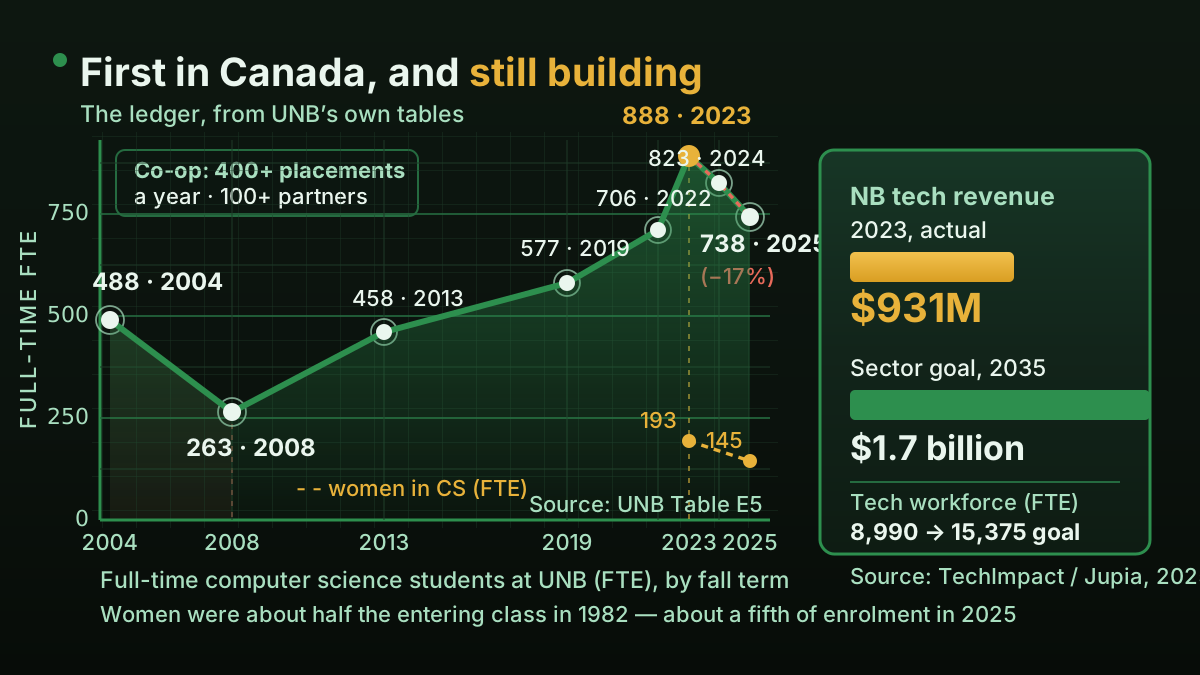
The faculty's tables show the ride: 488 full-time students in 2004, a dot-com trough of 263 in 2008, and a peak of 888 in 2023 — against the ambition Dean Luigi Benedicenti set in 2022: double undergraduate enrolments and triple professional graduate enrolments within five years. The last two years eased — 823 in 2024, 738 in 2025 — as the federal study-permit cap bit — UNB's 2026–27 budget blames federal policy changes.
By the Wasson family history, women were about half of the entering class in 1982; in 2025 they are 145 of 738 students, roughly one in five — the clearest headroom the faculty has.
The next build
TechImpact's 2025 report with Jupia Consultants puts New Brunswick technology revenue at $931 million in 2023 — within sight of a billion — with about 9,000 workers and a target of $1.7 billion by 2035. Its prescription: R&D investment rising from under two per cent of provincial GDP toward four or five.
The newest instrument is the McKenna Institute, established in September 2021 with a $5-million investment from Frank McKenna and a $50-million fundraising campaign — built to convert digital research into economic outcomes, at the university that started the story in 1959. Today's brochure lists two undergraduate programs, three master's programs, a PhD and 20-plus industry partners.
One first is unchallenged: the faculty itself. The 1981/82 brochure promised students a field that was going somewhere. It did — and the place that built it is still building.
Sources
- UNB History of IT, ITS history timeline — 1959 first computer, 1968 department, 1970 network, 1990 faculty.
- Dr. W. Dana Wasson, UNB History of IT person page — DANPEC, the LGP-30, the Computing Centre, founding dean.
- The Wasson family are computer science pioneers, UNB Faculty of Computer Science blog — co-op's arrival; women at roughly half of the 1982 entering class.
- Celebrating 60 years of computer science at U of T, University of Toronto — Toronto's computing centre from 1947; its CS department founded in 1964, graduate-only at first.
- About the David R. Cheriton School of Computer Science, University of Waterloo — Waterloo's department, founded in 1967.
- Computer science giving page, UNB — co-op partners, placements and job-offer figures.
- Salesforce's Radian6 acquisition announcement, March 30, 2011 — the $326-million deal ($276M cash, $50M stock).
- UNB hosts announcement of 100 cybersecurity positions in Fredericton, UNB Newsroom, 2016 — Q1 Labs developed QRadar with UNB.
- About the Canadian Institute for Cybersecurity, UNB — the CIC's mandate.
- CyberNB shuts down, lays off staff after province pulls funding, Huddle, February 28, 2022 — the shutdown and the missed-milestones rationale.
- Table E5, enrolment FTE by campus, faculty and degree, UNB Fact Book — the 2004–2025 CS enrolment series, including female FTE.
- UNB's Faculty of Computer Science is helping unlock New Brunswick's digital future, UNB Faculty of Computer Science blog, July 2022 — Dean Benedicenti's growth plan.
- TechImpact, the sector's industry association — the 2025 sector report with Jupia: $931M revenue, $1.7B-by-2035 goal.
- The McKenna Institute, UNB — the institute's mandate.
ChronologyAnalysis· 4 stories since Aug 11, 2025
- First in Canada, and still building (this story)
- N.B. Business Leaders' Barometer: Tired, Short-Staffed and Still Planning to Grow
Chronology · show all 4 storiesShow fewer
Related coverage
Companies · June 29, 2026
How Fredericton Became a Cybersecurity Town
News · November 11, 2026
The Huts That Built New Brunswick's Engineers
Startups · October 12, 2026
Gray Wolf Analytics Brings Scam-Detection Playbook to UNB's RBC Lunch & Learn
Comments
Loading comments…