
Companies4 min read
Black Arcs Built a 'What If?' Machine for Whole Towns. Rural Health Care Is Its Next Test.
Reported and fact-checked by NB Tech News staff; drafted with AI assistance. How we use AI


The Fredericton company behind Citisketch, demoed to MP David Myles this week, went from a 2017 school-siting game in Sackville to a $997,790 defence contract for pandemic modelling. Now it is mapping rural access to care with Vitalité.
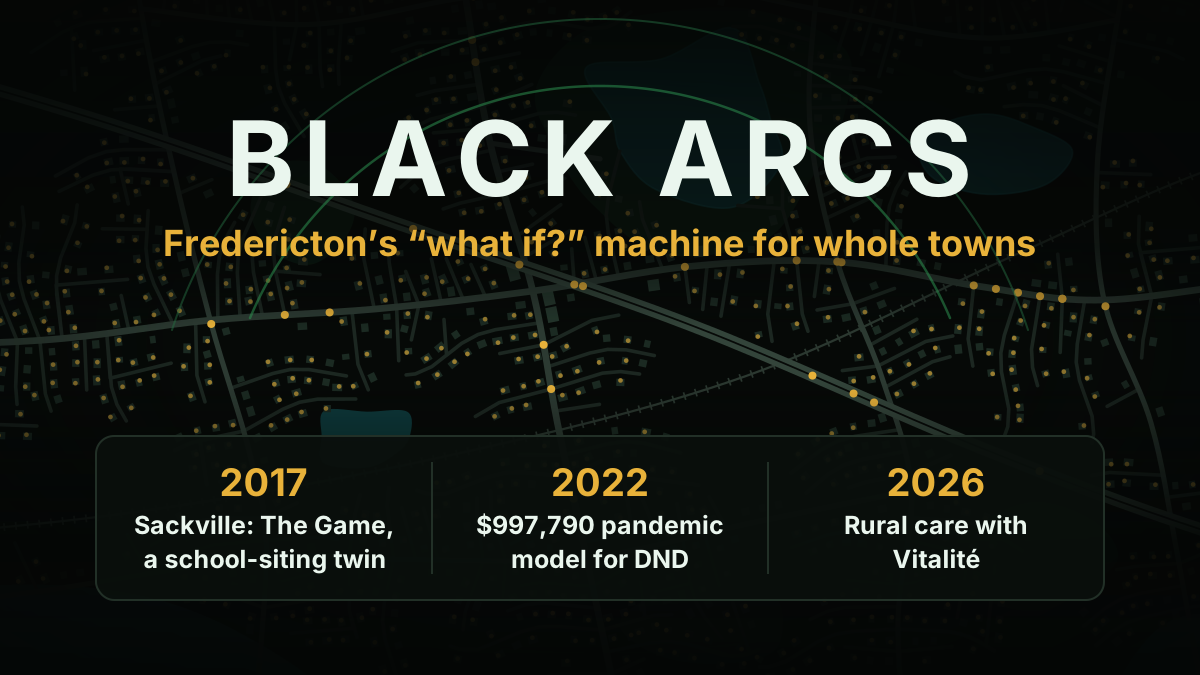
David Myles, the MP for Fredericton-Oromocto, stopped at Planet Hatch this week for a demo from Black Arcs, an 11-year-old Fredericton company that builds a working copy of a town, fills it with simulated residents, and lets you change something to see what they do next.
The timing is good. A federal AI research contribution to the company runs out on Nov. 30, and a project with Vitalité Health Network, announced in January, points the simulator at the health system for the first time.
A town you can rearrange
The product, Citisketch, runs in a browser and handles like a video game. A dark map sits under a 24-hour timeline, points of light stand for households, vehicles and pedestrians, and a model of travel behaviour decides who drives, walks or takes the bus.
Then you break something. Close a road and residents reroute. Move a school and the bus runs, walking distances and emissions all change with it.
CEO Jake Arsenault, who co-founded the company with Lori Clair in April 2015, does not sell it on precision. "This is not an analytical technology, it's really built as a social technology," he told Ignite in 2023. The point is to get a room of people arguing about the same picture.
Sackville: The Game
The first deployment came in 2017, with provincial support, in Sackville (now part of Tantramar), where the town was debating three schools near the end of their lives. Black Arcs built a digital Sackville and let people drag the schools around the map.
The company hauled a touch screen to the Sackville Farmers' Market and called it Sackville: The Game. By its own account, residents lined up all day to play.
"That really opened a lot of eyes to people as to how interconnected every issue in the city is because if you move one thing, it affects a hundred other things," director of operations Luke Robertson told Huddle in 2020. By then the City of Moncton and a regional service commission were clients.
Then the virus went into the model
A simulator that tracks where people gather is most of the way to one that tracks what they catch. At a 2021 workshop of the Atlantic Association for Research in the Mathematical Sciences, Black Arcs met UNB mathematician Dr. Sanjeev Seahra and computer scientist Dr. Suprio Ray.
Over two years, the pair and six UNB students and researchers built a disease model that runs inside the Citisketch twin, UNB reported. An analyst seeds the first cases, switches masking, contact tracing or closures on and off, and gets a spread of possible outbreak curves back. A configuration screen UNB published shows a 210-day simulation of Sackville queued to run 20 times.
The Department of National Defence paid for it: $200,000 in 2021, then $997,790 from January 2022 through its IDEaS program. UNB says it was one of only three of 21 funded projects to get more than $900,000.
"They really like the idea of our technology as a 'what if?' machine," director of technology Dane Sheppard told CBC in 2022, adding that a scenario runs "in a few minutes, rather than a few months." He was careful about the label: "We're not a pandemic machine, we're built to ask any sort of question you might want to be looking at for a community."
What Ottawa has put in
Black Arcs has not announced a venture round. Robertson told Huddle in 2020 that the company was raising $2 million when the pandemic hit; NB Tech News found no public announcement that it closed.
The public record is federal. Ottawa's grants and contributions database lists eight agreements since 2018, worth $1,544,189.
| Year | Source | Amount | Purpose |
|---|---|---|---|
| 2018–19 | ACOA (two) | $181,851 | Commercialization; hiring a director of operations |
| 2019 | NRC IRAP | $49,968 | Transportation simulator |
| 2021–22 | DND IDEaS (two) | $1,197,790 | Disease transmission modelling |
| 2022–24 | CanExport (two) | $43,500 | Export market development |
| 2025 | NRC IRAP | $71,080 | "AI Assist" pilot |
The newest line is the one to watch. The $71,080 IRAP contribution, extended to Nov. 30, pays for "pilot testing of AI strategies" on a platform the record describes as "now in limited use for community planning in Canada."
Vitalité and the rural map
On Jan. 13, the CAN Health Network announced Black Arcs as a member, working with Vitalité on a spatial analysis project meant to "optimize service locations, and improve access to care for rural residents."
That is the Sackville question with higher stakes: not where three schools go, but where a clinic sits so people in small communities can reach it. Neither organization has published results, a timeline or a contract value.
Sources
- David Myles for Fredericton-Oromocto — Facebook, November 2026 — the Planet Hatch visit and demo
- The Black Arcs — Citisketch, the 2017 Sackville deployment, team
- CBC News, Oct. 24, 2022 — Sheppard quotes
- UNB Research, June 20, 2023 — the UNB team, the AARMS workshop, the IDEaS ranking, configuration screenshots
- Government of Canada grants and contributions — all eight federal agreements, amounts and dates
- CAN Health Network, Jan. 13, 2026 — membership and the Vitalité project
- Entrevestor, Jan. 26, 2018 — co-founder Lori Clair, April 2015 incorporation
- Ignite, Dec. 12, 2023 — browser-based design, Arsenault quote
- Huddle, June 10, 2020 — Robertson quote, municipal clients, the interrupted $2-million raise
ChronologyUNB· 58 stories since Nov 20, 2024
- UNB's DataNB Says a Military Health Platform Is Feasible — If Trust Is Built
- Four N.B. Agtech Firms Share a Stage at UNB's Future of Innovation Conference
Chronology · show all 58 storiesShow fewer
- UNB Shoots a 360-Degree Video So Staff Can See a Justice Circle They Can't Sit In
- Black Arcs Built a 'What If?' Machine for Whole Towns. Rural Health Care Is Its Next Test. (this story)
- UNB's Arctic Ionosphere Network Has Grown to 34 Stations
- The Huts That Built New Brunswick's Engineers
- First in Canada, and still building
- Two UNB Students Win Atlantic Quantum Hackathon With a Satellite Collision Tool
- Bad API Wording, Timed: UNB Put 108 Developers on a Clock and Measured the Confusion
- The Screening AI That Argues Back — and Backs Down
- UNB Saint John Will Launch a Bachelor of Data Science in 2027
- UNB Opens VR Suites to Train Nurses for Newborn Emergencies
- N.B. Indie Builds: iPhone Apps, a Tourism Map and 3D-Printer Dashboards
- N.B. Researchers Put Caregiver Strain Under AI Motion Capture
- The $133M Device Meant to Keep Southeast N.B.'s Voltage From Collapsing
- UNB Joins a Transatlantic Alliance on Deployable Defence Infrastructure
- Hack Atlantic: 43 Student Projects in One Weekend at UNB
- Vidova Plugin Lets Claude Edit Video on a Real Timeline
- Senator Spotlights UNB's DAIR and Picketa as Proof of New Brunswick's 'Innovation Sandbox'
- UNB Researcher Is Designing a Radio Instrument to Map Space Weather at the Moon
- C-Therm's Path From a Team of Two in 2007 to Customers Worldwide
- UNB Inventors Were Granted 10 Patents in 2025–26, Tying a Decade High
- DataNB's ICT Workforce Study: N.B. Keeps Its Tech Grads for a Year, Then Loses Many
- Gray Wolf Analytics Brings Scam-Detection Playbook to UNB's RBC Lunch & Learn
- McKenna Institute Pulls District Tech Leads to Chelmsford to Scale Teacher Upskilling
- Sussex Elementary Opens a Saber STEAM Studio for Robotics and 3D Printing
- UNB Joins $5M National Push to Keep AI Weather Forecasts Grounded in Physics
- UNB's Fifth-Scale ATV Predicts the Ground Under Each Wheel — and Left AI Out of It
- Mastercard's Canada Security VP Keynoted CIC's Fredericton Summit — Then Toured the IoT Lab It Funds
- UNB Names Its First Digital Agriculture Chair — and He Starts With Small Farms
- UNB Sent Middle Schoolers Back to Class With Games, Websites and AI
- Review: UNB's Scott Bateman on the Three AI Myths That Won't Die
- UNB's Machine Learning Health Vault Wins CFI Infrastructure Funding
- UNB Co-Authors Confirm the First Native Sulfur Ever Found on Mars
- UNB Researchers Threat-Model the Protocols That Let AI Agents Act
- UNB Researchers Build a Practical Roadmap for the Post-Quantum Migration
- UNB Poster Weighs the Privacy Cost of Federated-Learning Aggregation
- UNB Researchers Deploy Collaborative AI Agents to Guard Power-Substation Networks
- UNB Researchers Build a Mixture-of-Experts Defence Against Adversarial AI Attacks
- UNB Researchers Make AI Malware Detection Explainable with a 'Dual Prototype' Framework
- UNB Researcher Takes a Geometric Axe to Optimization's Symmetry Problem
- UNB Researcher's 'Trust Passport' Would Stamp Every AI Reply with Its Risk Profile
- National Cyber Agencies and Big Banks Head to Fredericton for UNB's Cybersecurity Summit
- When the First Canadian Flew to the Moon, Fredericton Was Listening
- UNB Partners with Talent Innovation Canada to Put Grad Talent Inside Industry R&D
- McKenna Connect Puts UNB Mentors Beside 250 Rural Neighbours
- Cybersecurity Pioneer Ali Ghorbani Named to the Order of New Brunswick
- McKenna Institute's TeXplore Turns 17 Days Off School Into Soldering, Robots and AI
- SeaGreen Puts Seaweed Biochar in Ten Queen Street Flower Planters
- UNB Stitches Its Startup Machinery Into One Network
- Creduman Takes Top Spot at UNB’s MTME: NEXT 2026
- Four UNB MTME Startups Launch Next Week at MTME: NEXT
- The UNB Startup Pipeline: How a Fredericton Campus Keeps Minting Companies
- How Fredericton Became a Cybersecurity Town
- A Century of Circuits: UNB's Electrical Engineering Program Turns 100
- First Cheques: UNB's Fraser Fund Backs SpatialOne, Profitual, and AinaTest
- Gray Wolf Analytics: Crypto Forensics from a Fredericton Classroom
- Three Years In, the McKenna Institute Is Quietly Rewiring New Brunswick
Related coverage
News · October 27, 2026
The Screening AI That Argues Back — and Backs Down
News · October 20, 2026
N.B. Researchers Put Caregiver Strain Under AI Motion Capture
Startups · October 18, 2026
Vidova Plugin Lets Claude Edit Video on a Real Timeline
Comments
Loading comments…