
News4 min read
UNB's Arctic Ionosphere Network Has Grown to 34 Stations
Reported and fact-checked by NB Tech News staff; drafted with AI assistance. How we use AI


Physics professor P.T. Jayachandran says the Canadian High Arctic Ionospheric Network now has 34 sites sending real-time data used to improve GPS, communications and search-and-rescue in the North.
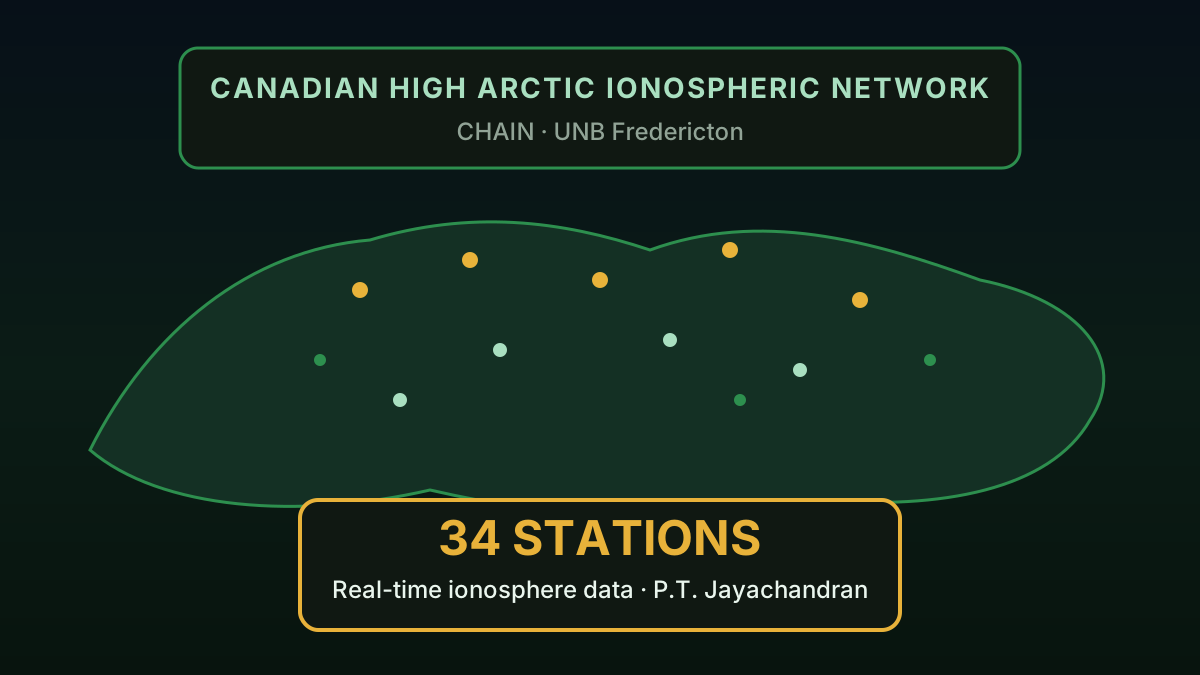
A University of New Brunswick physics professor says the Arctic monitoring network he has spent nearly three decades building now has 34 stations feeding real-time data on the upper atmosphere, work he argues can improve GPS, radio communications, and search-and-rescue across the North.
Dr. P.T. Jayachandran, a professor in UNB's Department of Physics in Fredericton and principal investigator of the Canadian High Arctic Ionospheric Network (CHAIN), described the expansion in a UNB Newsroom profile published Nov. 2. "We started with three, and currently we have 34 stations in the Arctic," he said. "Our CHAIN is one of the largest networks in the world for this particular purpose."
The layer that bends GPS and radio
The work focuses on the ionosphere, beginning about 90 kilometres up, where charged particles can disrupt GPS, communications, timing, and radar. The UNB Newsroom profile says the Arctic sees some of the strongest of those disturbances because it sits close to Earth's magnetic pole, under the same solar-wind conditions that produce the northern lights. Jayachandran first travelled there in 1998. Stations use specialized GPS receivers and ionosondes, and official project materials describe GNSS monitors that measure total electron content and scintillation, some collocated with the radars. A 2009 paper in Radio Science first described the network.
What the measurements are for
Those signals serve both civilian and defence users, from mining and northern communities to search-and-rescue and the Canadian Armed Forces. Jayachandran told UNB his team has done defence-related research for roughly 15 years, including Canada's role in modernizing NORAD. "We are working on improving the precision of satellite-based PNT (positioning, navigation, and timing) systems," he said. "It involves the defence of the North."
The same observations can improve centimetre-level positioning for mining drills, and show when search-and-rescue systems may lose accuracy or stop working. "And sometimes, this system may not work at all and knowing when and where that happens will be useful for finding alternate solutions," he said. NSERC's Impact profile earlier this year framed the research as high-latitude navigation and communications.
A national profile, and a Fredericton pipeline
NSERC featured the research earlier this year in Impact issue 4, the Defence and Security issue, under the headline "Precision navigation for the high north." Jayachandran leads UNB's Radio and Space Physics Laboratory. UNB says he has also been invited to appear as a panellist in a session on securing Canada's Arctic future at the 18th Canadian Science and Innovation Policy Conference.
He told UNB that former students and researchers from the group have gone on to build research capacity elsewhere, including the Space Environment and Radio Engineering (SERENE) group at the University of Birmingham. One of them is Dr. David Themens, who completed a PhD at UNB in 2018 under Jayachandran, developed the Empirical Canadian High Arctic Ionospheric Model (E-CHAIM), and is now an associate professor in that Birmingham group. The lab's people page still lists him as an adjunct professor at UNB, and it includes Giacomo Radaelli, whose lunar-ionosphere instrument concept we covered in October. Jayachandran was a co-author of the 2023 paper behind that work.
"There are not many institutions in the world which are capable of doing this kind of work. UNB, as an institution, is an expert in this field. Period," Jayachandran said.
Sources
- How University of New Brunswick research is strengthening Canada's Arctic presence — UNB Newsroom (Nov. 2, 2026) — Jayachandran quotes; 34 stations and 34 real-time sensors; first Arctic trip in 1998 and growth from three stations; ionosphere at about 90 kilometres and higher; roughly 15 years of defence-related research, PNT, and NORAD modernization; centimetre-level mining example; search-and-rescue and communications effects; NSERC Impact profile; invitation to the 18th Canadian Science and Innovation Policy Conference; former students at Birmingham's SERENE group
- Precision navigation for the high north — NSERC Impact issue 4 — Defence and Security issue profile of Jayachandran and UNB's high-latitude GPS and radio work
- The Defence and Security Issue — NSERC Impact issue 4 — issue contents listing the Jayachandran profile
- P.T. Jayachandran — UNB faculty profile — professor of physics, Fredericton; principal investigator of CHAIN
- Canadian High Arctic Ionospheric Network — UNB Radio and Space Physics Laboratory — official CHAIN project page; GNSS monitors measuring total electron content and scintillation; ionosondes collocated at some sites
- RSPL lab site and people page — lab leadership; Jayachandran as principal investigator; Themens listed as adjunct professor; Radaelli listed as a PhD student
- Jayachandran et al., Canadian High Arctic Ionospheric Network (CHAIN), Radio Science (2009) — original published description of the network
- David Themens — University of Birmingham — PhD in physics, University of New Brunswick, 2018, supervised by Jayachandran; associate professor in the SERENE group; developer of E-CHAIM
- Space Environment and Radio Engineering (SERENE) — University of Birmingham — group named in Jayachandran's quote
- UNB Researcher Is Designing a Radio Instrument to Map Space Weather at the Moon — NB Tech News — earlier coverage of Radaelli's work, including Jayachandran as a co-author
ChronologyUNB· 58 stories since Nov 20, 2024
- UNB's DataNB Says a Military Health Platform Is Feasible — If Trust Is Built
- Four N.B. Agtech Firms Share a Stage at UNB's Future of Innovation Conference
Chronology · show all 58 storiesShow fewer
- UNB Shoots a 360-Degree Video So Staff Can See a Justice Circle They Can't Sit In
- Black Arcs Built a 'What If?' Machine for Whole Towns. Rural Health Care Is Its Next Test.
- UNB's Arctic Ionosphere Network Has Grown to 34 Stations (this story)
- The Huts That Built New Brunswick's Engineers
- First in Canada, and still building
- Two UNB Students Win Atlantic Quantum Hackathon With a Satellite Collision Tool
- Bad API Wording, Timed: UNB Put 108 Developers on a Clock and Measured the Confusion
- The Screening AI That Argues Back — and Backs Down
- UNB Saint John Will Launch a Bachelor of Data Science in 2027
- UNB Opens VR Suites to Train Nurses for Newborn Emergencies
- N.B. Indie Builds: iPhone Apps, a Tourism Map and 3D-Printer Dashboards
- N.B. Researchers Put Caregiver Strain Under AI Motion Capture
- The $133M Device Meant to Keep Southeast N.B.'s Voltage From Collapsing
- UNB Joins a Transatlantic Alliance on Deployable Defence Infrastructure
- Hack Atlantic: 43 Student Projects in One Weekend at UNB
- Vidova Plugin Lets Claude Edit Video on a Real Timeline
- Senator Spotlights UNB's DAIR and Picketa as Proof of New Brunswick's 'Innovation Sandbox'
- UNB Researcher Is Designing a Radio Instrument to Map Space Weather at the Moon
- C-Therm's Path From a Team of Two in 2007 to Customers Worldwide
- UNB Inventors Were Granted 10 Patents in 2025–26, Tying a Decade High
- DataNB's ICT Workforce Study: N.B. Keeps Its Tech Grads for a Year, Then Loses Many
- Gray Wolf Analytics Brings Scam-Detection Playbook to UNB's RBC Lunch & Learn
- McKenna Institute Pulls District Tech Leads to Chelmsford to Scale Teacher Upskilling
- Sussex Elementary Opens a Saber STEAM Studio for Robotics and 3D Printing
- UNB Joins $5M National Push to Keep AI Weather Forecasts Grounded in Physics
- UNB's Fifth-Scale ATV Predicts the Ground Under Each Wheel — and Left AI Out of It
- Mastercard's Canada Security VP Keynoted CIC's Fredericton Summit — Then Toured the IoT Lab It Funds
- UNB Names Its First Digital Agriculture Chair — and He Starts With Small Farms
- UNB Sent Middle Schoolers Back to Class With Games, Websites and AI
- Review: UNB's Scott Bateman on the Three AI Myths That Won't Die
- UNB's Machine Learning Health Vault Wins CFI Infrastructure Funding
- UNB Co-Authors Confirm the First Native Sulfur Ever Found on Mars
- UNB Researchers Threat-Model the Protocols That Let AI Agents Act
- UNB Researchers Build a Practical Roadmap for the Post-Quantum Migration
- UNB Poster Weighs the Privacy Cost of Federated-Learning Aggregation
- UNB Researchers Deploy Collaborative AI Agents to Guard Power-Substation Networks
- UNB Researchers Build a Mixture-of-Experts Defence Against Adversarial AI Attacks
- UNB Researchers Make AI Malware Detection Explainable with a 'Dual Prototype' Framework
- UNB Researcher Takes a Geometric Axe to Optimization's Symmetry Problem
- UNB Researcher's 'Trust Passport' Would Stamp Every AI Reply with Its Risk Profile
- National Cyber Agencies and Big Banks Head to Fredericton for UNB's Cybersecurity Summit
- When the First Canadian Flew to the Moon, Fredericton Was Listening
- UNB Partners with Talent Innovation Canada to Put Grad Talent Inside Industry R&D
- McKenna Connect Puts UNB Mentors Beside 250 Rural Neighbours
- Cybersecurity Pioneer Ali Ghorbani Named to the Order of New Brunswick
- McKenna Institute's TeXplore Turns 17 Days Off School Into Soldering, Robots and AI
- SeaGreen Puts Seaweed Biochar in Ten Queen Street Flower Planters
- UNB Stitches Its Startup Machinery Into One Network
- Creduman Takes Top Spot at UNB’s MTME: NEXT 2026
- Four UNB MTME Startups Launch Next Week at MTME: NEXT
- The UNB Startup Pipeline: How a Fredericton Campus Keeps Minting Companies
- How Fredericton Became a Cybersecurity Town
- A Century of Circuits: UNB's Electrical Engineering Program Turns 100
- First Cheques: UNB's Fraser Fund Backs SpatialOne, Profitual, and AinaTest
- Gray Wolf Analytics: Crypto Forensics from a Fredericton Classroom
- Three Years In, the McKenna Institute Is Quietly Rewiring New Brunswick
Related coverage
News · October 17, 2026
UNB Researcher Is Designing a Radio Instrument to Map Space Weather at the Moon
News · November 17, 2026
UNB's DataNB Says a Military Health Platform Is Feasible — If Trust Is Built
News · October 27, 2026
Bad API Wording, Timed: UNB Put 108 Developers on a Clock and Measured the Confusion
Comments
Loading comments…