
News4 min read
Mapping Out Their Future: UNB's Geomatics Team Puts Fredericton-Area High School Students Behind the Instruments
Reported and fact-checked by NB Tech News staff; drafted with AI assistance. How we use AI


At UNB Engineering Shadow Day, the Geodesy and Geomatics Engineering department handed high school students drones, sonar and survey gear, with an opening talk from a professor who mapped the Antarctic seafloor from an uncrewed boat.
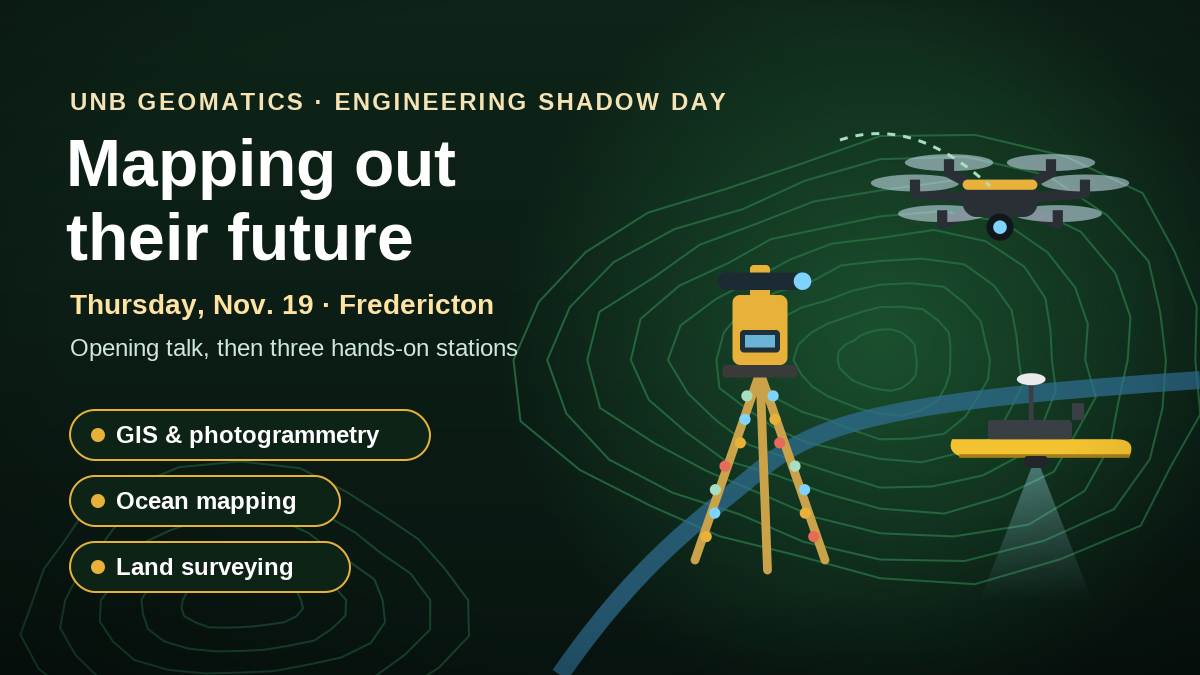
A professor who mapped the Antarctic seafloor from an uncrewed boat, three hands-on stations and a room of high school students holding the instruments. That was the lineup on November 19, when the University of New Brunswick's Department of Geodesy and Geomatics Engineering (GGE) introduced high school students from across the Fredericton region to the field at UNB Engineering Shadow Day, organized by the UNB Engineering Undergraduate Society.
The department recapped the day on its Facebook page: an opening presentation to every registered student on the program and the careers it leads to, then three hands-on stations in the afternoon. About two-thirds of the participating students stayed for the hands-on part. The department's photos show what was on the tables: a six-rotor drone, a yellow uncrewed survey boat on a wheeled cart, and a survey instrument on a yellow tripod wrapped in string lights.
The professor who mowed the Antarctic
The opening presentation was led by Kevin Wilcox and Leah Buyting. Wilcox is an assistant professor in the department, listed under ocean mapping and hydrodynamic modelling, and a researcher with UNB's Ocean Mapping Group.
He grew up on Grand Manan Island in the Bay of Fundy, and his recent fieldwork is about as far from there as the planet allows. On Canada's first all-Canadian expedition to Antarctica, part of Operation PROJECTION, Wilcox piloted the Ocean Mapping Group's customized two-metre uncrewed surface vessel by remote control, deployed from a rescue boat off the Canadian Navy ship HMCS Margaret Brooke, and ran sonar surveys of seafloor that in places had never been mapped in that detail. He was also looking for "sunken beaches," old shorelines drowned by past sea-level rise.
"It's like mowing the lawn — but with icebergs," he told UNB's newsroom, describing the back-and-forth survey lines. The group built the boat's equipment from an empty hull; Ian Church, the associate professor who leads the Ocean Mapping Group, called it "96% custom." A February 2026 customer spotlight from Eos Positioning Systems lists the kit: an EchoBoat-160 hull carrying a multibeam sonar, a motion sensor, lidar and a GNSS receiver using Galileo's High Accuracy Service, chosen because Antarctica has no correction networks and a land base station was not practical. His degrees are all from UNB: BScME'06, D-TME'08, PhD'11.
Three stations, three kinds of geomatics
Buyting led the afternoon sessions, which Nathaniel Thomas coordinated. Each station was run by someone from the department.
- GIS and photogrammetry, with Carina Butterworth: geospatial technology and its real-world uses, the side of the field where drone and camera images become measurements and 3D models. Photogrammetry and 3D GIS is one of the research areas GGE lists for graduate study, alongside GNSS and geodesy, GIS, remote sensing and ocean mapping.
- Ocean mapping, with Liam Delong: underwater mapping and the opportunities in it at UNB, the same discipline Wilcox took to Antarctica.
- Land surveying, with Kayla Wakefield: how surveying equipment establishes property boundaries and supports construction projects.
Land surveying is the department's oldest trade. According to the department's history, William Brydone Jack began lecturing on surveying at King's College in 1840, and in 1859, the year the University of New Brunswick was created, the university announced a special course in civil engineering and surveying. Surveying engineering became a distinct program in 1960.
Students who build the field
GGE students have a record of building things for the whole discipline. In 2018 a group of them, led by founder and organizing chair Justin Collett, created the National Geomatics Competition: nine teams from six schools came to UNB on February 17, 2018, to solve a geomatics problem in six hours. The competition now moves between universities; McMaster University hosted the 2026 edition in Hamilton in February, with 51 competitors.
The pitch underneath the day
GGE offers a four-year Bachelor of Science in Engineering (Geomatics Engineering), with a cadastral surveying option recognized by the Canadian Council of Land Surveyors, a three-year non-engineering Bachelor of Geomatics, and graduate degrees in fields from geodesy and precision navigation to hydrography and ocean mapping. The department says it is one of only three certified geomatics programs in Canada, reports a 100 per cent employment rate, and counts more than 1,000 graduates from 56 countries since 1961. Shadow Day's bet is that the shortest path to the next class is not a brochure. It is a high school student holding a total station while a professor who has surveyed Antarctica explains what it can do.
Sources
- https://facebook.com/100063642516773/posts/pfbid0ZACbxPdo6CnzgvNUpZeVHAxTdnKjs3CjnExGgcFSNw4PqiWy4rPAK9jUkTHHkAb4l/ — UNB GGE's Shadow Day recap and photos: date, audience, presenters, stations, share of students at the hands-on sessions, EUS as organizer, equipment on display
- https://lib.unb.ca/archives/unbhistory/Engineering_Undergraduate_Society — UNB Archives on the Engineering Undergraduate Society, the Shadow Day organizer
- https://blogs.unb.ca/newsroom/2025/05/kevin-wilcox.php — UNB News on Wilcox's Antarctic surveys: Operation PROJECTION, HMCS Margaret Brooke, the USV, sunken beaches, quotes, degrees
- https://eos-gnss.com/successes/customer-spotlights/kevin-wilcox — Eos spotlight (Feb. 16, 2026): assistant professor title, Grand Manan, EchoBoat-160 sensor package, Galileo HAS positioning
- https://www.unb.ca/faculty-staff/directory/engineering-geomatics/wilcox-kevin.html — Wilcox's UNB profile
- https://www.unb.ca/fredericton/engineering/depts/gge/faculty-staff.html — GGE faculty listing (Wilcox: ocean mapping and hydrodynamic modelling)
- https://www.unb.ca/gradstudies/programs/gge.html — GGE graduate research areas
- https://gge.ext.unb.ca/AllAboutGGE/History.html — surveying at UNB since 1840; the 1859 course; the 1960 program
- https://gge.ext.unb.ca/AllAboutGGE/Programs.html — degree programs and the cadastral surveying option
- https://www.unb.ca/academics/programs/engineering/gge.html — the four-year BScE and three-year Bachelor of Geomatics
- https://www.unb.ca/academics/calendar/undergraduate/current/frederictonprograms/bachelorofgeomatics.html — Bachelor of Geomatics calendar entry
- https://www.unb.ca/faculty-staff/directory/engineering-geomatics/church-ian.html — Ian Church's UNB profile
- http://www.biographi.ca/en/bio/jack_william_brydone_11E.html — Dictionary of Canadian Biography entry for William Brydone Jack
- https://www.unb.ca/fredericton/engineering/depts/gge/index.html — certified-program and employment-rate claims
- https://www.unb.ca/fredericton/engineering/depts/gge/about.html — more than 1,000 graduates from 56 countries since 1961
- https://resources.esri.ca/education-and-research/how-students-at-unb-made-national-geomatics-competition-a-reality — UNB students founded the National Geomatics Competition in 2018
- https://www.nationalgeomaticscomp.ca/the-competition.html — the competition's format
- https://sees.mcmaster.ca/mcmaster-sees-hosts-the-2026-national-geomatics-competition/ — McMaster hosted the 2026 competition, 51 participants
ChronologyUNB· 59 stories since Nov 20, 2024
- Mapping Out Their Future: UNB's Geomatics Team Puts Fredericton-Area High School Students Behind the Instruments (this story)
- UNB's DataNB Says a Military Health Platform Is Feasible — If Trust Is Built
Chronology · show all 59 storiesShow fewer
- Four N.B. Agtech Firms Share a Stage at UNB's Future of Innovation Conference
- UNB Shoots a 360-Degree Video So Staff Can See a Justice Circle They Can't Sit In
- Black Arcs Built a 'What If?' Machine for Whole Towns. Rural Health Care Is Its Next Test.
- UNB's Arctic Ionosphere Network Has Grown to 34 Stations
- The Huts That Built New Brunswick's Engineers
- First in Canada, and still building
- Two UNB Students Win Atlantic Quantum Hackathon With a Satellite Collision Tool
- Bad API Wording, Timed: UNB Put 108 Developers on a Clock and Measured the Confusion
- The Screening AI That Argues Back — and Backs Down
- UNB Saint John Will Launch a Bachelor of Data Science in 2027
- UNB Opens VR Suites to Train Nurses for Newborn Emergencies
- N.B. Indie Builds: iPhone Apps, a Tourism Map and 3D-Printer Dashboards
- N.B. Researchers Put Caregiver Strain Under AI Motion Capture
- The $133M Device Meant to Keep Southeast N.B.'s Voltage From Collapsing
- UNB Joins a Transatlantic Alliance on Deployable Defence Infrastructure
- Hack Atlantic: 43 Student Projects in One Weekend at UNB
- Vidova Plugin Lets Claude Edit Video on a Real Timeline
- Senator Spotlights UNB's DAIR and Picketa as Proof of New Brunswick's 'Innovation Sandbox'
- UNB Researcher Is Designing a Radio Instrument to Map Space Weather at the Moon
- C-Therm's Path From a Team of Two in 2007 to Customers Worldwide
- UNB Inventors Were Granted 10 Patents in 2025–26, Tying a Decade High
- DataNB's ICT Workforce Study: N.B. Keeps Its Tech Grads for a Year, Then Loses Many
- Gray Wolf Analytics Brings Scam-Detection Playbook to UNB's RBC Lunch & Learn
- McKenna Institute Pulls District Tech Leads to Chelmsford to Scale Teacher Upskilling
- Sussex Elementary Opens a Saber STEAM Studio for Robotics and 3D Printing
- UNB Joins $5M National Push to Keep AI Weather Forecasts Grounded in Physics
- UNB's Fifth-Scale ATV Predicts the Ground Under Each Wheel — and Left AI Out of It
- Mastercard's Canada Security VP Keynoted CIC's Fredericton Summit — Then Toured the IoT Lab It Funds
- UNB Names Its First Digital Agriculture Chair — and He Starts With Small Farms
- UNB Sent Middle Schoolers Back to Class With Games, Websites and AI
- Review: UNB's Scott Bateman on the Three AI Myths That Won't Die
- UNB's Machine Learning Health Vault Wins CFI Infrastructure Funding
- UNB Co-Authors Confirm the First Native Sulfur Ever Found on Mars
- UNB Researchers Threat-Model the Protocols That Let AI Agents Act
- UNB Researchers Build a Practical Roadmap for the Post-Quantum Migration
- UNB Poster Weighs the Privacy Cost of Federated-Learning Aggregation
- UNB Researchers Deploy Collaborative AI Agents to Guard Power-Substation Networks
- UNB Researchers Build a Mixture-of-Experts Defence Against Adversarial AI Attacks
- UNB Researchers Make AI Malware Detection Explainable with a 'Dual Prototype' Framework
- UNB Researcher Takes a Geometric Axe to Optimization's Symmetry Problem
- UNB Researcher's 'Trust Passport' Would Stamp Every AI Reply with Its Risk Profile
- National Cyber Agencies and Big Banks Head to Fredericton for UNB's Cybersecurity Summit
- When the First Canadian Flew to the Moon, Fredericton Was Listening
- UNB Partners with Talent Innovation Canada to Put Grad Talent Inside Industry R&D
- McKenna Connect Puts UNB Mentors Beside 250 Rural Neighbours
- Cybersecurity Pioneer Ali Ghorbani Named to the Order of New Brunswick
- McKenna Institute's TeXplore Turns 17 Days Off School Into Soldering, Robots and AI
- SeaGreen Puts Seaweed Biochar in Ten Queen Street Flower Planters
- UNB Stitches Its Startup Machinery Into One Network
- Creduman Takes Top Spot at UNB’s MTME: NEXT 2026
- Four UNB MTME Startups Launch Next Week at MTME: NEXT
- The UNB Startup Pipeline: How a Fredericton Campus Keeps Minting Companies
- How Fredericton Became a Cybersecurity Town
- A Century of Circuits: UNB's Electrical Engineering Program Turns 100
- First Cheques: UNB's Fraser Fund Backs SpatialOne, Profitual, and AinaTest
- Gray Wolf Analytics: Crypto Forensics from a Fredericton Classroom
- Three Years In, the McKenna Institute Is Quietly Rewiring New Brunswick
Related coverage
News · November 17, 2026
UNB Shoots a 360-Degree Video So Staff Can See a Justice Circle They Can't Sit In
News · November 11, 2026
The Huts That Built New Brunswick's Engineers
News · August 30, 2026
UNB Sent Middle Schoolers Back to Class With Games, Websites and AI
Comments
Loading comments…